
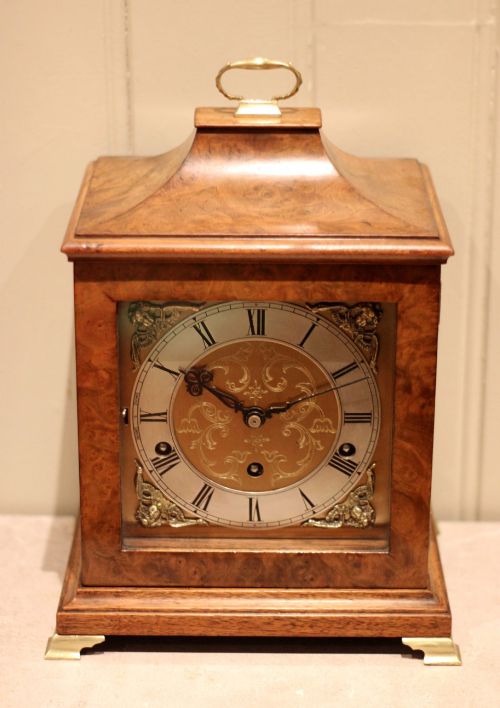
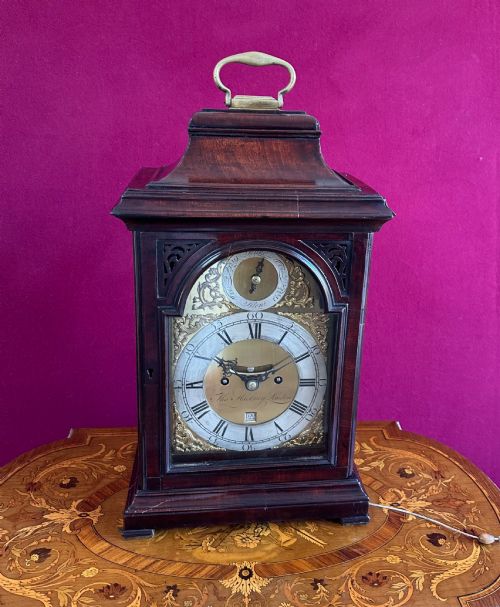


Caddy Top Mantel Clock
A caddy top mantel clock is a substantial timepiece featuring a distinct arched lid, offering classic proportions and traditional movement for any room.

Caddy Top Mantel Clock
A caddy top mantel clock stands as a traditional timepiece shaped by centuries of cabinet-making and horological design. These pieces combine mechanical movements with architectural wooden cases designed to sit securely on shelves, desks, or mantelpieces.
The versions most commonly met on this page span several distinct periods, including pieces from the seventeenth, eighteenth, and nineteenth centuries, alongside later revivals. Makers constructed them in forms such as bracket clocks and table clocks, often housing verge, anchor, or French movements within the wooden housing.
Materials range from rich timbers like mahogany, burr walnut veneer, and ebony to polished brass fittings and protective glass panels. Stylistic influences draw heavily on Georgian, George II, William and Mary, and Chinoiserie traditions, reflecting the changing tastes of British and continental makers.
What varies in quality
Quality in a caddy top mantel clock rests upon the crispness of the timber cabinet-making and the fidelity of the period style. Finer examples display carefully matched burr walnut veneer or deep ebony finishes with precise joinery at the caddy lid junctions.
The sophistication of the internal movement dictates much of the standing of the piece. Clocks featuring signed brass backplates, intricate quarter-striking mechanisms, or early verge escapements represent higher standards of horological achievement than standard later movements.
Original hardware, including cast gilded brass carrying handles, sound frets with fabric backing, and signed dials, preserves the integrity of the object. Pieces that retain their original matched components and untouched movement signatures command greater respect among collectors.
Some eighteenth-century examples included a mechanical alarm alongside the usual striking trains, ensuring restless owners woke up on time.
Mappin & Webb·Henry Jones·Lenzkirch·John Taylor·Watson London
The Caddy Top Mantel Clock Glossary
- Caddy top
- A raised, stepped, or domed lid style on a clock case, resembling the shape of eighteenth-century tea caddies. This architectural roof form defines the silhouette of the wooden housing.
- Bracket clock
- A portable table clock originally designed to sit upon a matching wall bracket or table surface. These spring-driven timepieces often feature elaborate striking or chiming mechanisms.
- Verge movement
- An early mechanical escapement using a crown wheel and a vertical rod with pallets. This mechanism regulates the speed of the gear train in antique clocks.
- Spandrel
- An ornamental corner bracket applied to the dial face of a clock. These cast brass decorations fill the space between the circular chapter ring and the rectangular dial frame.
- Chinoiserie
- A decorative European style imitating Chinese artistic traditions. Applied to clock cases, it typically involves hand-painted or lacquered motifs on a dark wooden background.
Caddy Top Mantel Clock: Frequently Asked Questions
What is a caddy top mantel clock?
A caddy top mantel clock is a mechanical timepiece housed in a wooden case featuring a distinctive arched, stepped, or domed lid. These clocks were designed to be portable and placed on tables, shelves, or architectural wall brackets.
Examples on this page span from the seventeenth century through to the early twentieth century, utilising materials such as mahogany, ebony, and burr walnut veneer.
How do I wind an antique bracket clock?
Winding requires a matching key inserted into the winding holes on the dial face, turned gently until resistance is felt. Care must be taken not to overwind the spring mechanism.
Many of these pieces house spring-driven movements that require regular attention to maintain accurate timekeeping and striking functions.
Where should I place a mantel clock?
These clocks need a stable, level surface away from direct sunlight, excessive moisture, and temperature fluctuations. Placing them on a sturdy mantelpiece or firm table ensures the pendulum or balance wheel operates correctly.
Because many examples feature delicate wood veneers and gilded brass mounts, stable placement protects both the exterior finish and the internal mechanism.