



Gilt Bronze Desk Inkwell
A gilt bronze desk inkwell brings sculptural weight and polished gleam to a writing table.
Gilt Bronze Desk Inkwell
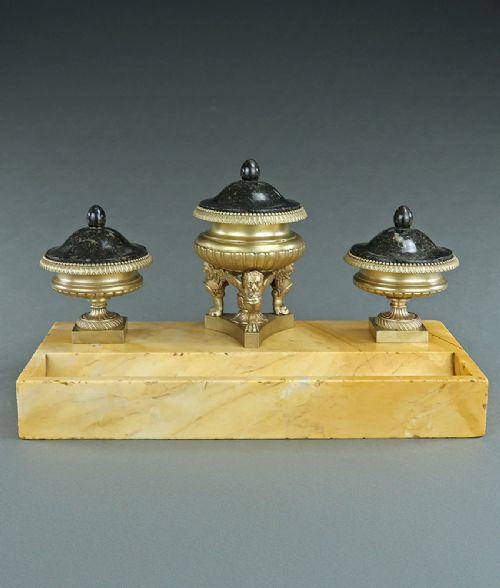
A gilt bronze desk inkwell sits upon a writing surface as a substantial desk accessory, frequently taking the form of an inkstand, encrier or desk set. The pieces found here span the nineteenth century and the Edwardian era, with French Empire, Victorian and Art Nouveau designs dominating the selection.
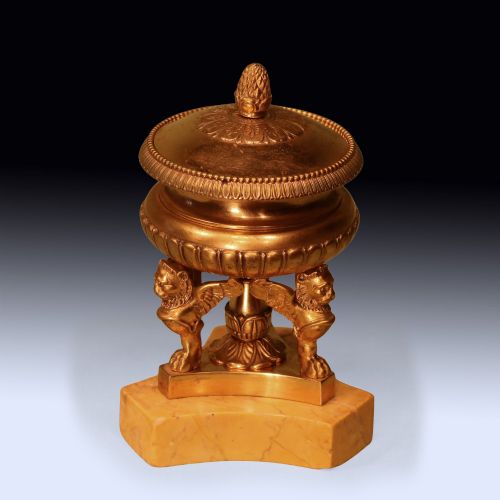
Most examples combine gilded or ormolu bronze with marble bases, utilising materials such as Sienna marble, vert marble and onyx. Figural subjects appear regularly, including lions, stags, foxes in nightgowns and playing kittens, alongside classical Neoclassical motifs.
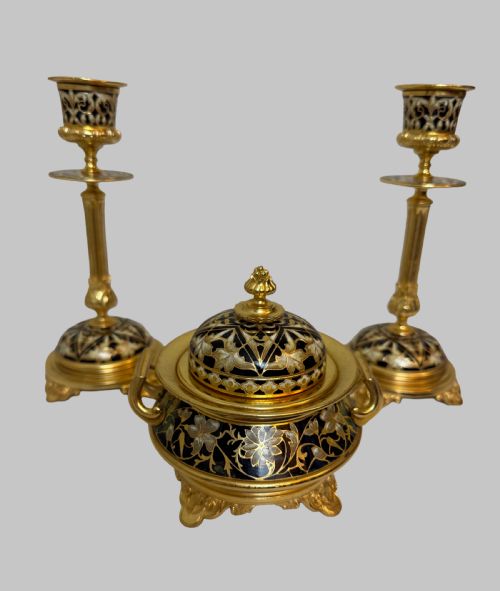
Many items incorporate glass inserts for the ink reservoir, while larger desk sets pair the inkwell with matching candlesticks, stamp boxes or mahogany and coromandel-wood mounts.
How they were made
Craftsmen cast these objects in bronze, utilising mercury gilding or electroplating techniques to achieve the characteristic rich gilt surface known as ormolu. Champlevé enamel work and patinated bronze details frequently accent the primary gilded metalwork.
Stonemasons shaped the heavy marble bases, turning and polishing Sienna, vert and onyx blocks to support the metal castings. Glassmakers blew and cut the internal ink inserts to fit precisely within the bronze collars.
Desk accessories extend beyond standalone inkwells to include matching candlesticks, mahogany trays, coromandel-wood stands and figural animal groups.
What varies in quality
The selection of materials dictates overall grade, where richly figured Sienna marble and heavy ormolu castings outweigh simpler brass or lighter alloy constructions. Original glass inserts and matching components preserved together elevate a desk set above assembled or altered groupings.
Albert Marionnet·Moser
The Gilt Bronze Desk Inkwell Glossary
- Gilt Bronze
- Metal alloy coated with a thin layer of gold, providing a bright golden finish that resists tarnishing. It forms the primary structural body for many nineteenth-century desk accessories.
- Ormolu
- French term for high-quality gilt bronze, specifically denoting mercury-gilded finishes applied to decorative metalwork during the eighteenth and nineteenth centuries. This technique produces a deep, warm lustre.
- Encrier
- French descriptor for an inkstand or portable writing desk set, typically incorporating one or more inkwells and pen holders upon a decorative tray or base.
- Champlevé
- Enamelling technique where troughs or cells are hollowed out of the metal surface and filled with vitreous enamel before firing. It adds colourful geometric or floral patterns to the bronze framework.
- Sienna Marble
- Natural yellow-gold limestone with dark grey and purple veining, quarried in Italy. It provides a colourful, heavy foundation for French desk stands and clock garnitures.
Gilt Bronze Desk Inkwell: Frequently Asked Questions
How do I clean a gilt bronze inkwell?
Dusting gently with a dry, soft brush is the safest method for preserving gilded and ormolu surfaces. Moisture and chemical polishes strip away the historic gilt layer.
Marble bases benefit from a wipe with a damp cloth, provided no water contacts the surrounding metal mounts or exposed interior wells.
Are glass liners original?
Original glass inserts fit snugly within the bronze collars and often show slight bubbles, pontil marks or wear consistent with age. Replacements are frequently clear or modern cut glass.
Finding an inkwell with its matching glass reservoir intact preserves the structural integrity and historical completeness of the piece.
What periods do these inkwells come from?
The pieces span the nineteenth century into the Edwardian era, encompassing French Empire, Victorian, Neoclassical and Art Nouveau movements. Mid-century examples often feature architectural marble and ormolu mounts.
Later Victorian and Edwardian items introduce playful figural subjects, champlevé enamel work and ceramic variations.