
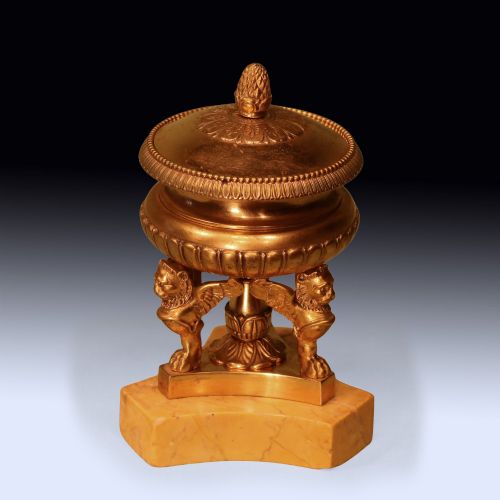


Gilt Brass Inkstand
A gilt brass inkstand brings desk organisation into the realm of fine metalwork, combining polished alloy with glass, marble, and gilt bronze.
Gilt Brass Inkstand
A gilt brass inkstand serves as a desk accessory designed to hold writing fluid, pens, and sometimes correspondence within a decorative metal framework. These pieces range from simple portable desk sets to substantial desk stands featuring integrated marble bases and lidded wells.
The versions most commonly found here date from the nineteenth century, reflecting French Empire, Victorian, and Louis XV taste. Makers often combined cast brass or ormolu with contrasting materials such as Sienna marble, coromandel wood, and champlevé enamel.
Beyond standard double or single inkwells, the form frequently expands into complete desk sets that incorporate letter holders, decorative caskets, or integrated desk clocks. Each example demonstrates how writing equipment occupied a prominent, ornamental position on period writing desks.
How they were made
Foundry workers cast brass and bronze components using traditional sand or lost-wax methods, achieving crisp surface detail in foliage, figural subjects, and architectural mounts. Gilding was then applied via mercury amalgamation, known as ormolu, or through modern electroplating techniques to impart a rich golden lustre.
Stonemasons shaped dense bases from Sienna and vert marble, boring recesses to securely anchor metal feet, inkwell collars, and pen trays. Glassmakers blew and cut the internal inkwell inserts, fitting them with hinged metal lids to prevent the ink from drying out.
Cabinetmakers occasionally combined these metal mounts with mahogany or coromandel wood bodies, integrating secure compartments for stationery and nibs. Enamellers added vibrant colour using champlevé techniques, carving recesses into the metal base to receive powdered glass before firing.
Listings feature nineteenth-century materials including gilt bronze, ormolu, brass, Sienna marble, coromandel wood, glass, and champlevé enamel.
What varies in quality
The crispness of the metal chasing separates standard production from exceptional work, as finer casts retain sharp feather, fur, and acanthus leaf details without softening from worn moulds. Artisans who invested time in hand-chiselling after casting produced pieces with distinct depth and tonal variation across the gilt surfaces.
Material selection dictates the structural weight and visual gravity of the piece, with dense marbles and heavy gilt bronze outperforming lighter brass and patinated substitutes. The inclusion of specialised elements, such as original hand-cut glass liners, figural casts like lions or stags, and complete matching components, elevates the standing of an individual desk set.
Integration of secondary decorative arts, including multi-coloured champlevé enamel or precision clock movements, demonstrates higher workshop ambition. When every component from the hinge pin to the marble plinth remains unified and unaltered, the object retains its original design integrity.
Moser·Elkington
The Gilt Brass Inkstand Glossary
- Ormolu
- Gilded bronze produced by applying a mercury and gold amalgam to a bronze casting and heating it until the mercury vaporised. This historic technique creates a durable, warm golden finish characteristic of French decorative metalwork.
- Champlevé
- An enamelling technique where troughs or cells are hollowed out of the metal surface and filled with vitreous enamel paste before firing. The piece is then polished flat to reveal the metallic outlines defining the pattern.
- Sienna marble
- A yellow-brown ornamental limestone quarried in Italy, featuring dramatic dark veining and brecciated patterns. It was frequently utilised in nineteenth-century desk stands to provide a weighty, colourful plinth for gilt metal mounts.
- Coromandel wood
- A dense, heavily figured exotic timber from Asia, displaying dark brown and black grain patterns. Cabinetmakers valued it for luxury desk accessories and portable writing boxes.
- Escapement
- The mechanical linkage in a clock movement that controls the release of power to maintain regular oscillation. Specialised mechanisms, such as chaff-cutter escapements, appear in desk sets that combine timepieces with inkwells.
Gilt Brass Inkstand: Frequently Asked Questions
What is the difference between an inkstand and an inkwell?
An inkwell is simply the small vessel that holds the ink, usually fitted with a protective lid. An inkstand comprises the broader tray or housing that holds one or more inkwells alongside pen rests and other desk accessories.
Desk stands often feature integrated marble bases or gilt bronze framing that elevates the entire writing apparatus above the desk surface.
How do I care for gilt brass and ormolu?
Gilt metal surfaces require gentle treatment to preserve the microscopic gold layer. Dust them regularly with a dry, soft microfiber cloth and avoid abrasive polishes that strip the gilding.
Keep marble bases clean by wiping them with a damp cloth, taking care not to let moisture seep into unsealed stone joints or metal mounts.
How can I tell French nineteenth-century metalwork apart?
French pieces from this era frequently employ heavy ormolu casting combined with coloured marbles like Sienna or vert. Stylistic cues draw heavily on historical revivals, including Louis XV curves and ornate French Empire motifs.
Maker signatures or Paris foundry stamps are occasionally found stamped discreetly into the bronze base or underneath the marble plinth.