
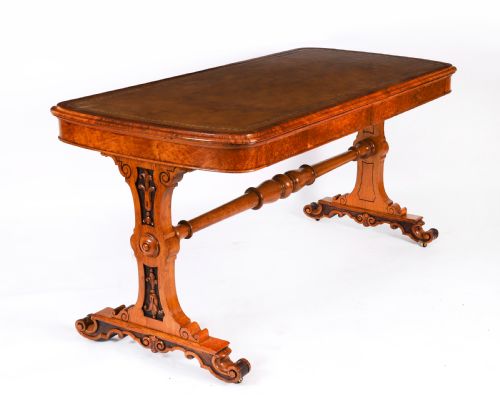
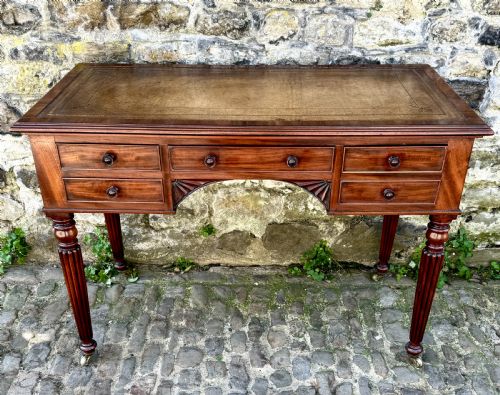
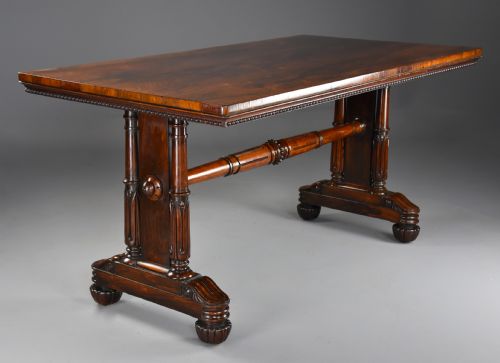
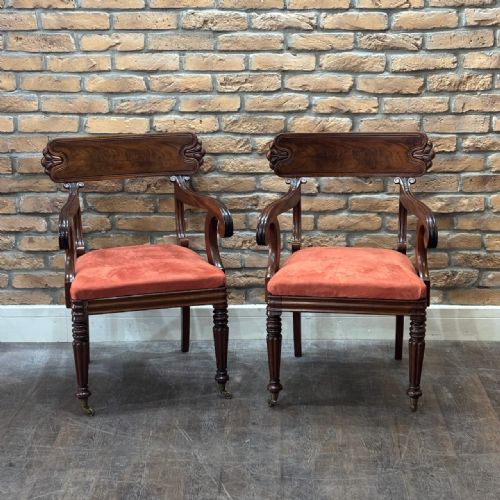


Gillow Style Library Desk
A gillow style library desk brings robust timber and refined proportions to a study, offering a dedicated surface for correspondence and reading.
Gillow Style Library Desk
When searching for a gillow style library desk, buyers encounter writing tables, partners desks, and occasional seating spanning the Georgian, Regency, and Victorian periods. These pieces range from substantial mahogany partners tables to rosewood, pollard oak, and walnut writing desks created in the manner of the Lancaster firm.
The forms on this page include freestanding centre tables with leather-insets, pedestal desks, and associated armchairs like bergères and Gainsborough chairs. Mahogany and rosewood predominate amongst the listings, alongside walnut, burr amboyna, and birdseye maple variants.
Makers and designers such as Bruce James Talbert are represented alongside pieces bearing Bramah locks or reflecting Pugin designs. The selection captures both documented workshop output and the wider nineteenth-century revival of cabinet-making standards.
How they were made
Cabinet-makers utilised dense timbers such as Cuban mahogany, rosewood, walnut, and pollard oak, often selecting veneers with pronounced grain patterns for writing surfaces and drawer fronts. Brass hardware, including castors, drop handles, and gallery rails, complemented the structural joinery.
Writing surfaces were typically inset with tooled leather panels, providing a durable plane for daily correspondence. Drawers incorporated secure locking mechanisms, such as Bramah locks, embedded flush into the timber framing.
Several desks retain their original Bramah locks, keeping secrets safe since the Georgian era.
What varies in quality
The standard of a piece depends upon the selection of timber and the crispness of its carved detailing. Fine examples exhibit carefully matched grain patterns across expansive surfaces and solid secondary timbers within drawer construction.
Proportion and execution distinguish standard vernacular pieces from workshop output attributed to skilled makers. Refined turning on legs, precise dovetailing, and the retention of original brass fittings elevate the standing of a desk.
Gillows of Lancaster·Bruce James Talbert
The Gillow Style Library Desk Glossary
- Partners desk
- A large double-sided writing table designed for two people to work opposite one another, featuring drawers and cupboards on both faces.
- Bergère
- An enclosed upholstered armchair with exposed wooden framing and cane-work sides, frequently produced during the Regency period.
- Bramah lock
- A high-security cylindrical lock patented in the late eighteenth century, commonly fitted to quality desks and cabinet furniture.
- Partners table
- A freestanding library or writing table finished on all sides so it can sit centrally in a room rather than against a wall.
- Pollard oak
- Oak timber taken from pollarded trees, yielding a knotty, highly figured grain pattern prized for decorative veneering.
Gillow Style Library Desk: Frequently Asked Questions
What is a library table?
A library table is a large freestanding desk or table designed to sit in the centre of a room rather than against a wall. These pieces typically feature finished sides and drawers accessible from one or both directions.
They served as versatile surfaces for reading, writing, and sorting papers in domestic libraries and studies.
How do I identify a Regency desk?
Regency desks are characterised by classical restraint, architectural proportions, and dark timbers such as mahogany and rosewood. They often incorporate brass inlay, reeded legs, and elegant drop handles.
Cabinet-makers of this era favoured clean lines influenced by neoclassical design principles.
What is pollard oak?
Pollard oak is a decorative timber obtained by cutting back the branches of oak trees to encourage dense, knotty growth. This creates a turbulent, highly figured grain that cabinet-makers utilised for striking veneered panels on nineteenth-century furniture.
It provides a rich contrast to plainer structural woods on desks and tables.
How do I care for leather desk tops?
Leather desk surfaces benefit from regular dusting and occasional treatment with specialist leather balms to prevent drying and cracking. Avoid using harsh household cleaners or excessive moisture on the hide.
Keeping the leather conditioned preserves the gold-tooled borders and the supple texture of the writing plane.