


Antique Breakfront Desk
An antique breakfront desk brings architectural presence and ample writing space to a room, combining substantial storage with a characteristic recessed central section.
Antique Breakfront Desk
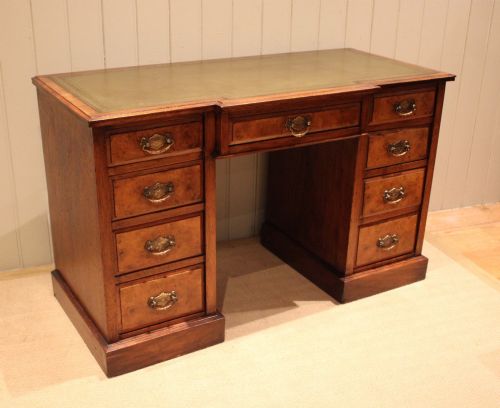
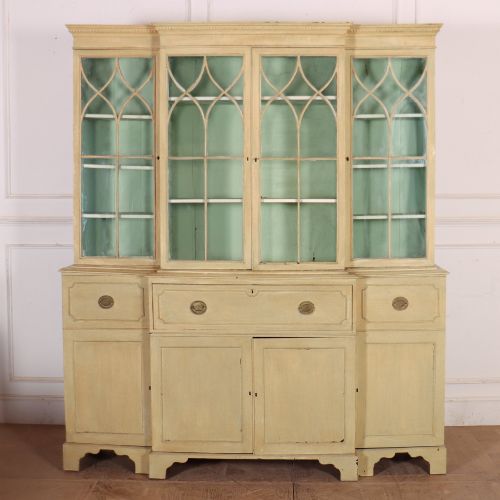
When you search for an antique breakfront desk, you encounter substantial writing furniture defined by a central section set back from flanking pedestals or cabinets. The form appears most frequently in mahogany, often paired with contrasting woods and leather writing surfaces.
The selection ranges from pedestal desks to larger secretary bookcases and sideboards incorporating writing compartments. Dating spans from the Georgian and Regency eras through the Victorian period and into the late nineteenth century.
Makers such as Gillow and Co., Druce and Co., and Maples and Co. produced notable examples in this configuration. These pieces reflect the shift from formal Georgian proportion to the heavier, varied styling of the nineteenth century.
Materials and construction
Makers relied primarily on solid mahogany and mahogany veneers, occasionally incorporating burr walnut, padauk, satinwood, and burr amboyna wood for decorative effect. Brass hardware, including inlaid stringing and galleries, provides structural contrast to the timber.
Insets of green leather frequently form the writing surface on pedestal desks and secretaire drawers. Carved details, glass doors, and painted finishes appear across different periods from the eighteenth to the late nineteenth century.
The listings on this site span mahogany, walnut, burr walnut, padauk, and satinwood, covering Georgian, Regency, and Victorian periods.
Assessing quality
Quality rests on the selection of timber veneers and the precision of cabinetmaking within the breakfront configuration. Superior examples display careful matching of grain patterns on drawer fronts and cupboard doors.
The integration of secondary materials, such as brass inlay, fine leather writing surfaces, and carved details, separates standard production from superior workshops. Original hardware and secondary timbers inside drawers indicate higher standards of manufacture.
Gillow & Co.·Druce & Co.·Maples & Co.
The Antique Breakfront Desk Glossary
- Breakfront
- A piece of furniture whose front projects in sections, with the central portion set back or pushed forward. This architectural arrangement creates depth and visual variety across the facade.
- Secretaire
- A desk or cabinet containing a pull-down writing flap that conceals small drawers and pigeonholes. It allows a tall bookcase or chest to function as a writing place.
- Pedestal desk
- A heavy writing table supported by two pedestals of drawers or cupboards resting on the floor. The sitter sits in the central kneehole space between them.
- Inlaid
- A technique where contrasting materials are set into the surface of the wood to form patterns or lines. Brass and lighter woods are common on these pieces.
- Kneehole
- The recess beneath the centre of a desk designed to accommodate the legs of the user. It divides the under-desk storage pedestals.
Antique Breakfront Desk: Frequently Asked Questions
How do I date an antique desk?
Dating relies on stylistic markers, construction methods, and timber choices associated with periods like the Georgian era, the Regency, and Victorian times. Secondary woods and hardware styles offer further chronological clues.
Makers' stamps and labels, when present, provide specific attribution to firms like Gillow or Maples.
Are these desks suitable for daily use?
Many examples provide sturdy construction and functional writing surfaces fitted with leather inserts. Their generous proportions accommodate modern seating and writing materials.
Care must be taken to protect antique wood and leather surfaces from excessive moisture and direct sunlight.
What is a secretaire bookcase?
A secretaire bookcase combines upper shelving or glass-fronted display cabinets with a lower section containing a pull-down writing drawer. This multifunctional form saves floor space while offering both storage and a writing desk.
Georgian and Victorian cabinetmakers built these tall pieces in mahogany and walnut.