





Brass Gallery Pedestal Desk
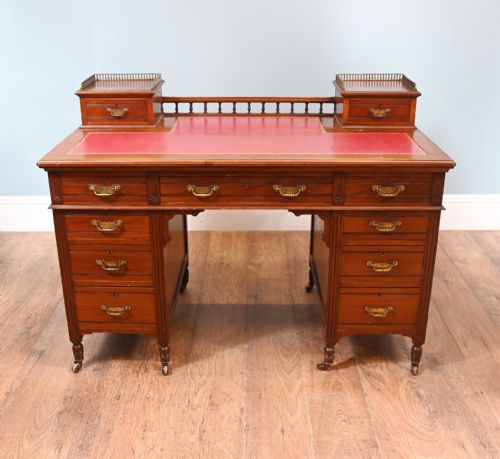
A brass gallery pedestal desk delivers a substantial workspace finished with a distinctive metal rail.
Brass Gallery Pedestal Desk
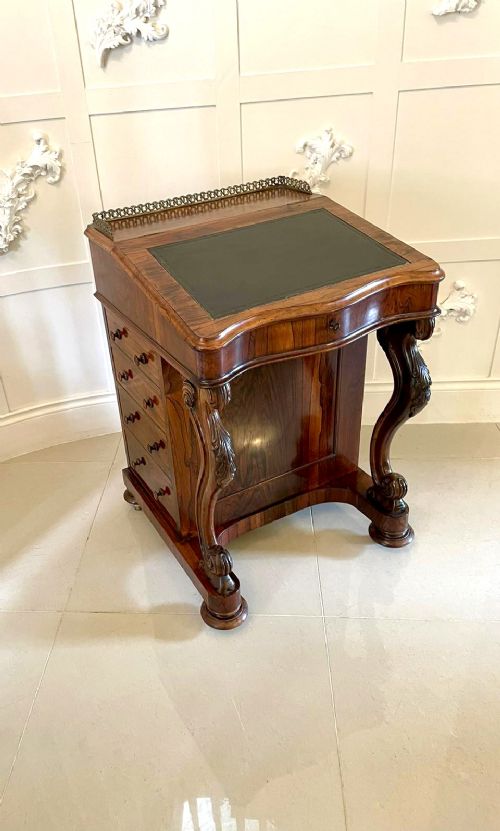
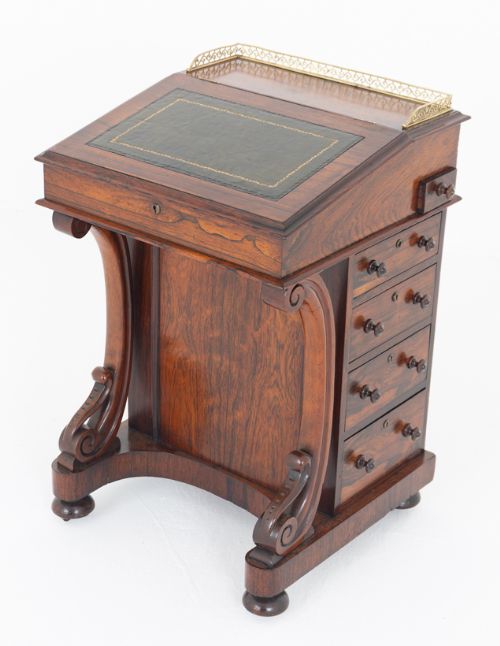
A brass gallery pedestal desk provides a sturdy writing surface supported by sets of drawers or cupboards, framed by a delicate metal railing around the top. These pieces emerge primarily from Victorian and Edwardian workshops, spanning formats from pedestal writing tables to compact Davenports and elaborate Carlton House desks.
The version most commonly encountered on this page combines a rich mahogany, rosewood, or walnut structure with fitted leather inset tops and raised brass galleries. Such tables served administrative and private writing duties in period libraries, estate offices, and formal studies.
How they were made
Cabinet makers built these desks using solid timbers like mahogany, oak, and walnut, frequently applying veneers of satinwood, burr walnut, or rosewood to prominent surfaces. Crossbanding and marquetry inlay provide decorative contrast along drawer fronts and borders.
Functional hardware integrates brass handles, fitted leather writing surfaces, and cast metal galleries secured to the desktop. Internal drawer compartments utilise secondary timbers like oak with traditional dovetail joinery.
What varies in quality
The distinction between standard production and top tier work rests on the selection of timber veneers and the crispness of inlaid marquetry details. Superior examples exhibit tightly grained burr walnut or figured satinwood matched symmetrically across the writing surface.
Finishing touches dictate overall merit, notably the weight of the cast brass gallery and the precision of internal oak-lined drawer construction. Pieces bearing documented maker signatures command further distinction through superior carving and structural integrity.
Edwards and Roberts·Gillow & Co·Gillows of Lancaster
The Brass Gallery Pedestal Desk Glossary
- Brass gallery
- A low metal rail fitted around the upper edges of a desk to prevent stationery and inkwells from sliding off.
- Pedestal desk
- A heavy writing table supported by two separate banks of drawers resting on the floor.
- Carlton House desk
- A form of writing desk featuring a curved superstructure fitted with small drawers and pigeonholes enclosed by a brass gallery.
- Davenport
- A compact writing desk featuring a sloping, leather-lined lid above a bank of side drawers.
- Crossbanding
- A narrow strip of veneer laid across the grain of the primary timber to create a decorative border.
Brass Gallery Pedestal Desk: Frequently Asked Questions
What is a brass gallery?
A brass gallery is a decorative and functional metal railing mounted to the top perimeter of a desk or sideboard. It secures writing implements and small items from rolling off the surface.
Cabinet makers attached these railings using small screws or integrated mounts, creating a polished border that defines the upper edge of Victorian and Edwardian writing furniture.
How do I identify an Edwardian desk?
Edwardian desks often feature lighter satinwood or inlaid mahogany timbers compared to heavier earlier Victorian pieces. They frequently adopt refined Sheraton Revival motifs.
Construction methods from this period include machine-assisted precision alongside traditional hand joinery, producing sophisticated writing tables with satinwood crossbanding and delicate stringing.
Where were pedestal desks used?
These pieces functioned as administrative centres in estate offices, libraries, and private drawing rooms. Their substantial drawers provided secure storage for correspondence and documents.
Freestanding variants allowed placement in the middle of a room, finished with drawers or dummy panels on all sides to present a polished appearance from every angle.
What woods were used?
Primary construction relied on sturdy timbers such as mahogany, oak, and walnut. Finer surfaces received decorative veneers including rosewood, satinwood, and burr walnut.
Secondary woods like oak were utilised for internal drawer linings and structural framing to ensure long-term durability under daily administrative use.