



Gilded Frame Livestock Art
Gilded frame livestock art brings pasture and farmyard straight to the wall in heavily ornamented settings.
Gilded Frame Livestock Art
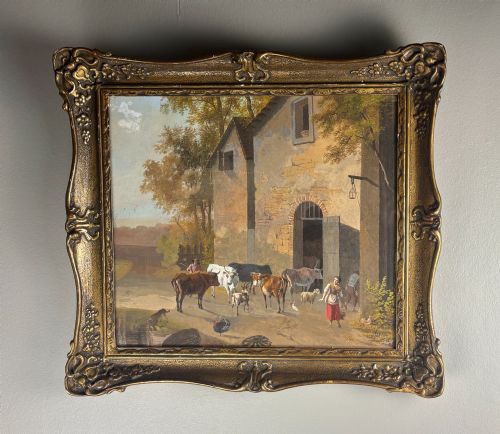
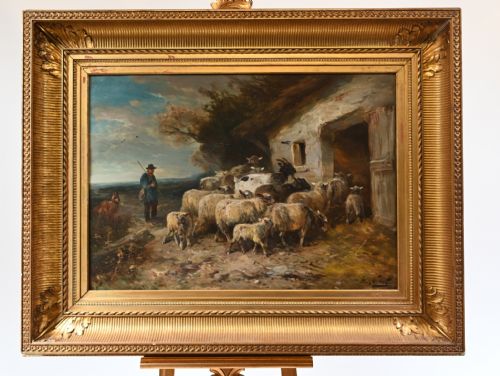
Gilded frame livestock art encompasses oil paintings, watercolours and framed artworks depicting cattle, sheep, goats and poultry. These rural and pastoral scenes capture agricultural life across the eighteenth, nineteenth and twentieth centuries.
The version most commonly met on this page is the nineteenth century oil painting on canvas, housed within its original gilded wood or gesso frame. Painters working in British and continental European traditions dominate the selection, portraying herds by rivers, flocks in highlands, and poultry in farmyards.
How they were made
Artists built these works using oil paint or watercolour applied to canvas or paper supports. Canvases were stretched across wooden frames before artists rendered cattle, sheep and rural landscapes with fine brushwork.
The frames themselves rely on wood foundations built up with gesso and finished with gold leaf or gilding. This technique created deeply reflective, ornate borders designed to catch and project light into the painted pastoral scene.
Gilded Frame Livestock Art Retail Price Guide 2026
Typical asking prices for gilded frame livestock art among the pieces listed under this phrase on Sellingantiques today, from the lower quarter to the upper quarter. They describe what is for sale here now, not the wider market.
Cockerels, chickens and chicks claim their share of the pasture alongside heavy bulls, grazing cattle and woolly sheep.
What varies in quality
The success of the composition and the fidelity of the animal anatomy separate accomplished academic painting from simpler folk art representations. Master painters handled light on a beast's flank and the recession of a river valley with acute observational skill.
Frame craftsmanship also dictates the calibre of the piece, distinguishing hand-carved, heavily gilded mouldings from later replacements. Original frames that retain their early gilding and structural integrity elevate the entire object.
Henry Schouten·Franz van Severdonck·Frederick Septimus Lewis·Eugene Verboeckhoven·Andre de Moller·Heinrich Harder·Julius Caesar Ibbetson·Frederick Richard Lee·Thomas Sidney Cooper·Edgar Hunt·Henry Cheadle·William Sidney Cooper·Charles Jones·Louis Marie Dominique Robbe
The Gilded Frame Livestock Art Glossary
- Gesso
- A plaster-like mixture applied to wooden frames to provide a smooth base for gilding. It was often moulded into ornamental reliefs before receiving gold leaf.
- Giltwood
- Timber that has been coated with gold leaf or powdered gold. This material defines the luxurious surrounds typical of nineteenth century picture frames.
- Pastoral realism
- An artistic style focused on authentic depictions of rural life and agricultural animals. Painters of this movement studied livestock in natural landscapes with great precision.
- Watercolour painting
- A work executed with water-soluble pigments on paper. These delicate pieces required protective glazing within framed presentations.
- Follower
- An artist whose work closely imitates the style and subjects of a master painter. Such pieces often date from the same period or shortly after the master's active years.
Gilded Frame Livestock Art: Frequently Asked Questions
What is gilded frame livestock art?
These works are traditional paintings of farm animals, cattle and sheep set inside ornate gold-leaf wooden frames. They celebrate rural and pastoral life from historical periods.
Most examples date from the nineteenth century and use oil on canvas. They range from detailed academic studies to expressive rural scenes.
How were these paintings displayed originally?
Owners hung these framed artworks in parlours, drawing rooms and country houses to signal an appreciation for rural wealth and nature. The bright gilded borders were specifically chosen to illuminate darker Victorian interiors.
Today, they suit traditional and eclectic living spaces alike. They bring warmth and historical texture to modern walls.
How do I identify a nineteenth century frame?
Nineteenth century frames typically feature heavy wooden construction coated in gesso and gold leaf. Close inspection often reveals hand-tooled ornament and signs of age beneath the gilding.
Many pieces retain their original frames, which complement the painting's era. Mismatched or newer frames usually lack the patination of the canvas.
Who painted these agricultural scenes?
Numerous British and continental European artists specialised in painting livestock and rural landscapes. Painters like Eugene Verboeckhoven and Thomas Sidney Cooper achieved renown for their precise animal portraits.
Other works come from followers or regional painters working within the pastoral tradition. Signatures or stylistic traits often help connect a painting to a specific hand.