


Gilded Frame Harbour Art
These gilded frame harbour art pieces bring maritime life into a room through oil paint and watercolour.
Gilded Frame Harbour Art
When you search for gilded frame harbour art, you encounter oil paintings, watercolours, and panels depicting coastal scenes, ports, and shipping. These works range from the nineteenth century into the twentieth century, taking in Victorian marine art, impressionism, and continental townscapes.
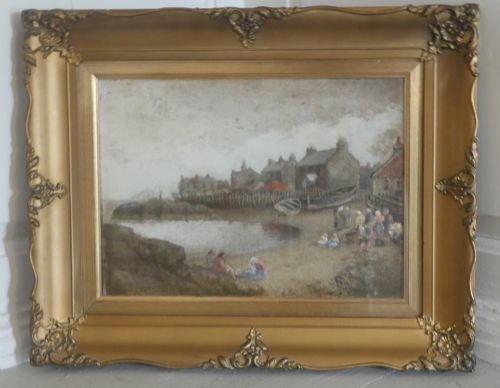
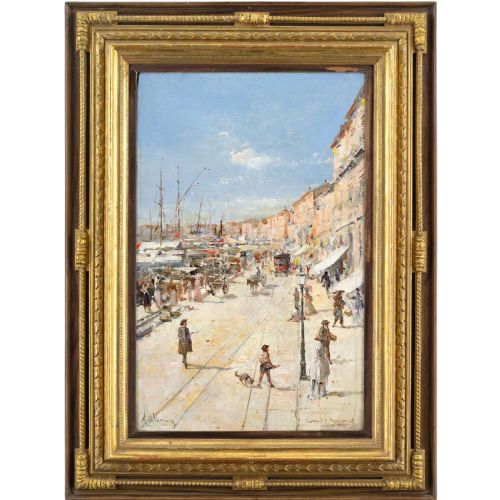
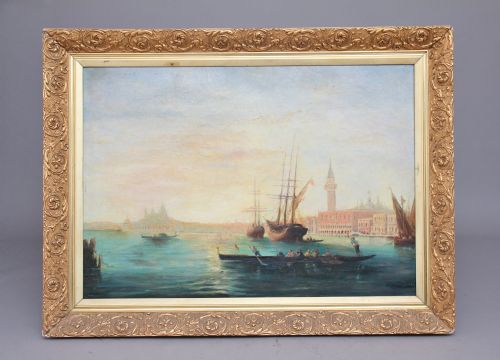
The most common examples on this page are nineteenth-century oil paintings on canvas or panel, framed in giltwood or gesso. They show busy harbours, Venetian lagoons, and coastal towns from British and European locations.
How they were made
Artists applied oil paint or watercolour to canvas, wood panels, or paper, capturing coastal light and maritime traffic. Many works date from the nineteenth and early twentieth centuries.
Surrounding the artwork is a wooden frame finished with carved or moulded gesso, then gilded to create a gold surface that reflects light.
Several artists painted the exact same Yorkshire harbour.
What varies in quality
Quality rests upon the artist's brushwork, the accuracy of the maritime architecture or shipping details, and the composition of the coastal scene. Stronger works capture the atmosphere of the port or lagoon with assured handling of light and water.
The framing also matters, distinguishing works housed in period giltwood and gesso frames from those in simpler or later replacements.
Edward Mills·Augusto Alberici·Paul-Jean Anderbouhr·James Kyd·Adrian Van Porten·Stanley Leader·Claude Lorrain·Fred Waugh·Pauwels·James Webb·Alfred Henry Vickers·John Callow·Edward Henry Holder·Owen Bowen·William Langley·Charles Euphrasie Kuwasseg·Ludwig Hermann·Charles France·Arthur Joseph Meadows·John James Wilson·Walter Meegan·Hubert Thornley·Frank William Scarbrough·Francis Moltino·Stephen Brownlow
The Gilded Frame Harbour Art Glossary
- Giltwood
- Wood carved and covered with a thin layer of gold leaf or metal powder. It provides the bright border seen on many nineteenth-century painting frames.
- Gesso
- A paint mixture consisting of a neutral binder mixed with chalk, gypsum, or pigment. It forms the moulded base beneath the gold leaf on traditional frames.
- Marine art
- Paintings that focus on ships, sea views, harbours, and coastal towns. This genre includes historical naval scenes as well as calm port views.
- Oil on canvas
- Pigment mixed with drying oil applied to a stretched woven fabric support. It allows for rich colour layering and varied surface textures.
Gilded Frame Harbour Art: Frequently Asked Questions
What periods do these paintings date from?
The works span from the seventeenth century through the nineteenth and twentieth centuries, with a strong representation of nineteenth-century and Edwardian pieces.
Artists worked across distinct periods including Victorian marine art and early twentieth-century impressionism.
Are all the frames original to the paintings?
Frames are often period giltwood or gesso structures contemporary with the artwork, though mountings can vary.
Buyers find a mix of original gilt frames and later protective surrounds housing these coastal scenes.
Where do these harbour scenes depict?
The views encompass British ports and coastal towns alongside continental European locations such as Venice, Messina, Rouen, and Cannes.
Scenes range from busy merchant shipping harbours to quiet coastal lagoons and river estuaries.
What mediums are used in these artworks?
Most pieces are oil paintings executed on canvas, wood panels, or boards, using oil paint.
Some selections feature watercolour on paper, capturing lighter atmospheric effects of coastal skies and water.