


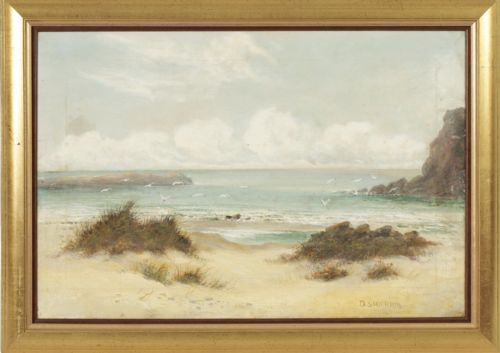


Gilded Frame Beach Scene
These gilded frame beach scene works bring nineteenth-century coasts and maritime views indoors through oil paintings set in traditional gold leaf and gesso surrounds.
Gilded Frame Beach Scene
When you search for a gilded frame beach scene, you encounter oil paintings on canvas and board depicting maritime landscapes, coastal gatherings, and seaside views. These works span nineteenth-century pieces up through nineteen-sixties interpretations, capturing shores from French seascapes to British marine locations.
You are most likely to meet Victorian marine scenes and nineteenth-century coastal works housed in decorative gold leaf frames. The subjects range from boats on the shore and lighthouses on cliffs to dramatic sunsets at low tide and figures gathering kelp along the coast.
How they were made
Makers built these frames using wood foundations layered with gesso and composition ornament before applying gold leaf to achieve the characteristic metallic brilliance. The paintings themselves employ oil paint applied to canvas or board supports, utilising techniques found in British Impressionism, Post-Impressionism, and the Hague School.
Artists layered oil pigments to capture the atmospheric light of coastal environments, while framers shaped intricate mouldings designed to complement the maritime subject matter. The combination of oil on canvas or board within a gilded surround created a finished piece intended to draw the eye toward the painted horizon.
Some nineteenth-century artists clearly salt-aired their boots while painting, judging by the occasional stray grain of sand embedded deep within the old gesso frames.
What varies in quality
Quality rests upon the handling of light and atmosphere within the oil paint, distinguishing works with vibrant depth from flatter compositions. The execution of the coastal subject matter, whether depicting crashing waves or quiet shores, determines the artistic merit of the painting.
The craftsmanship of the frame also dictates overall standing, as hand-applied gesso and genuine gold leaf display superior crispness compared to simpler composition mouldings. Pieces signed by recognised nineteenth-century and early twentieth-century artists carry greater distinction within the range.
James Webb·Sir David Murray RA·William Shayer·George Smith·Daniel Sherrin
The Gilded Frame Beach Scene Glossary
- Gesso
- A plaster-like mixture applied to wood frames to create a smooth surface for gilding. It provides the foundation for intricate moulded details.
- Composition
- A mixture of whiting, resin, and glue pressed into moulds to form ornamental details on frames. It offers a cost-effective alternative to carved wood.
- Oil on Board
- A painting executed on a rigid wooden or cardboard panel rather than stretched canvas. This medium provides a firm surface favored by many plein air artists.
- Marine Landscape
- A genre of art focusing primarily on the sea, ships, and coastal views. These works document maritime life and coastal topography across various historical periods.
- Post-Impressionism
- An art movement extending Impressionism while rejecting its limitations, emphasising symbolic content and heavier brushwork. It appears in several mid-twentieth-century French coastal interpretations.
Gilded Frame Beach Scene: Frequently Asked Questions
What periods do these paintings come from?
The selections span the nineteenth century through the nineteen-sixties, incorporating Victorian marine art and early twentieth-century French and British coastal works.
These periods reflect changing approaches to maritime subjects, moving from traditional realism towards impressionistic interpretations of light and water.
How should I display a gilded frame beach scene?
Hang these oil paintings in spaces with stable humidity and away from direct sunlight to protect both the canvas and the delicate gold leaf finish.
Consider pairing the gilded frame with neutral wall colours that allow the metallic surround and coastal tones to stand out properly.
How do I identify a Victorian marine painting?
Look for characteristic subjects such as traditional sailing vessels, rugged British coastlines, and dramatic skies rendered in rich oil pigments. Signatures, canvas stamps, and the style of the wood and gesso frame often provide further clues to the nineteenth-century origin.
Examining the stretcher bars and the ageing of the oil paint helps confirm the historical period of the piece.
What is the difference between oil on canvas and oil on board?
Oil on canvas involves pigment applied to a woven fabric stretched across a wooden frame, offering a slight give and traditional texture. Oil on board uses a rigid panel, which provides a completely firm support often utilised for smaller coastal studies.
Both supports were widely used by marine artists depending on whether they painted in a studio or outdoors by the shore.