




Gilded Foyer Console
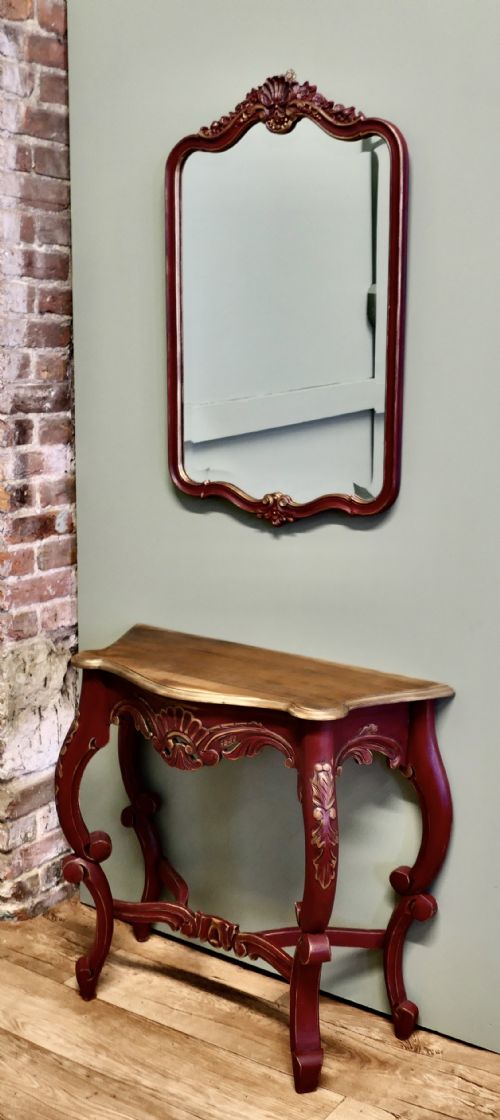
These gilded foyer console pieces bring striking architectural presence to an entrance hall, combining reflective surfaces with rich historical carving.
Gilded Foyer Console
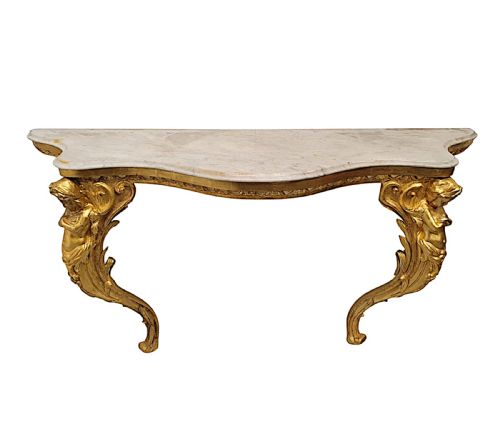
A gilded foyer console serves as a grand focal point in an entrance hall, often featuring a heavy stone top set upon a richly decorated base. When you search for a gilded foyer console, you are looking at statement furniture designed to sit flat against a wall or stand freely as a centre table.
The versions you meet on this page span the nineteenth century up to nineteen twenty, drawing on French Rococo, Louis XVI, Regency, and Italian Baroque revival styles. They arrive in forms ranging from standalone tables to paired console and mirror sets.
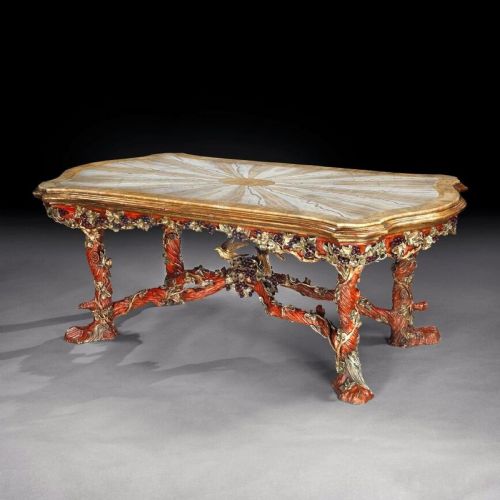
Makers and workshops from these periods favoured substantial timber frames finished in giltwood or polychrome paint, topped with marble or onyx. Each piece reflects the decorative ambitions of nineteenth-century interiors through elaborate carving and classical motifs.
How they were made
Craftsmen shaped these tables from carved wood, oak, and giltwood, applying layers of gold leaf or polychrome paint to the timber surfaces. The structural frames often incorporate complex motifs such as lion's paw supports.
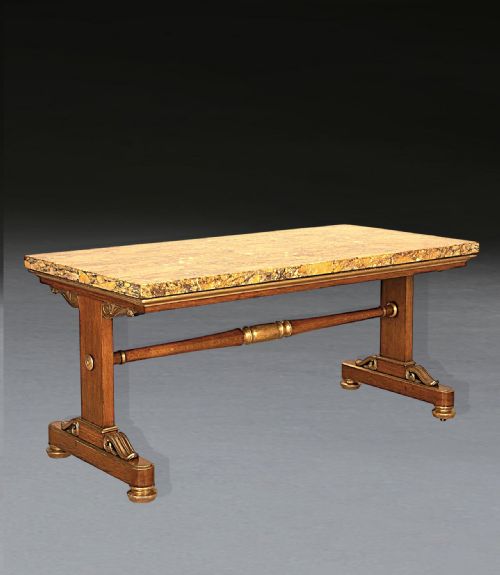
Tops were fashioned from solid slabs of marble, Siena marble, onyx, or breccia marble, cut and polished to contrast with the shimmering gilt bases below. Joinery and carving were executed by hand, uniting heavy stone surfaces with intricate wooden chassis.
The listings span the nineteenth century and nineteen twenty, featuring giltwood, oak, marble, onyx, and polychrome paint across console and centre table forms.
What varies in quality
Quality in these pieces rests upon the crispness of the wood carving and the depth of the gilding applied to the frame. Hand-chrysopeia work and deeply undercut foliage separate ordinary joinery from exceptional workshop production.
The selection of the stone top further defines the tier of the piece, with distinctive marble varieties like Siena or breccia indicating higher ambition. The harmony between the weight of the stone and the proportion of the carved base dictates the overall success of the design.
Amleto Bertoni
The Gilded Foyer Console Glossary
- Giltwood
- Timber coated with gold leaf or gold powder over a prepared gesso ground. This finish provides the bright reflective quality seen on historical console frames.
- Console Table
- A table designed to be fixed against a wall, frequently supported by ornamental brackets or legs rather than four standard vertical posts.
- Siena Marble
- A distinctive yellow-gold marble quarried in Italy, featuring deep brownish-purple veins. It was frequently utilised for high-status table tops.
- Breccia Marble
- A composite stone made of angular rock fragments embedded in a fine-grained matrix. Its busy, multi-coloured pattern creates a dramatic contrast with gilded wood.
- Rococo Revival
- A nineteenth-century design movement mimicking the asymmetrical scrollwork, C-scrolls, and naturalistic shell motifs of the eighteenth-century French style.
Gilded Foyer Console: Frequently Asked Questions
Where should a gilded foyer console go?
These tables are traditionally placed in an entrance hall or reception room against a primary wall. They anchor the space and provide a surface for decorative objects upon entering a home.
Paired versions or console and mirror sets work particularly well beneath large wall spaces or windows, reflecting light through the room.
How do I care for a marble top?
Marble and onyx surfaces require gentle cleaning with a damp cloth and mild soap. Avoid acidic cleaners or citrus substances which can etch the polished stone.
Protect the surface from heavy impacts and moisture rings by using coasters or felt pads under decorative items.
Are these tables freestanding?
Some pieces on this page are centre tables designed to be viewed from all sides in the middle of a room. Console tables, however, are traditionally built to stand against a wall.
Wall-mounted or console variants often rely on structural attachment or wall brackets for absolute stability due to the heavy stone tops.
How do I identify the revival styles?
French Rococo and Italian Baroque revival pieces display exuberant, curved lines, asymmetrical scrolls, and organic motifs like leaves and shells. Louis XVI style pieces introduce straighter lines, symmetry, and classical architectural details.
Examining the carving depth and the specific type of marble helps connect the piece to its nineteenth-century design source.