
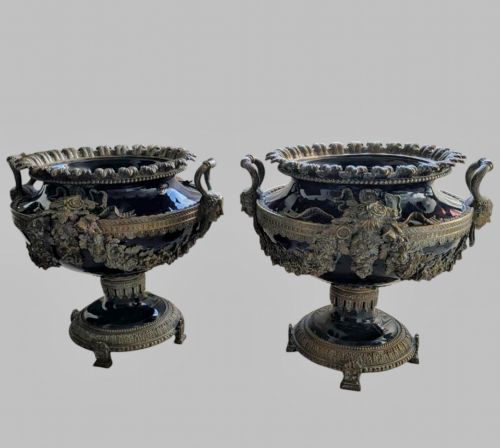
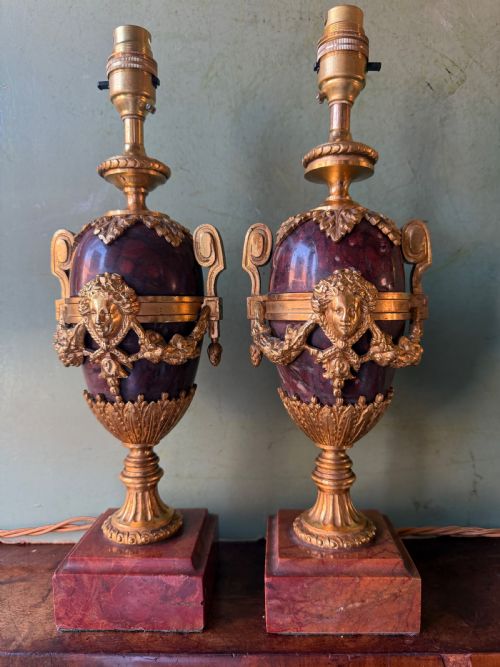


Gilded Bronze Mounted Urns
Gilded bronze mounted urns bring French neoclassical elegance and weight to a room, combining cast metal with ceramic, glass, or marble.
Gilded Bronze Mounted Urns
Gilded bronze mounted urns are ornamental and functional vessels originating largely from nineteenth-century France, encompassing styles from Louis XVI revival to French Empire and Rococo Revival. Buyers seeking these pieces encounter decorative vases, lidded urns, garnitures, mantel clocks, and table lamps that merge classical forms with rich surface decoration.
The selection on this page relies heavily on nineteenth-century examples, spanning specific dates from the 1850s to 1900 alongside Victorian pieces. Many items utilise Sevres style porcelain bodies paired with metal mounts, while others incorporate blue ceramic, pink porcelain, rouge marble, and blue glass.
The forms function as focal points on mantelpieces, side tables, and pedestals, often surviving in pairs or larger matching sets. Their dual role as ornamental art and functional lighting or timekeeping devices reflects the Grand Tour aesthetic popular in the nineteenth century.
Materials and Construction
Makers constructed these pieces by combining cast metal mounts in ormolu, gilt bronze, and brass with bodies of porcelain, marble, glass, and ceramic. The metal components were cast and gilded to frame the ceramic or stone vessels with scrolling foliage, handles, and feet.
Porcelain bodies frequently emulate Sevres production, featuring painted surfaces beneath or framed by metalwork. Marble sections, including rouge marble, provide stable, heavy bases and columns that anchor the lighter bronze and porcelain elements above.
Listings feature nineteenth-century French design, predominantly showcasing Sevres style porcelain, ormolu mounts, and rouge marble.
Assessing Quality
Quality rests in the crispness of the bronze casting and the depth of the gilding on the mounts. Sharp detail in the chased foliage and handles distinguishes superior metalwork from softer, more repetitive casting.
The integration between the mount and the body determines structural success. Tightly fitted bronze collars that follow the contours of the porcelain, marble, or glass indicate careful assembly by skilled workshops.
The Gilded Bronze Mounted Urns Glossary
- Ormolu
- Gilded bronze, where a layer of gold amalgam is applied to a bronze base and heated to leave a rich finish. This material is characteristic of French decorative arts from the eighteenth and nineteenth centuries.
- Garniture
- A set of three or more matching ornamental objects designed to sit together on a mantelpiece. These typically consist of a central clock or urn flanked by matching vases or candelabra.
- Grand Tour
- A cultural journey undertaken by wealthy Europeans in the eighteenth and nineteenth centuries to study classical art. Souvenirs brought back included marble and bronze ornaments that inspired later revival designs.
- Louis XVI Style
- A neoclassical design movement characterised by straight lines, symmetry, and classical motifs such as urns, swags, and fluting. Nineteenth-century revivals frequently adopted these proportions.
Gilded Bronze Mounted Urns: Frequently Asked Questions
What are gilded bronze mounted urns?
These decorative objects combine ceramic, glass, or stone vessels with cast metal mounts finished in gold. They originate primarily from nineteenth-century French workshops.
Such pieces range from ornamental vases and lidded urns to converted lamps and clock garnitures. Their design draws heavily on earlier neoclassical and Louis XVI aesthetics.
How were these urns used?
Nineteenth-century interiors utilised these urns and vases as prominent decorative centerpieces on mantelpieces, console tables, and cabinets. Many pairs formed part of three-piece garnitures.
Some examples were later adapted into table lamps or combined with clock movements. Their primary purpose remained visual display and the demonstration of refined taste.
How do I care for ormolu and marble?
Dust bronze and ormolu mounts gently with a soft, dry cloth to prevent the accumulation of grit in the chased details. Avoid abrasive cleaners that can strip the gilding.
Marble bases require simple wiping with a damp cloth followed by immediate drying. Protect the stone from acidic substances and heavy impacts that can chip the polished surface.