



Gilded Bronze Bracket Clock
A gilded bronze bracket clock brings monumental French or English architectural presence and intricate brasswork to a room.
Gilded Bronze Bracket Clock
A gilded bronze bracket clock unites heavy cast bronze or brass frames with precise mechanical movements, often paired with matching wall brackets or designed for mantel placement.
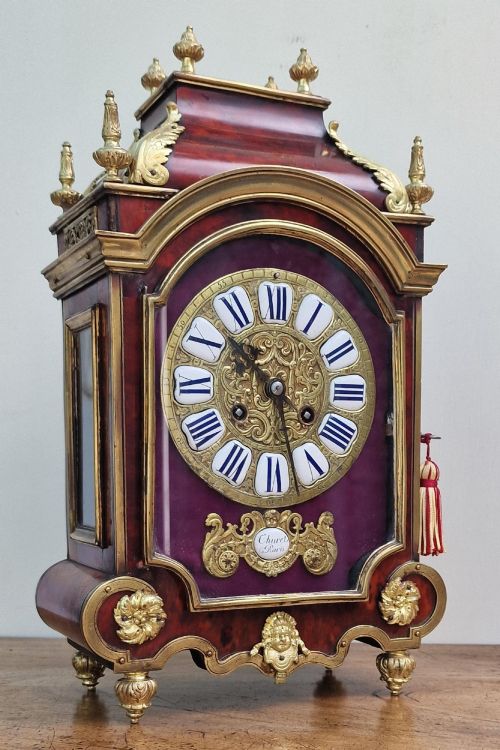
Most examples found here hail from nineteenth-century French and English workshops, spanning styles from Louis XIV and Rococo Revival to simpler four-glass architectural cases.
Buyers encounter freestanding mantel clock variants alongside specimens housed in tortoiseshell boule work or featuring enamel dials and visible pendulum assemblies.
Materials and construction methods
Craftsmen built these pieces using heavy bronze, brass, and gilt metal foundations, frequently applying mercury gilt or ormolu finishes to create a brilliant golden surface.
Intricate cases incorporate glazed glass panels, champlevé enamel dials, and tortoiseshell veneer laid over wooden substrates in traditional Boulle marquetry techniques.
Interior movements rely on brass gear trains, single fusee or chain fusee mechanisms, and pendulum regulation designed to maintain accurate timekeeping.
Listings feature Victorian and nineteenth-century pieces alongside mid-eighteenth-century examples, constructed in gilt bronze, ormolu, tortoiseshell, and marble.
Assessing quality and execution
The finest specimens display exceptional depth and crispness in their cast bronze ornamentation, showing sharp chisel work on acanthus leaves, cherubs, and architectural mouldings.
Superior execution extends to the movement itself, where signed makers and complex single fusee or champlevé enamel integrations separate standard production from masterwork horology.
The preservation of original mercury gilding, undamaged enamel chapter rings, and intact tortoiseshell boule panels dictate the standing of an individual piece.
Thuret Paris·Le Roy and Fils·A D Mougin·Hay London·Baetens London·Henri Dasson
The Gilded Bronze Bracket Clock Glossary
- Ormolu
- Finely ground high-carat gold applied to a bronze base using a mercury amalgamation process. This technique produces a deep, lasting metallic lustre distinct from modern electroplating.
- Fusee
- A conical pulley used in clock movements to maintain even tension on the chain or cord as the mainspring unwinds. It ensures consistent force is delivered to the gear train.
- Boulle
- An elaborate marquetry technique involving tortoiseshell and brass inlaid in contrasting patterns. It is named after the French cabinetmaker André-Charles Boulle.
- Champlevé
- An enamelling technique where troughs or cells are hollowed out of the metal surface and filled with vitreous enamel before firing. The resulting design sits flush with the metal partitions.
Gilded Bronze Bracket Clock: Frequently Asked Questions
Where should I place a heavy bronze clock?
Position the piece on a sturdy mantelpiece, sideboard, or dedicated wall bracket capable of supporting considerable bronze and glass weight. Level the surface carefully.
Keep the clock away from direct sunlight, heating vents, and damp exterior walls to protect the delicate gilt bronze and tortoiseshell surfaces.
What is the difference between an ormolu and gilt brass clock?
Ormolu specifically denotes a mercurial gold finish applied to a bronze casting, yielding a warm and heavy golden hue typical of high-end French decorative arts.
Gilt brass or gilt bronze generally describes alternative alloy compositions or different plating methods encountered across nineteenth-century English and French manufacturing.
How do I identify a French Rococo style clock?
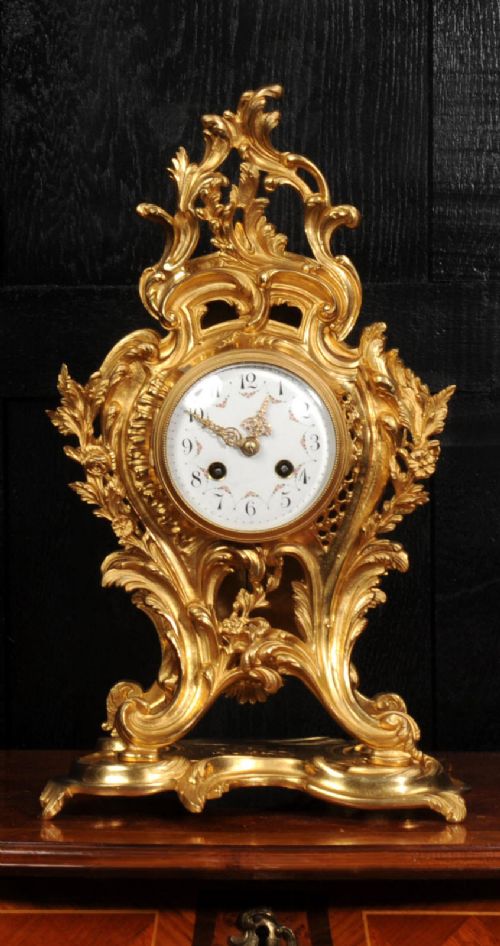
Look for asymmetrical scrolls, C-volutes, naturalistic floral motifs, and sculptural figures such as cherubs integrated into the cast metal case. These designs emerged in eighteenth-century France and saw widespread revival.
The dials often feature individually pinned enamel cartouches and ornate gilt hands that complement the flowing lines of the bronze chassis.