
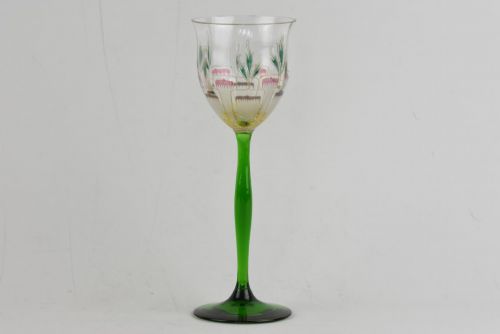


German Enamelled Glass
German enamelled glass pieces bring bright heraldic motifs and florals to the table, and handling them reveals the bold pigments fused to blown vessels over centuries.
German Enamelled Glass
German enamelled glass encompasses blown vessels, goblets, flasks, and roemers decorated with colourful vitreous pigments, spanning periods from the eighteenth century through the art deco era. Buyers searching for german enamelled glass will encounter everything from eighteenth-century schnapps flasks to nineteenth-century vases and twentieth-century crystal hock glasses.
The objects on this page range from Georgian continental flasks and German historicism roemers to Theresienthal cordial sets and Munich cups signed by Emmy Seyfried. Forms shift from heavy traditional roemers with heraldic motifs to delicate floral wine glasses and pale green vessels.
Earlier pieces lean towards folk art traditions and armorial bearings, while later twentieth-century examples embrace art nouveau, jugendstil, and art deco lines. This mix reflects changing domestic tastes across German and Bohemian workshops over two hundred years.
How they were made
Makers formed these vessels using blown glass and crystal, shaping roemers, bottles, and goblets by hand before applying surface decoration. Glass was sometimes tinted pale green or left clear to contrast with the pigments.
Decoration relied on enamel and gold leaf applied to the exterior of the glass and fired to fuse the colours. Polychrome enamels provided bright hues for heraldic coats of arms, floral sprays, and abstract motifs.
Listings feature periods spanning the eighteenth century, the late nineteenth century, and twentieth-century decades up to nineteen-thirty-five.
What varies in quality
Quality rests in the precision of the enamel work and the clarity of the blown glass vessel beneath. Finer pieces display crisp lines in heraldic and floral motifs without blurring or pooling in the fired pigments.
The weight and finish of the glass itself distinguish standard production from premier workshop output. Sets featuring matching crystal hock glasses or cordial vessels demonstrate greater uniformity in shape and hand-painted detail.
Theresienthal·Emmy Seyfried·Frits Hechert
The German Enamelled Glass Glossary
- Roemer
- A traditional Germanic drinking vessel featuring a large bowl atop a decorated cylindrical stem and foot. These glasses often display armorial bearings or heraldic motifs in polychrome enamel.
- Hock glass
- A tall-stemmed wine glass traditionally used for white wine, often rendered in crystal with delicate enamel decoration. These frequently appear in matched sets from makers such as Theresienthal.
- Historismus
- A nineteenth-century artistic movement reviving historical styles and medieval motifs. Pieces from this period frequently borrow sixteenth or seventeenth-century armorial designs.
- Vitreous enamel
- A material made by fusing powdered glass to a substrate through firing, creating a durable and glossy coloured surface. On these pieces, it provides the bright polychrome pigments found on flasks and goblets.
- Cordials
- Small glasses designed for after-dinner liqueurs, often hand-enamelled with floral patterns. They appear as individual items or in complete matching sets.
German Enamelled Glass: Frequently Asked Questions
What is german enamelled glass?
German enamelled glass refers to blown glass vessels, roemers, flasks, and tableware decorated with fused coloured glass pigments. These pieces range from eighteenth-century armorial bottles to twentieth-century art deco crystal sets.
The tradition spans various regions including Germany and Bohemia, encompassing both folk art styles and sophisticated workshop productions from makers like Theresienthal.
How were these glasses used?
Many of these vessels served practical roles as wine glasses, cordial glasses, schnapps flasks, and tableware for daily dining or formal toasts. Roemers and larger goblets often held wine during feasts and gatherings.
Some decorated bottles and flasks served as storage for spirits, while others functioned primarily as decorative glassware displayed on sideboards and tables.
How do I care for enamelled glass?
Enamelled glass requires gentle handling and should be washed by hand in lukewarm water using mild soap. Avoid soaking the pieces, as moisture can affect old glass and delicate enamel over time.
Keep them away from sudden temperature changes to protect both the blown vessel and the fired enamel and gold leaf decoration from thermal shock.
How can I tell the period?
Dating relies on the vessel form, the manufacturing technique of the glass, and the artistic style of the enamel decoration. Eighteenth-century pieces often show heavier, simpler blown forms with rustic armorial painting.
Later nineteenth and twentieth-century examples reflect movements like historicism, art nouveau, and art deco, sometimes accompanied by maker marks, signatures, or specific crystal qualities.