





Georgian Walnut Toilet Glass
A georgian walnut toilet glass brings rich timber and refined proportion to a dressing surface, offering a practical mirror with integrated drawers.
Georgian Walnut Toilet Glass
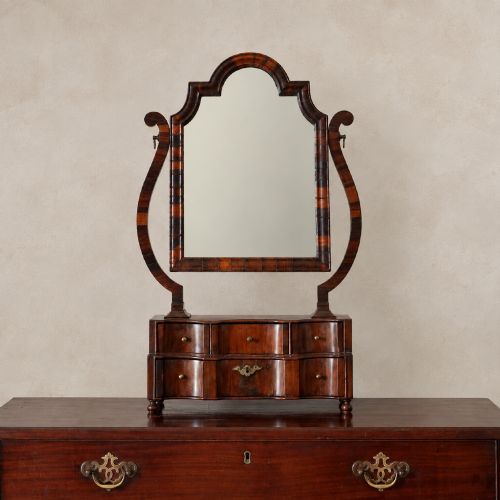
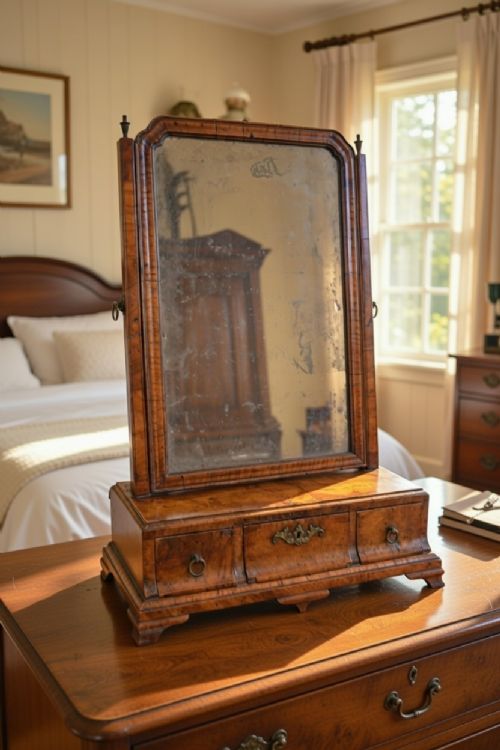
A georgian walnut toilet glass sits upon a bureau, chest or dressing table, providing a pivoting mirror plate mounted above a small box base fitted with drawers. These pieces date from the eighteenth and early nineteenth centuries, spanning Queen Anne, George II, George III and Dutch Neo-Classical styles.
The most common examples on this page are eighteenth-century dressing table mirrors constructed in walnut, burr walnut or red walnut, often featuring box bases with small drawers. Forms range from simple Queen Anne designs to more elaborate George II and George III variants, alongside occasional nineteenth-century interpretations.
Makers designed these glasses for the daily routine of grooming, placing them where light from a window fell best upon the glass. The combination of a pivoting frame and a stationary box base made them both functional desk accessories and miniature pieces of case furniture.
How they were made
Cabinet makers built these mirrors using solid walnut, burr walnut and occasionally laburnum, applying figured veneers over secondary timbers to create decorative surfaces on the box bases. Boxwood inlay added linear contrast to the casework, while gold leaf sometimes appeared on internal mouldings or decorative details.
The mirror plates themselves utilise early mirror glass held within pivoting wooden frames attached to upright arms, allowing the user to tilt the reflection as needed. Brass hinges, lock escutcheons and small drawer pulls completed the construction, securing the pivoting mechanism and the small storage compartments below.
Georgian Walnut Toilet Glass Retail Price Guide 2026
Typical asking prices for georgian walnut toilet glass among the pieces listed under this phrase on Sellingantiques today, from the lower quarter to the upper quarter. They describe what is for sale here now, not the wider market.
The listings span the eighteenth and nineteenth centuries, incorporating walnut, burr walnut, laburnum, boxwood inlay, gold leaf and brass fittings.
What varies in quality
The choice of timber sets the visual hierarchy, with highly figured burr walnut and rich red walnut commanding greater appreciation than plain grain. Finer examples display meticulous matching of veneers across the fall of the box base and the upright supports.
Proportion and execution of the mouldings define the cabinet maker's hand, where slender uprights and well-balanced drawer arrangements elevate the piece. The retention of original mirror glass and period brass hardware adds significantly to the integrity of the object.
The Georgian Walnut Toilet Glass Glossary
- Toilet glass
- A portable mirror mounted on a small wooden box base fitted with drawers, designed for a dressing table.
- Burr walnut
- Walnut timber taken from a growth on the tree, showing swirling, knotted grain patterns prized for decorative veneer.
- Boxwood inlay
- Narrow strips of pale boxwood set flush into the darker walnut surface to create geometric borders or stringing lines.
- Pivoting frame
- The mobile mirror housing held between two upright arms by adjustable screw nuts or wooden pins.
- Red walnut
- A dense, richly coloured variety of American or European walnut used extensively in mid-eighteenth-century case furniture.
Georgian Walnut Toilet Glass: Frequently Asked Questions
What is a toilet glass?
A toilet glass is a small, portable mirror designed to sit on top of a table or chest, featuring a pivoting frame mounted above a miniature set of drawers.
Cabinet makers produced these pieces from the seventeenth century onwards to assist with personal grooming before dedicated dressing tables became widespread.
Where were they placed?
These mirrors rested on chests of drawers, writing desks or dedicated dressing tables in bedrooms and dressing rooms.
Their portable nature allowed owners to move them around the room to catch the best natural light from windows.
How do I date a walnut mirror?
Dating relies on examining the construction methods of the box base, the profile of the mirror frame, and the timber selection.
Earlier pieces often show Queen Anne or early Georgian proportions in the base, while later examples incorporate Dutch Neo-Classical details or nineteenth-century framing techniques.
Are the mirror plates original?
Many surviving pieces retain later mirror plates, as old glass was fragile and prone to degradation or silvering loss over centuries of use.
Finding a piece with its original mercury glass plate is uncommon, though period replacements in older frames are standard.