



Georgian Walnut Table Mirror
A georgian walnut table mirror brings warmth and sharp proportion to a surface, offering the practical luxury of a movable glass.
Georgian Walnut Table Mirror
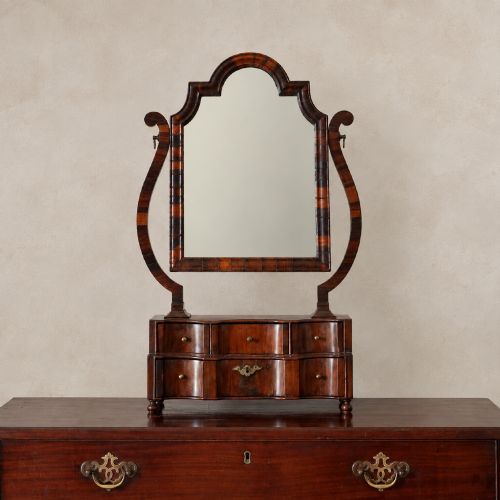
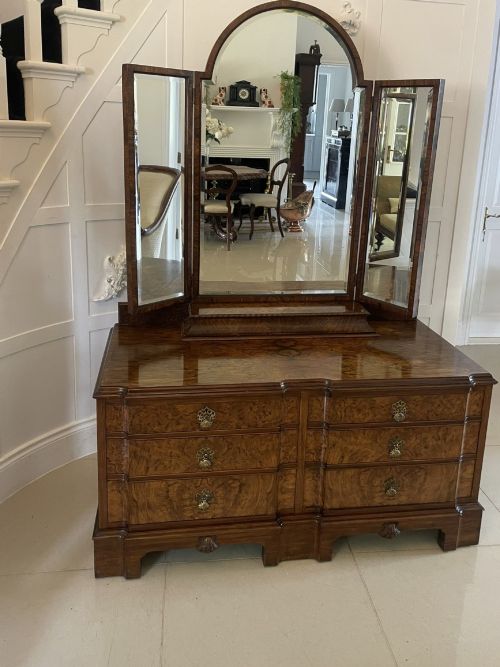
A georgian walnut table mirror sits on a chest or low stand, designed to adjust for personal grooming or dressing. The form is dominated by upright frames holding pivoting glass plates above small drawer bases.
Most examples date from the eighteenth century, spanning the reigns of Queen Anne and the Georges, alongside later revivals from the Victorian era and the nineteen-twenties. The earlier versions rely on rich figuring and simple arched crests, whilst later iterations often introduce boxwood inlay or compact drawer configurations.
What varies in quality
Quality rests in the choice of timber and the harmony of the proportions between frame and base. Well-figured burr walnut and carefully matched grain patterns distinguish the finer examples from plain stock.
The refinement of the brasswork, the neatness of the dovetails in the miniature drawers, and the subtlety of the crestings dictate the standing of a piece within its period.
Georgian Walnut Table Mirror Retail Price Guide 2026
Typical asking prices for georgian walnut table mirror among the pieces listed under this phrase on Sellingantiques today, from the lower quarter to the upper quarter. They describe what is for sale here now, not the wider market.
Many a small drawer concealed secret compartments for rouge and pins, designed for the intricate dressing rituals of the Georgian morning.
The Georgian Walnut Table Mirror Glossary
- Toilet mirror
- A small mirror designed to stand on a dressing table or chest for personal grooming. These pieces often incorporate small drawers in the base for storage.
- Swing mirror
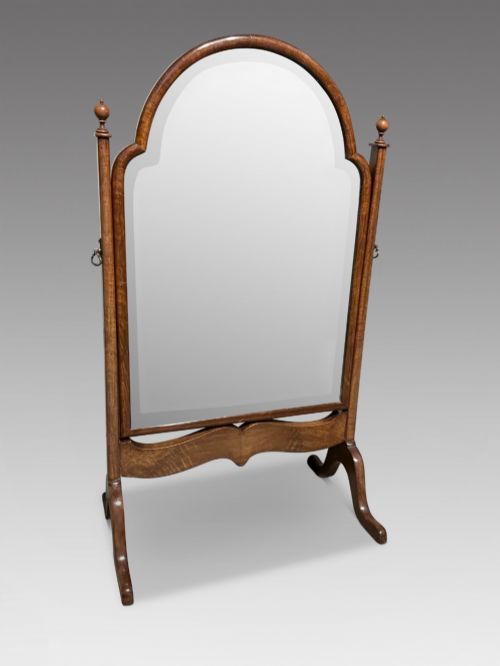
- A glass plate hung on side pivots within an upright frame, allowing the user to adjust the angle. The mechanism relies on threaded brass screws or pins.
- Boxwood inlay
- Narrow strips of pale wood inserted into contrasting dark veneers to form geometric borders or lines. This technique provides delicate surface decoration on eighteenth-century and revival pieces.
Georgian Walnut Table Mirror: Frequently Asked Questions
Where should I place a table mirror?
These mirrors suit dressing chests, sideboards, or low tables where their height can be appreciated without crowding the room.
Position them away from direct moisture to protect the walnut surfaces and the silvering on the glass.
How do I adjust the mirror angle?
Most pieces use brass side screws or pivot pins that pass through the upright arms into the frame. Tightening or loosening these fittings controls the tension on the swing glass.
Handle the frame gently by the sides rather than the crest when altering the position.
Are the mirror plates original?
Many surviving examples have replacement mirror plates due to the fragile nature of early glass over centuries of use. Original plates often display minor oxidation, foxing, or slight distortion.
Replacements are chosen to match the thickness and bevel style appropriate to the period.
How do I tell an 18th-century piece from a revival?
Eighteenth-century examples show hand-cut dovetails, older secondary woods, and wear consistent with age on the drawer runners. Revival pieces from the Victorian era or the twentieth century often display machine precision or different timber preparation.
Examine the backboards and construction joints for clues to the true age.