


Georgian Tavern Clock
These georgian tavern clock pieces are large wall-mounted timepieces driven by fusee movements, offering bold dials and rich timber cases that anchor a room.

Georgian Tavern Clock
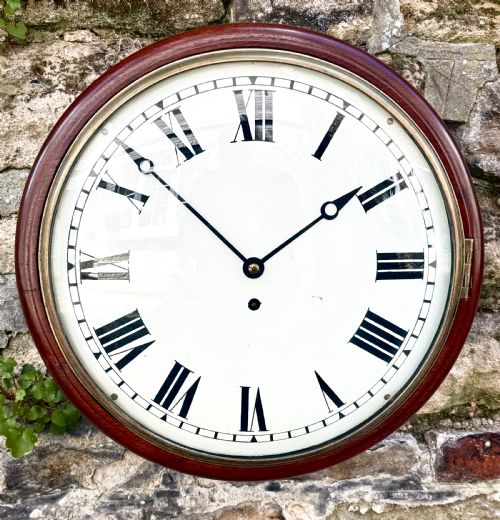
A georgian tavern clock is a substantial wall-mounted timepiece designed for public houses or large domestic spaces, emerging from the 18th century and continuing into the 19th century. These pieces feature prominent circular dials intended for easy reading across a busy room, housed within timber cases that often include a lower access door for the pendulum.
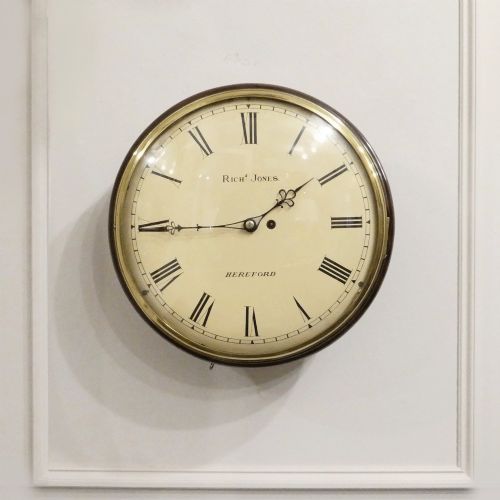
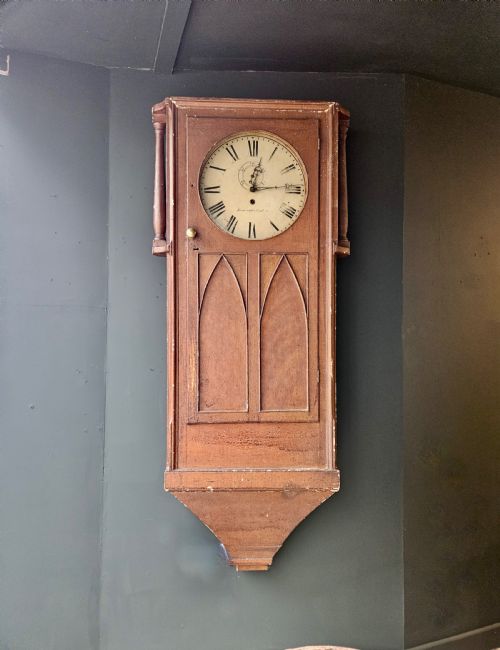
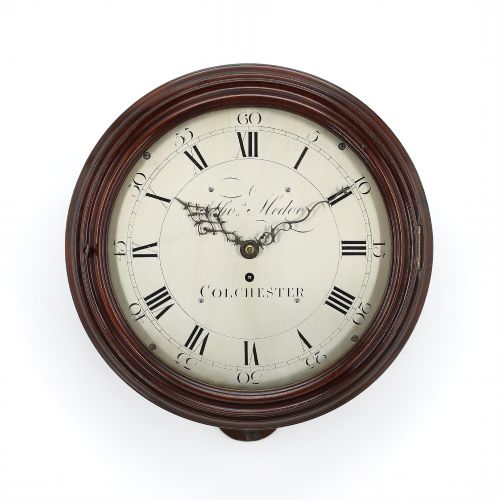
The versions most commonly met on this page span the Georgian and Regency periods, alongside mid-19th century interpretations. Formats range from traditional mahogany drop-dial wall clocks to architectural pine variants finished in original paint or regional dial clocks signed by makers from London, Colchester, Hereford, and beyond.
How they were made
Makers constructed the primary cases using solid mahogany, flame mahogany veneer, or pine, frequently pairing them with brass bezels and glass dial covers. Movements rely on iron and steel components, utilising fusee mechanisms to maintain steady tension as the driving weight descends.
Dials themselves vary in construction, executed in painted metal or solid wood, with some examples adopting octagonal or Gothic revival geometries. Surviving pieces often retain original paint surfaces on the pine bodies, recording the decorative choices of their period.
The evidence spans multiple stylistic phases including Gothic Revival alongside standard Georgian and Regency forms.
What varies in quality
Quality in a georgian tavern clock rests heavily on the crispness of the dial work and the integrity of the timber case. Superior examples display finely figured flame mahogany veneers, well-proportioned drop cases, and untouched painted metal or wooden dials bearing legible original signatures.
Lesser or heavily altered pieces may exhibit mismatched timber repairs, indistinct dial lettering, or replacement movements that dilute the historical consistency of the object. The presence of original paint surfaces or documented regional maker signatures elevates the standing of a piece considerably.
Richard Jones of Hereford·Thomas Hedge of Colchester·Robert Salmon·J. Beckett of London·Peter Debaufre
The Georgian Tavern Clock Glossary
- Fusee
- A conical pulley used in clock movements to equalise the decreasing power of the mainspring or falling weight as it unwinds. This mechanism ensures consistent timekeeping across the winding cycle.
- Drop Dial
- A clock case featuring an extended lower trunk below the circular face to accommodate a swinging pendulum. It balances the visual weight of the dial above.
- Verge Escapement
- An early type of escapement mechanism that controls the release of the gear train using a crown wheel and a verge rod with pallets. It is typical of older horology before anchor escapements became standard.
- Dial
- The visible face of the clock where numerals and hands indicate the time. In this group, dials are formed from painted metal or carved wood.
Georgian Tavern Clock: Frequently Asked Questions
Where were tavern clocks hung?
These clocks were traditionally positioned in public spaces such as coaching inns, taverns, and large assembly rooms where numerous people needed to check the time simultaneously. Their large dials and commanding presence ensured visibility across crowded or dim environments.
Over time, many of these timepieces transitioned into grand domestic halls and stairwells, where their architectural proportions suited high ceilings and expansive wall space.
How do fusee movements work?
A fusee movement employs a cone-shaped grooved pulley connected to the drive weight or mainspring via a cord or chain. As the power source unwinds, the leverage shifts to wider parts of the cone to maintain steady force on the gear train.
This clever mechanical compensation prevents the clock from losing speed as the power diminishes between windings, resulting in more accurate timekeeping.
What is a drop dial?
A drop dial clock incorporates an extended lower wooden case beneath the main circular dial face. This drop portion houses the pendulum and allows the case to maintain a balanced, pleasing geometry rather than appearing as a simple round box on the wall.
In many examples, this lower section includes a glazed or solid door for accessing the pendulum bob and regulation.
How to tell Georgian from Regency clocks?
Georgian pieces often display restrained classical proportions, solid mahogany construction, and traditional dial layouts associated with the 18th century. Details follow the prevailing tastes of the Georgian reigns up to the early 1800s.
Regency clocks, emerging around 1820, frequently introduce bolder architectural elements, octagonal dial surrounds, or refined flame mahogany veneers that reflect changing interior aesthetics.