
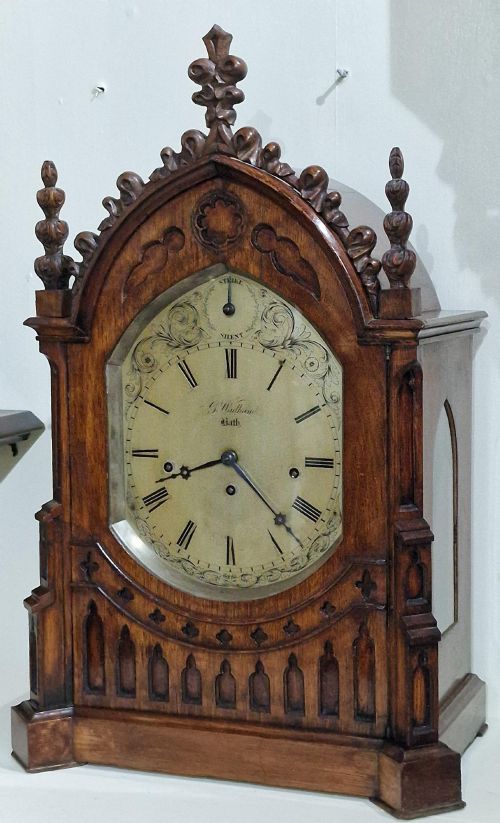
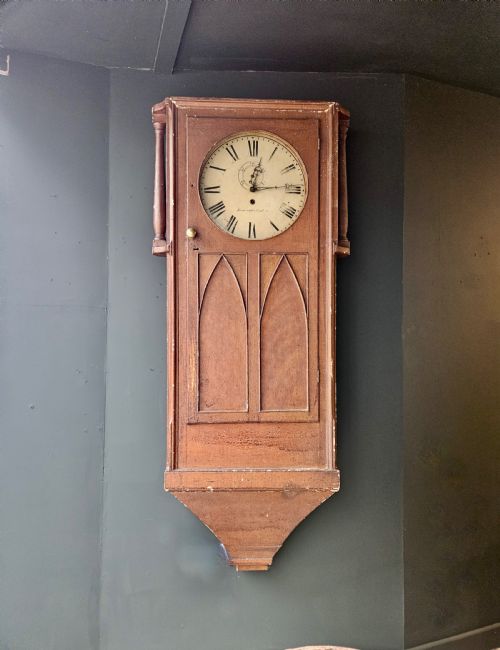
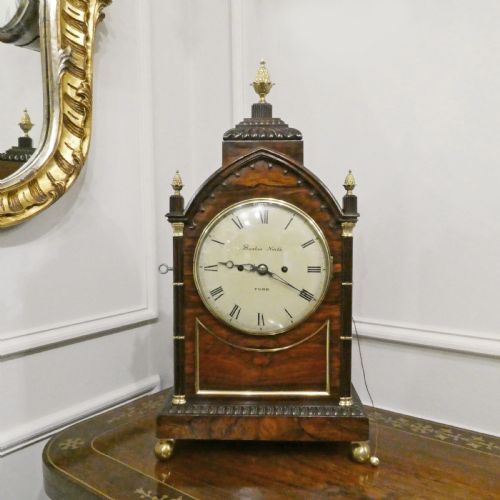


Gothic Arch Wooden Clock
A gothic arch wooden clock brings architectural drama and precision timekeeping into a room, defined by pointed arches and rich timber cases.
Gothic Arch Wooden Clock
A gothic arch wooden clock draws on architectural traditions, appearing in forms such as bracket clocks, mantel clocks, and longcase clocks. These timepieces reflect the Gothic Revival style alongside Regency and Victorian interpretations.
Buyers encounter examples spanning the Georgian, Regency, Victorian, and Edwardian eras. Each piece demonstrates how cabinetmakers adapted ecclesiastical geometry for domestic interiors.
How they were made
Cabinetmakers constructed these clock cases primarily using mahogany, rosewood, oak, and pine, often selecting flame mahogany veneers to highlight the wood grain. Brass details and glazed dial doors complemented the timber frames.
Mechanisms were built with precision, utilising brass plates, gear trains, and fusee movements to ensure accurate timekeeping. Dials frequently featured enamel for legibility, paired with fine steel or brass hands.
A small music grandmother clock brings a tune alongside the hours, proving that grand architecture can come in miniature.
What varies in quality
Quality rests in the harmony of the architectural proportions and the selection of timber veneers. Superior examples display carefully matched grain patterns on flame mahogany or rosewood cases.
The sophistication of the internal movement dictates distinction, with double or triple fusee systems and bell strikes representing high levels of horological achievement. Signed dials by established makers also elevate a piece.
George Wadham·Barber and North·Cording of London·Wilkinson Leicester·Ganthony of London·Edwards Of London·Perigal
The Gothic Arch Wooden Clock Glossary
- Fusee
- A conical pulley used in spring-driven clocks to equalise the torque of the mainspring as it unwinds. This mechanism improves timekeeping accuracy across the power reserve.
- Bracket clock
- A portable clock designed to sit on a bracket or table. These were traditionally built with carrying handles and fine movements.
- Lancet top
- A case design featuring a pointed, arched top resembling a lancet window. This shape is characteristic of Gothic Revival pieces.
- Longcase clock
- A tall pendulum clock housed in a wooden case resting on the floor. They are often referred to colloquially as grandfather or grandmother clocks.
- Quarter-striking
- A striking mechanism that sounds the quarters of the hour on bells or gongs. It adds auditory complexity to the movement.
Gothic Arch Wooden Clock: Frequently Asked Questions
What is a gothic arch wooden clock?
A gothic arch wooden clock is a timepiece housed in a timber case featuring pointed architectural arches inspired by medieval structures.
These clocks range from compact table and bracket models to tall floor-standing longcase examples produced across the eighteenth and nineteenth centuries.
How do I wind a fusee clock?
Winding a fusee clock involves inserting a key into the dial aperture and turning it gently until resistance is met. Care must be taken not to overwind the movement.
Most traditional fusee movements require a key turned clockwise, though specific instructions depend on the individual mechanism.
Where were these clocks placed?
These clocks typically sat on mantelpieces, tables, or specialised wall brackets in principal rooms of the home. Larger longcase versions stood in hallways or living spaces where their height and striking capabilities could be appreciated.
Their architectural silhouettes made them prominent decorative furnishings as well as functional objects.
How do I identify a Regency gothic clock?
A Regency gothic clock combines classical proportions with pointed arch outlines and rich timbers like mahogany or rosewood. Details often include brass inlay and architectural mouldings reflective of the early nineteenth century.
The integration of Regency design principles with Gothic Revival motifs marks this distinct stylistic group.