
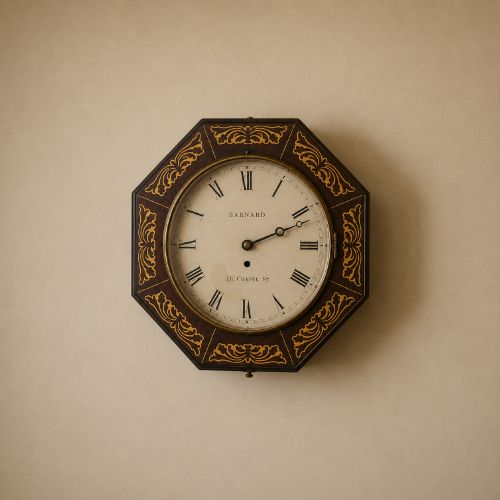


Octagonal Mahogany Wall Clock
An octagonal mahogany wall clock brings architectural geometry and dependable timekeeping into a room, favoured for its clean lines and practical wall-hanging form.

Octagonal Mahogany Wall Clock
An octagonal mahogany wall clock combines a distinctive eight-sided wooden case with a clear white dial designed for easy reading from across a room. These timepieces served utilitarian purposes in public spaces, hallways and domestic interiors throughout the nineteenth century.
The pieces appearing on this page span the Regency and Victorian periods, showcasing the evolution of case design from simple geometric frames to drop-dial variants. Most examples rely on timber framing combined with brass bezels and protective glass covers to shield the painted face.
How they were made
Cabinetmakers constructed the eight-sided cases using solid timber alongside flame mahogany veneer to create rich grain patterns across the wooden surround. Brass inlay and rosewood accents frequently highlight the perimeter of the frame on finer Regency examples.
Movements inside these cases rely on fusee mechanisms designed to maintain even tension as the mainspring unwinds, ensuring accurate timekeeping. Iron components and brass gears work together within the housing, while a pendulum regulates the beat.
The site records both standard single fusee and bell striking twin fusee movements.
What varies in quality
The refinement of the timber selection dictates much of the visual distinction across these pieces, with figured veneer and precise brass inlay marking out superior cabinetwork. Simpler housings rely on plain timber framing without decorative embellishment around the bezel.
Movement sophistication also separates standard timepieces from more complex workshop output, particularly when comparing simple time-only fusee mechanisms to twin fusee movements that strike bells on the hour.
Barnard·Kleyser of London·Webb of Frome
The Octagonal Mahogany Wall Clock Glossary
- Fusee
- A conical pulley connected to the mainspring by a chain or cord, designed to equalise the torque as the spring unwinds. This mechanism is central to achieving consistent timekeeping in traditional British wall clocks.
- Drop dial
- A clock case featuring an extended lower section below the main octagonal frame, often housing a pendulum box. This shape became popular during the nineteenth century for commercial and domestic interiors.
- Bezel
- The brass ring that holds the glass face in place over the dial, often hinged to allow access for hand-setting. On better pieces, this frame fastens securely with a locking hook.
- Regency
- A design period spanning the early nineteenth century characterised by classical restraint and classical motifs. Clocks from this era often incorporate brass inlay and sophisticated rosewood details.
Octagonal Mahogany Wall Clock: Frequently Asked Questions
How do I wind the clock?
Most of these timepieces use a key inserted directly through a small hole in the dial face to tension the mainspring.
Care should be taken not to overwind the mechanism, stopping as soon as resistance is felt.
Where should I hang it?
Choose a sturdy interior wall capable of supporting the weight of a solid timber and glass case, preferably away from damp areas or direct sunlight.
Mounting the clock securely ensures the pendulum swings evenly and the movement keeps reliable time.
What is a fusee movement?
A fusee is a mechanical device that regulates the power delivered from the mainspring to the gear train as it runs down.
This clever design compensates for the changing tension of the spring, resulting in more accurate timekeeping throughout the week.
How do I tell Regency from Victorian?
Regency clocks typically feature sharper classical proportions, often enhanced with brass inlay and fine flame mahogany veneers.
Victorian pieces tend toward drop-dial variants and heavier functional cases suited to institutional or domestic spaces.