
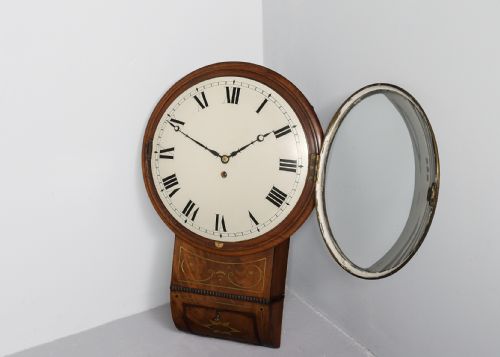
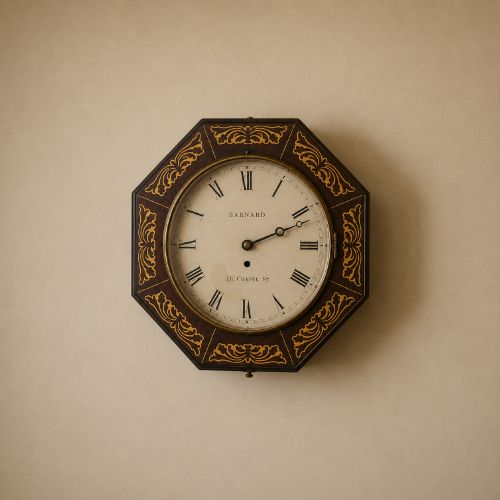
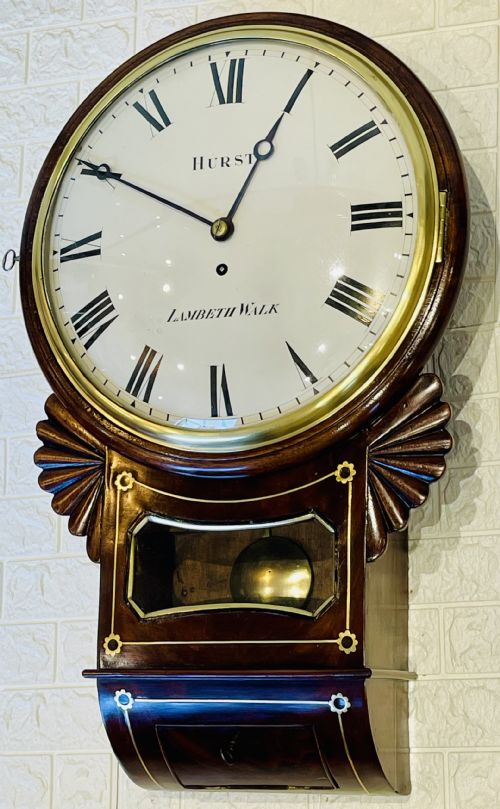
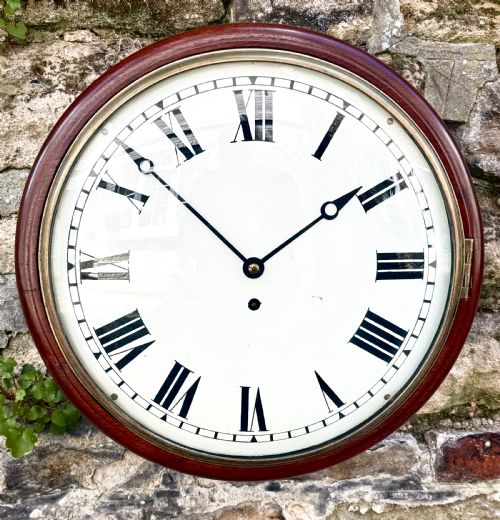
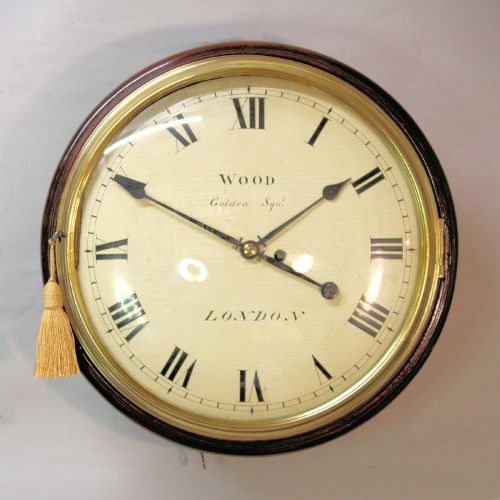


Regency Mahogany Wall Clock
A regency mahogany wall clock brings architectural presence and precise timekeeping to a room through its polished timber case and clear dial.

Regency Mahogany Wall Clock
When searching for a regency mahogany wall clock, a buyer encounters timepieces originating principally from the nineteenth century, including the Regency, Georgian, and Victorian eras. These objects take the form of wall-mounted timepieces, drop-dial clocks, and bracket clocks housed in timber cases.
The most frequent examples on this page are drop-dial fusee wall clocks and octagonal wall clocks dating from around eighteen hundred to eighteen fifty. They combine functional timekeeping with cabinetry executed in mahogany, flame mahogany veneer, and occasionally rosewood.
Makers from London, Bristol, and regional towns produced these pieces for domestic, public, and commercial interiors. The designs range from simple round wooden dials to elaborate brass inlaid cases with chisel bottoms.
Materials and Movement Construction
Cabinetmakers constructed the housing using solid mahogany and flame mahogany veneer, selecting timber for deep grain patterns and warm colour. Cases often incorporate brass inlay, glass bezels, and iron components to secure the internal mechanism.
The mechanical heart relies on a fusee movement, which standardises the pull of the mainspring to maintain steady time as the power winds down. Dials are fashioned from wood, enamel, or silvered metal, presenting clear numerals for reading time across a room.
Several makers operated out of Bristol and London, ensuring clocks travelled by coach to provincial homes.
Distinctions in Quality and Execution
Quality rests upon the crispness of the cabinetwork and the refinement of the dial execution. Finer examples display carefully matched flame mahogany veneers, precise brass inlay, and well-proportioned octagonal or round bezels.
The internal fusee movement dictates the mechanical standard, where clean, signed brass plates and original components separate superior workshop output from standard production. The clarity of the wooden or painted convex dial and the retention of original hands further define the standing of the piece.
Barnard·Cording of London·Thomas Connold of Alysham·Ganthony of London·John Wilson·Kleyser of London·Osborn of Kingsbridge·Haley and Milner·John Thwaites·Mark Bartley·J Beckett of London·H Marks·Halliday and Rich·Russell of Liverpool·James Tupman·Thomas Lindey·Edwin Fisher·George Younge
The Regency Mahogany Wall Clock Glossary
- Fusee
- A conical pulley connected to the mainspring by a chain or cord, designed to equalise the torque as the spring unwinds. This mechanism ensures consistent force is delivered to the gear train throughout the winding cycle.
- Drop-dial
- A clock case featuring a circular dial section at the top that extends downward into a rectangular or chisel-bottom trunk to accommodate the pendulum. This shape became standard for English wall timepieces.
- Convex dial
- A clock face that curves outward toward the viewer rather than sitting flat. This profile reduces glare from room lighting and improves legibility from various angles.
- Bracket clock
- A portable timekeeper designed to sit on a table, shelf, or bracket rather than hanging permanently on a wall. Many share the mahogany construction and fusee movements typical of wall-mounted variants.
- Bezel
- The ring, often made of brass or wood, that holds the glass protecting the clock face. It typically swings open on a hinge to allow hand-setting and winding.
Regency Mahogany Wall Clock: Frequently Asked Questions
How do I wind a fusee wall clock?
You insert the winding key into the dial aperture and turn it gently until the resistance stops. Care must be taken not to overwind the mechanism.
Most eight-day movements require winding once a week to maintain accurate timekeeping without straining the mainspring.
Where should I hang a wall clock?
Choose an interior wall free from dampness, direct sunlight, and excessive vibration from heavy foot traffic. A stable surface ensures the pendulum swings evenly.
Ensure the clock hangs at a comfortable eye level so the dial can be read easily and the winding aperture remains accessible.
How do I tell if a dial is original?
Examine the integration of the paint or wood grain around the numerals and winding holes. Original wooden dials display natural ageing that matches the wear on the surrounding case timber.
Look for hand-painted lettering and subtle craquelure in the finish, which indicate genuine period execution rather than modern replacement.
What is the difference between a timepiece and a clock?
A timepiece refers specifically to a mechanism that indicates the hours and minutes without a striking train. It keeps time silently throughout the day.
A clock includes an additional striking or chiming mechanism, often powered by a twin-fusee setup, that rings a bell on the hour.