


Georgian Style Serving Tray
These georgian style serving tray pieces are functional antiques built for hosting, combining mahogany, brass, and silver to anchor a room.
Georgian Style Serving Tray
When searching for a georgian style serving tray, buyers encounter a mix of timber serving trays, folding butlers trays on stands, and occasional silver or porcelain display dishes. The selection spans the eighteenth century through the Edwardian period and the early twentieth century, showing sustained appreciation for classic dining forms.
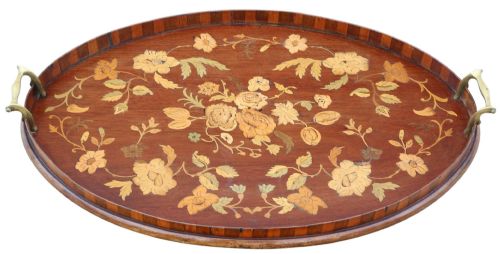
Most items on this page are nineteenth-century mahogany pieces or Edwardian revivals, often featuring inlaid satinwood or brass handles. Alongside standard serving trays, one finds related dining furniture like silver tables, bread stands, and lidded serving dishes.
The aesthetic leans heavily on Georgian and George III design principles, translated through later revival periods such as Sheraton Revival and Edwardian craftsmanship. Buyers seeking authentic period presence will find both utilitarian folding trays and decorative earthenware platters represented.
How they were made
Timbers like mahogany and satinwood provide the structural foundation for the wooden trays and tables, often enhanced by intricate marquetry inlay. Cabinetmakers utilised traditional joinery techniques to ensure the folding stands and raised rims remained durable during regular use.
Metal items incorporate sterling silver and silver-plated copper, shaped through hammering, piercing, and soldering to create bread baskets and lidded dishes. Ceramic pieces employ soft-paste porcelain and glazed earthenware decorated with cobalt pigment underglaze.
Materials range from sterling silver and soft-paste porcelain to glazed pottery bearing cobalt blue painted patterns.
What varies in quality
Quality in these items is dictated by the crispness of the timber inlay, the weight and balance of the metalwork, and the precision of the ceramic painting. Finer wooden trays show tight grain matching in the mahogany and secure, well-fitted brass handles.
Early porcelain and pottery pieces are distinguished by the clarity of the cobalt pigment transfer and the delicacy of pierced borders. Stands accompanying butlers trays demonstrate quality through stable folding mechanisms and well-turned wooden legs.
John Hunt
The Georgian Style Serving Tray Glossary
- Butlers tray
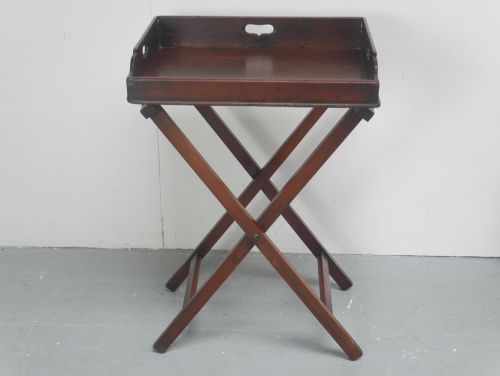
- A shallow wooden tray with hinged sides, designed to rest on a folding X-frame stand for serving. These pieces enabled servants to transport and present food efficiently.
- Marquetry
- The art of applying decorative veneer pieces in wood to a structural surface to create pictorial patterns. This technique frequently ornament satinwood and mahogany trays.
- Soft-paste porcelain
- A ceramic material composed of clay and glass frit, fired at lower temperatures than hard-paste porcelain. Eighteenth-century factories utilised this body for fine leaf dishes and tableware.
- Pierced work
- Metal or ceramic decoration featuring cut-out geometric or floral patterns. This method appears on bread baskets and serving platters to lighten the visual weight.
- Cobalt pigment
- A blue metallic oxide used to decorate pottery under the glaze. It remains stable at high kiln temperatures, producing the deep blue tones seen on blue and white dishes.
Georgian Style Serving Tray: Frequently Asked Questions
What is a butlers tray stand?
A butlers tray stand is a collapsible wooden frame designed to hold a removable tray at a convenient height for serving. They allowed households to clear dining spaces quickly.
Most stands feature folding cross-legs secured with brass hinges or wooden pins for straightforward storage when not in use.
How do I date a mahogany tray?
Dating mahogany relies on examining the timber grain, construction methods, and handling wear. Eighteenth-century examples often display deep patination and hand-cut dovetailing.
Revival pieces from the Edwardian era utilise similar woods but generally show machine-assisted preparation and cleaner internal joints.
Were these trays used for dining?
These items served various roles in formal dining, from carrying tea services to presenting bread and side dishes. Silver baskets and ceramic platters held food directly at the table.
Wooden trays functioned primarily as transport vessels between the kitchen and the dining room before being placed on stands.
What is Sheraton Revival style?
Sheraton Revival refers to late nineteenth and early twentieth-century furniture inspired by the neoclassical designs of Thomas Sheraton. These pieces incorporate light satinwood inlay and symmetrical geometry.
Makers of this period reinterpreted Georgian elegance to suit Edwardian drawing rooms and updated dining spaces.