


Georgian Style Secretaire
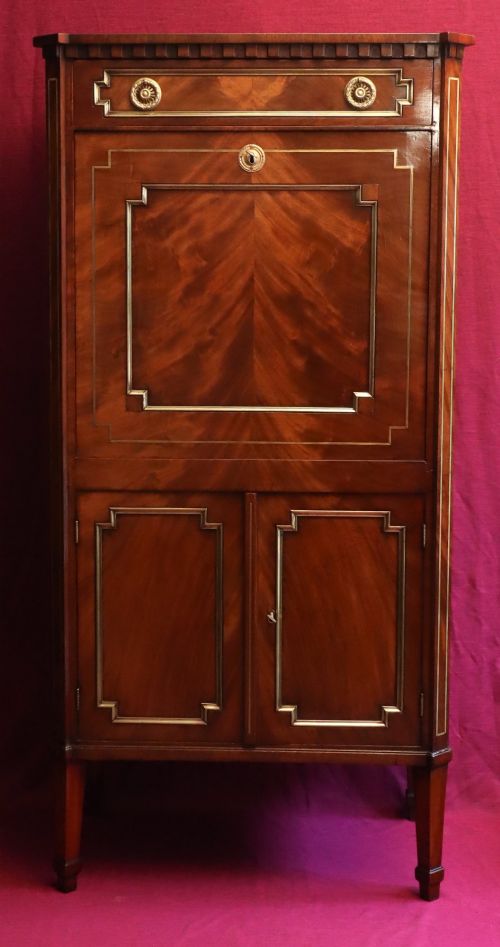
A georgian style secretaire brings refined workspace storage into a room through clever fitted writing drawers and glazed upper bookcases.
Georgian Style Secretaire
A georgian style secretaire spans functional forms including bureau bookcases, secretaire tallboys, and library writing tables designed for concealed correspondence. These pieces emerge across the eighteenth, nineteenth, and early twentieth centuries, reflecting enduring tastes for classical proportions.
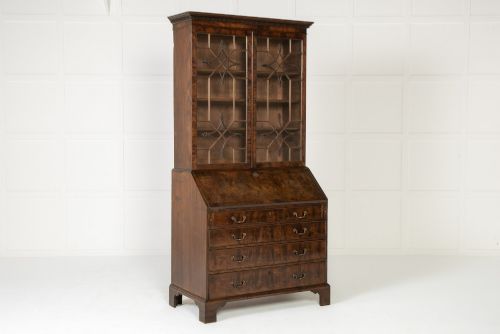
The version most commonly met on this page is the tall mahogany secretaire bookcase, featuring a fitted fall-front desk drawer beneath upper shelving. Cabinet variations range from compact satinwood writing cupboards to substantial oak chest-on-chest tallboys.
Makers and designers from the georgian era onward adapted these writing cabinets using stylistic influences such as Chippendale, Sheraton, and Regency. Such forms combine bookshelves and enclosed desks into single architectural units suited for domestic libraries and parlours.
How They Were Made
Cabinetmakers constructed these pieces primarily using solid timbers and veneers of mahogany, oak, satinwood, and padauk wood. Interiors often incorporate finer secondary woods and fitted compartments for ink and paper.
Decorative detailing relies on precision craftsmanship, utilising brass hardware, leather writing surfaces, and intricate marquetry inlays. Glazed upper doors feature timber framing arranged in geometric or arched patterns.
Georgian Style Secretaire Retail Price Guide 2026
Typical asking prices for georgian style secretaire among the pieces listed under this phrase on Sellingantiques today, from the lower quarter to the upper quarter. They describe what is for sale here now, not the wider market.
Some desks arrive with clever secret compartments hidden behind dummy pigeonholes, designed to keep private letters away from prying housemaids.
What Varies In Quality
The distinction between standard examples and the finest pieces rests on the choice of timber figures and the crispness of carved details. Superior execution shows in the balanced grain of mahogany or satinwood facades and the delicate precision of marquetry work.
Internal engineering also separates workshop outputs, particularly the complexity of secret compartments, the smoothness of fall-front desk hinges, and the integration of functional locking mechanisms.
Gillows·Edwards and Roberts
The Georgian Style Secretaire Glossary
- Secretaire
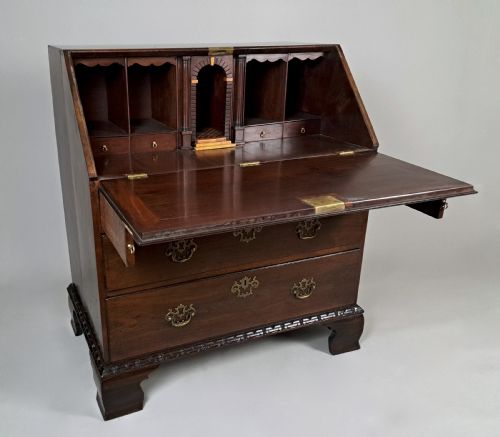
- A desk or cabinet featuring a concealed writing drawer that drops down to reveal pigeonholes and small drawers. This clever design keeps correspondence private while maintaining a clean exterior profile.
- Bureau bookcase
- A combination furniture form stacking a slant-front or pull-out writing desk beneath glazed shelving for books. It serves as both a study station and a display cabinet.
- Tallboy
- A tall chest of drawers built in two sections, sometimes incorporating a secretaire drawer within the upper chest. This vertical configuration maximises storage capacity within a compact floor footprint.
- Marquetry
- The art of applying decorative veneer pieces to a structure to create pictorial or geometric patterns. Craftsmen use contrasting woods to achieve rich surface ornamentation.
- Swan neck pediment
- A decorative architectural cornice featuring two curved scrolls rising to a central point. It frequently tops the upper casework of large eighteenth-century bookcases.
Georgian Style Secretaire: Frequently Asked Questions
What is a secretaire drawer?
A secretaire drawer appears as a standard drawer from the outside but pulls out and hinges down to form a writing surface. Inside, it reveals a series of small pigeonholes and letter drawers.
This clever mechanism allows a piece of furniture to serve multiple functions without sacrificing its traditional exterior appearance.
How do I date a mahogany secretaire?
Dating relies on examining construction methods, timber choice, and stylistic vocabulary such as Chippendale pediments or Regency brass mounts. Eighteenth-century examples typically show dense Cuban mahogany and hand-cut dovetailing.
Later nineteenth and twentieth-century revivals often incorporate softer secondary woods alongside machine-finished elements while copying earlier Georgian proportions.
Where were these pieces used?
These cabinets originally stood in libraries, withdrawing rooms, and grand bedchambers where estate owners managed correspondence and personal accounts. Their dual storage allowed books and writing materials to remain close at hand.
In modern rooms, they function well in home offices or living spaces for storing books and paperwork behind closed doors.
What timber varieties appear most often?
Mahogany forms the structural backbone for the vast majority of these cabinets, valued for its rich grain and structural stability. Satinwood and padauk wood appear in select decorative pieces.
Oak is also common in earlier utilitarian carcases and drawer linings, providing robust support beneath fine exterior veneers.