
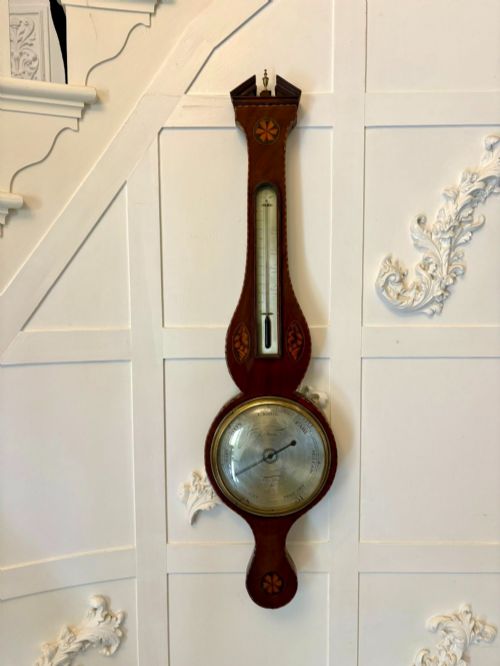


Georgian Style Barometer
These Georgian style barometer examples bring domestic weather tracking into the hallway with traditional timber cases and mercury dials.
Georgian Style Barometer
A georgian style barometer is a domestic weather glass housed in a timber case, designed to monitor atmospheric pressure through a mercury column. You meet these pieces mostly as banjo barometers or stick barometers across this selection, tracing weather patterns in domestic interiors.
The objects span periods from the eighteenth century through nineteenth century revivals into the twentieth century. Mahogany dominates the corpus, accompanied by rosewood and inlaid decoration, establishing a formal traditional appearance for the entrance hall or study.
Makers and retailers such as Prada of High Wycombe, Giana of Shrewsbury, Jenkins of Old Swindon, L Casatelli of Liverpool, J Groce of York, and Alexander Adie appear in the records. These pieces reflect both original eighteenth and nineteenth century production and later revival work from the interwar decades.
How they were made
Cases rely on dense timbers such as mahogany and rosewood, shaped into long banjo profiles or straight stick barometer trunk forms. Cabinetmakers applied decorative veneers, boxwood inlay, and marquetry enrichment to the primary wood surfaces.
Glass protects the dial faces, mercury columns, and enclosed thermometers, while brass fittings secure the scales, pointers, and hanging brackets. Skilled workshops integrated working mercury cisterns and engraved brass register plates into the timber bodies.
Materials across these listings include mahogany, rosewood, satinwood, brass, glass, boxwood, and marquetry inlay.
What varies in quality
Quality rests upon the crispness of the timber cabinetwork, the delicacy of the boxwood or marquetry inlay, and the retention of original brass fittings. Finer examples display balanced proportions in the banjo shape and well-engraved register plates rather than plain replacements.
The integrity of the mercury tube and the preservation of the original glass face distinguish superior specimens from altered ones. Workshop attribution through inscribed brass plates or dial signatures also separates standard production from named makers.
Prada of High Wycombe·Giana of Shrewsbury·Jenkins Of Old Swindon·L Casatelli Of Liverpool·J Groce York·Alexander Adie
The Georgian Style Barometer Glossary
- Banjo barometer
- A wall barometer shaped like a banjo, featuring a widened dial at the base and a long trunk containing the thermometer and humidity indicators above.
- Stick barometer
- A tall, narrow wall barometer that houses the mercury tube directly behind an exposed scale, offering a precise reading of atmospheric pressure.
- Marquetry inlay
- Decorative patterns formed by fitting contrasting veneers into the primary wood surface, frequently seen on eighteenth and nineteenth century instrument cases.
- Mercury thermometer
- A temperature measuring instrument containing mercury within a glass tube, commonly mounted alongside the main barometer scale on domestic wall instruments.
- Register plate
- The engraved brass plate behind the instrument pointer that displays the weather conditions and numerical pressure measurements.
Georgian Style Barometer: Frequently Asked Questions
What is a banjo barometer?
A banjo barometer is a domestic wall instrument shaped broadly like a banjo, featuring a circular dial at the bottom for pressure and a long vertical trunk above.
This form became popular during the Georgian period and remained a staple of hallway decoration through the nineteenth century.
How do stick barometers work?
Stick barometers measure atmospheric pressure through a vertical column of mercury sealed in a glass tube against a graduated scale.
Changes in air pressure cause the mercury level to rise or fall within the narrow trunk of the wooden case.
Where should I hang a barometer?
These instruments hang best in domestic hallways, studies, or reception rooms away from direct heat sources and strong sunlight.
Mounting them securely to a solid wall ensures the wooden case remains stable and plumb for accurate readings.
How do I identify a revival piece?
Revival barometers from the twentieth century often combine Georgian stylistic elements with machine-cut veneers and twentieth century hardware.
Examining the construction methods, backboards, and glass types helps distinguish these later interpretations from eighteenth century originals.