
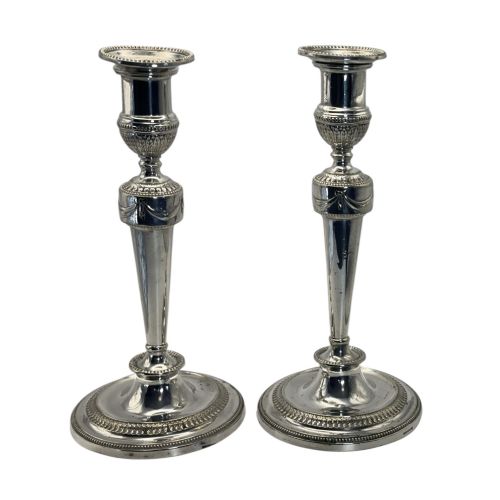
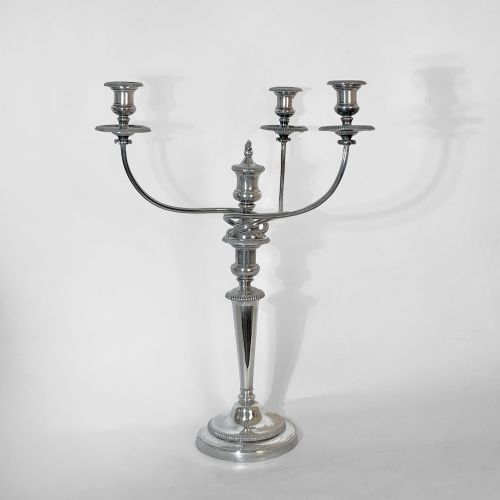
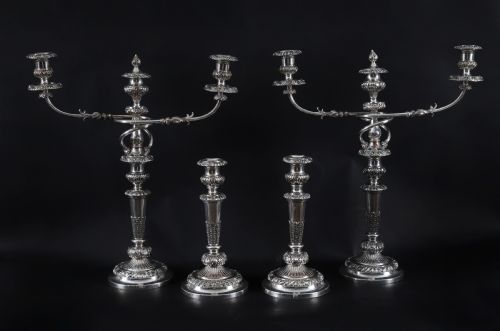
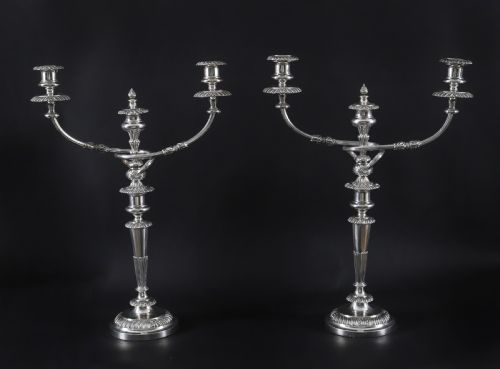


Georgian Silver Plated Candlesticks
Georgian silver plated candlesticks bring tactile warmth and period form to a room, ranging from simple chambersticks to multi-light candelabra.
Georgian Silver Plated Candlesticks
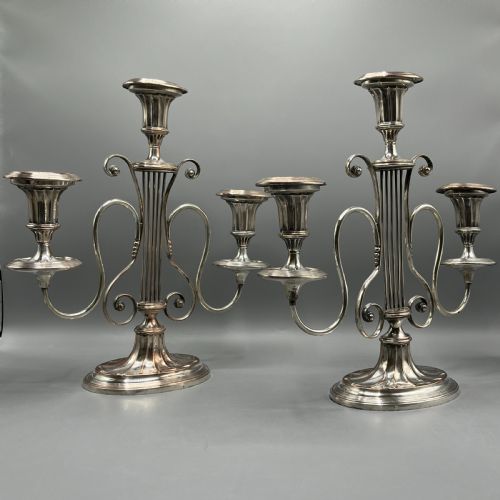
When searching for georgian silver plated candlesticks, buyers encounter lighting pieces originating primarily from the eighteenth and nineteenth centuries, alongside later revivals. The selection includes standard candlesticks, extending telescopic designs, chambersticks with fitted extinguishers, and large multi-light candelabra.
The prevailing form on this page is the pair of candlesticks or candelabra, often fashioned in styles such as George III, Regency, and Neoclassical. Makers adapted these lighting devices from solid silver prototypes, using durable base metals covered in precious metal layers.
How they were made
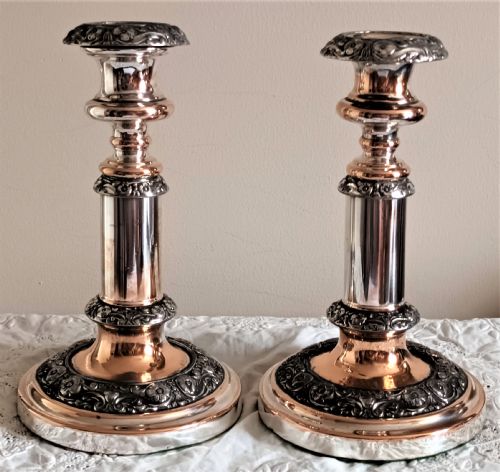
Old Sheffield plate involves fusing a thin sheet of silver to a thicker copper core, sometimes revealing the reddish base metal at the edges and seams from wear or manufacture. Later nineteenth and twentieth-century pieces utilise electroplating, known as EPNS, depositing silver onto nickel silver or other white metal alloys.
Casting and stamping techniques formed the columns, urn-shaped sockets, and square or circular bases, which were frequently weighted internally with pitch or resin for stability. Detachable nozzle sconces top many of the designs to catch melting wax during use.
Listings feature periods spanning from the eighteenth-century George III era through to 1930s Edwardian and twentieth-century production.
What varies in quality
The distinction between ordinary and superior examples rests on the crispness of the chased or stamped ornamentation and the proportion of the classical columns and bases. Heavier gauge metalwork and intact original silver layers without extensive replating separate masterwork pieces from standard production.
Mechanical integrity defines quality in extending forms, where telescopic shafts slide smoothly and hold position securely. Maker marks, when present, also influence desirability by identifying notable workshops and plating houses.
Mappin and Webb·Matthew Boulton·Elkinton and Co·Barker Ellis·Blagden Hodgson and Co
The Georgian Silver Plated Candlesticks Glossary
- Old Sheffield Plate
- A fused composite material made by melting a sheet of silver onto a copper ingot before rolling them together into thin sheets. This technique predates nineteenth-century electroplating methods.
- Sconce
- The detachable top pan or nozzle inserted into the candle socket to catch dripping wax. These components are easily lost or mismatched over the centuries.
- Telescopic
- An adjustable shaft design allowing the candlestick height to extend or shorten. Mechanics usually rely on a snug inner sleeve fit.
- Chamberstick
- A low, saucer-like candle holder fitted with a handle and frequently a conical snuffer. They travelled through dark houses before the invention of electric lighting.
- EPNS
- Electroplated Nickel Silver, a method introduced in the nineteenth century where a silver coating is applied via electrical current. It replaced the older fused plating technique.
Georgian Silver Plated Candlesticks: Frequently Asked Questions
How do I clean silver plated candlesticks?
Use a soft cloth and a gentle silver cream formulated to protect thin metal layers from harsh abrasives. Avoid aggressive rubbing that might expose the underlying copper or nickel.
Take care around stamped seams and weighted bases to prevent moisture seeping inside the internal filling materials during polishing.
What is the difference between Old Sheffield Plate and EPNS?
Old Sheffield Plate is created by physically fusing silver and copper together under heat before rolling. This older method produces a distinct edge where the copper base shows beneath the silver.
EPNS uses an electrical current to deposit silver onto a white metal alloy base. This later technique lacks the characteristic copper bleed of fused plate.
Are telescopic candlesticks genuine period items?
Many extending telescopic designs date from the late eighteenth and early nineteenth centuries. Makers engineered them for versatility on dining tables and desks.
Check the inner sliding mechanism and proportions to confirm period manufacture rather than later reproduction work.
Why do some candlesticks have removable nozzles?
Removable nozzle sconces catch dripping wax during use and protect the main socket structure. They made cleaning easier when wax accumulated heavily.
Because they lift out independently, replacement sconces are common, so matching pairs require careful inspection.
How were chambersticks used historically?
Chambersticks served as portable lighting for navigating unlit hallways and bedrooms at night. The wide saucer base caught melting wax, while the loop handle offered a secure grip.
Many examples include a small conical snuffer resting in a dedicated clip on the pan.