
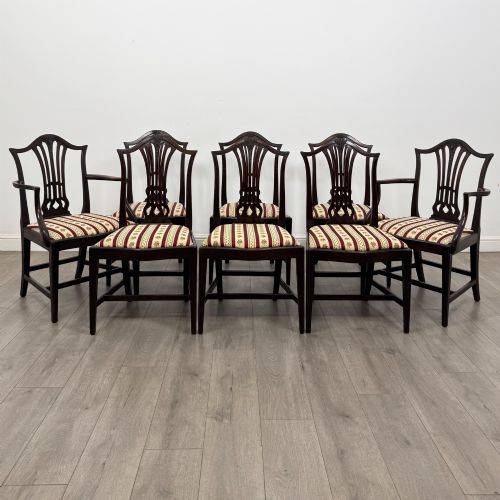
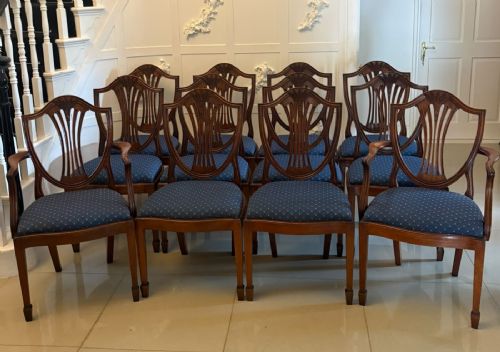
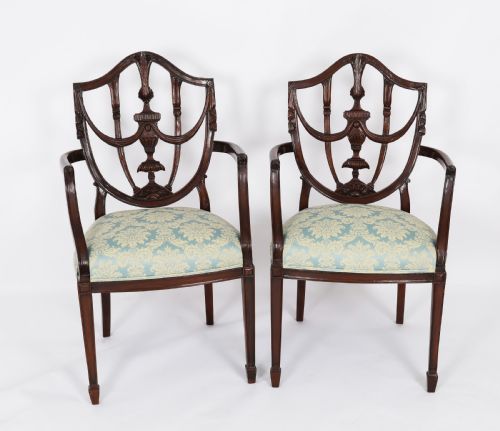
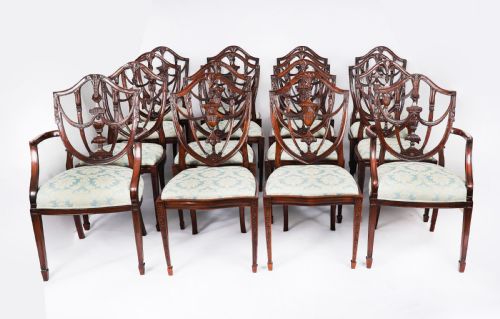


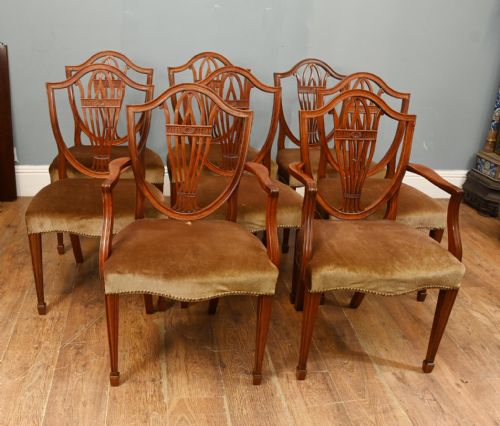


Georgian Shield Back Armchair
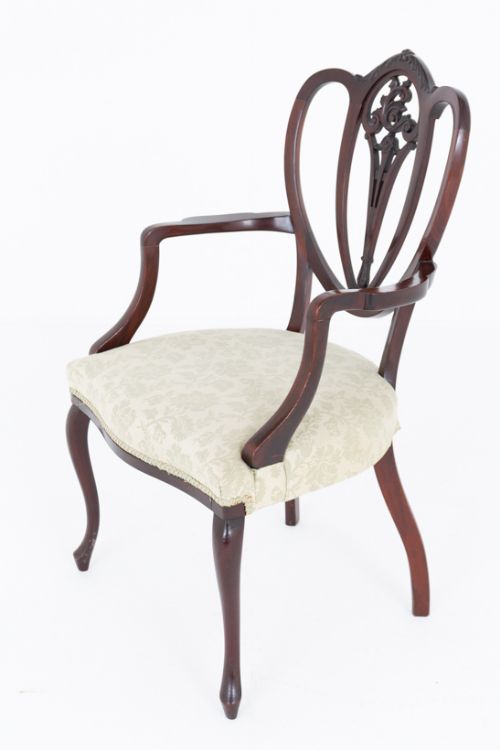
A georgian shield back armchair brings architectural grace to a room through its characteristic carved timber splat.
Georgian Shield Back Armchair
A georgian shield back armchair is a seating form defined by a backrest shaped like an inverted shield or heart, prominent in dining and carver chairs from the eighteenth century onwards. These seating options emerge from periods spanning the eighteenth century, the georgian era, and later revivals from the nineteenth and twentieth centuries.
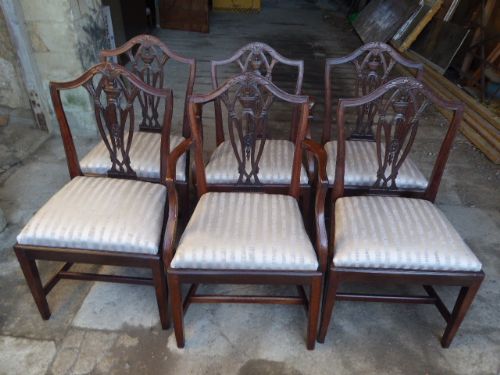
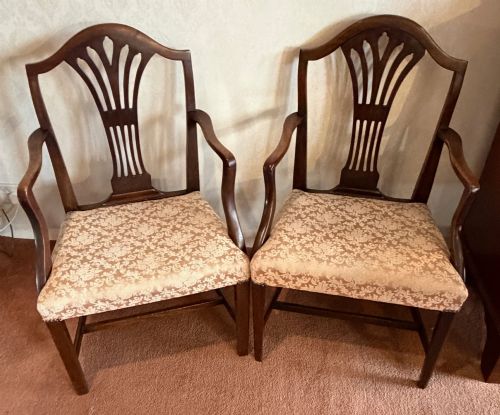
The pieces on this page encompass authentic eighteenth-century examples alongside later revivals including Hepplewhite Revival, Federal Revival, and Sheraton styles. Buyers encounter single armchairs, pairs, and larger suites incorporating carver chairs alongside matching dining chairs.
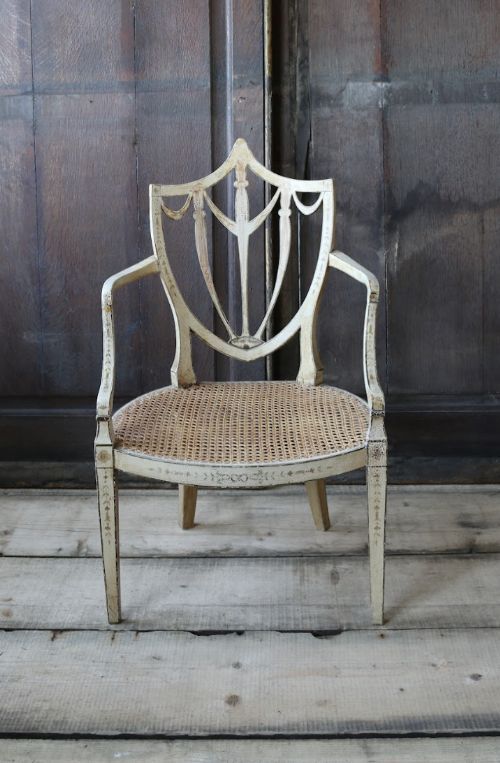
Forms include open armchairs, carvers with upholstered seats, and painted or polished timber frames. Mahogany and oak serve as the primary woods, often paired with fabric, leather, or velvet upholstery.
Assessing quality and craftsmanship
Quality rests upon the crispness of the carving within the shield splat and the structural integrity of the arm supports. Finer examples display deeply pierced woodwork and harmonious proportions between the curved back and the timber frame.
The choice of primary timber and the execution of secondary decorative elements, such as polychrome painting or brass upholstery accents, distinguish standard production from superior craftsmanship.
Listings feature mahogany and oak timbers, alongside upholstery in fabric, leather, velvet, and brass.
The Georgian Shield Back Armchair Glossary
- Shield back
- A chair back shaped like an inverted shield or spade, popularised in the late eighteenth century by designers such as Hepplewhite and Sheraton. This silhouette defines the visual identity of these seating forms.
- Carver
- An armchair, typically designed with open arms to sit at the head of a dining table or alongside matching side chairs. These pieces often pair with larger sets of dining chairs.
- Hepplewhite
- A neoclassical style associated with furniture designer George Hamilton Hepplewhite, characterised by elegant curved lines, shield backs, and tapered legs. Revival interpretations recreate these eighteenth-century aesthetic principles.
- Sheraton
- A neoclassical furniture style of the late eighteenth century defined by strict geometry, straight lines, and refined inlay work. Sheraton shield backs often feature delicate rectilinear framing within the curved outline.
- Polychrome
- Painted decoration utilising multiple colours to adorn the timber frame of a chair. This surface treatment appears on select neoclassical and revival armchairs.
Georgian Shield Back Armchair: Frequently Asked Questions
What is a shield back armchair?
A shield back armchair is a seating form featuring a backrest carved in the shape of an inverted shield. This design became popular during the late eighteenth century.
Craftsmen often incorporated pierced splats, urn motifs, and sweeping curves into the wooden frame.
How do I date a shield back armchair?
Dating relies on examining the timber, construction methods, and stylistic cues present in the carving. Eighteenth-century originals exhibit hand-cut joints and period joinery techniques.
Revival pieces from the nineteenth and twentieth centuries often employ machine-assisted manufacturing while imitating earlier Georgian aesthetics.
Where were these chairs used?
These armchairs served primarily as principal seating around dining tables or within formal reception rooms. Carver versions were positioned at the ends of dining tables alongside matching side chairs.
Their decorative backs allowed them to sit visibly against walls when not in use around a table.
What is the difference between Hepplewhite and Sheraton styles?
Hepplewhite designs favour flowing curves, rounded shield backs, and graceful serpentine lines. The overall aesthetic leans towards organic shapes and delicate openwork splats.
Sheraton designs incorporate straighter geometry, rectilinear framing within the shield outline, and crisp neoclassical detailing.
How should I care for antique upholstery?
Care involves gentle vacuuming with a soft brush attachment to remove dust from fabric, leather, or velvet surfaces. Avoiding direct sunlight prevents the fading of both the textile coverings and the timber finish.
Conditioning leather and dusting polished mahogany maintains the structural and visual integrity of the chair.