
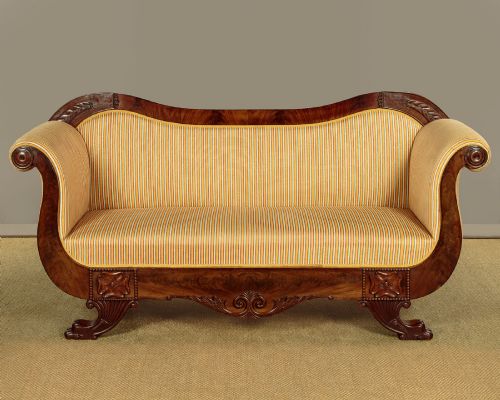

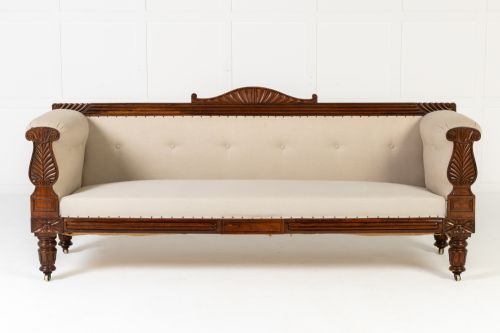


Georgian Scroll Arm Settee
A georgian scroll arm settee brings architectural grace to a room, offering deep seating framed in rich timbers and scrolled woodwork.
Georgian Scroll Arm Settee
A georgian scroll arm settee combines generous proportions with sculptural ends, typically seen in forms designated as sofas, double ended sofas, and chaise longues. These seating pieces emerge predominantly from the Regency period and the wider nineteenth century, drawing on Grand Regency, William IV, and George II revival styles.
The pieces you encounter on this page span genuine early nineteenth-century examples alongside later nineteenth-century interpretations and twentieth-century revivals. Mahogany and rosewood dominate the frames, often complemented by simulated rosewood finishes and brass details.
Makers and workshops constructed these settees for formal libraries and country house drawing rooms alike. They serve today as commanding central seating arrangements that anchor traditional and eclectic interiors.
What varies in quality
The caliber of a georgian scroll arm settee rests in the crispness of the carved wooden scrolls and the integrity of the timber framing. Superior examples display substantial mahogany or figured rosewood without structural compromise.
Proportion and scale distinguish finer pieces, particularly where lyre shapes or double-ended symmetry are executed with architectural balance. The quality of secondary woods and the retention of original brass mounts further elevate an individual settee.
Listings span the Regency period, nineteenth century, and twentieth-century revivals, utilising mahogany, rosewood, simulated rosewood, leather, and fabric.
The Georgian Scroll Arm Settee Glossary
- Scroll end
- A sweeping, curved wooden terminal on a sofa or settee that rolls outward or inward. It defines the profile of Regency seating.
- Double ended sofa
- A seating form featuring symmetrical scrolled ends of equal height at both sides. This design allows a person to recline comfortably from either direction.
- Simulated rosewood
- A painted surface treatment that mimics the dark grain and warm tones of genuine rosewood on a more common timber base. Cabinet makers used this technique during the nineteenth century.
- Lyre shaped
- A decorative motif resembling an ancient Greek musical instrument, incorporated into the wooden frame supports of sofas. This shape reflects classical Regency taste.
Georgian Scroll Arm Settee: Frequently Asked Questions
What is a scroll arm settee?
A scroll arm settee is a traditional upholstered seat featuring prominent curved wooden terminals at the ends. These pieces date primarily from the Regency and nineteenth-century periods.
They were designed for formal reception rooms and country houses, providing both upright seating and a surface for reclining. The wooden frames showcase cabinet-making skills through carved mahogany or rosewood.
How do I identify a Regency sofa?
Regency sofas are identified by classical revival motifs, symmetrical scroll ends, and the use of dark timbers like mahogany and rosewood. Brass castors and lyre-shaped frame supports also point to this era.
Later nineteenth-century and twentieth-century revivals often emulate these specific characteristics. Examining the timber construction and frame joinery helps distinguish period originals from later interpretations.
Where should I place a settee?
These settees work well as freestanding statement pieces in large living rooms, libraries, or wide hallways. Because many feature finished backs and symmetrical scroll ends, they do not need to sit flat against a wall.
Pairing a scroll arm settee with open floor space allows the architectural woodwork and upholstery shape to remain visible from multiple angles in the room.
What fabrics suit these antiques?
Traditional upholstery materials include patterned fabric, hessian foundations, and deep leather hides as seen on nineteenth-century library and Chesterfield styles. Selecting a textile often depends on whether you prefer a formal period aesthetic or a country house look.
Many listings on this page require reupholstery, giving you the opportunity to choose fabrics that match your interior design scheme.