


Georgian Satinwood Card Table
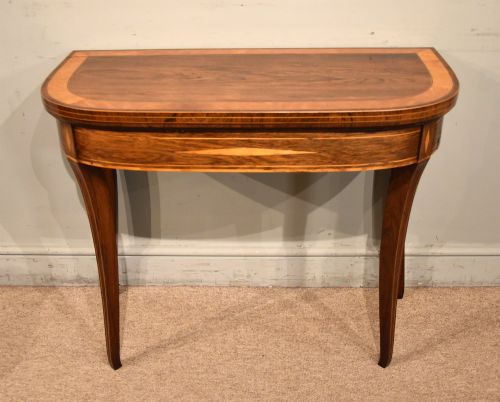
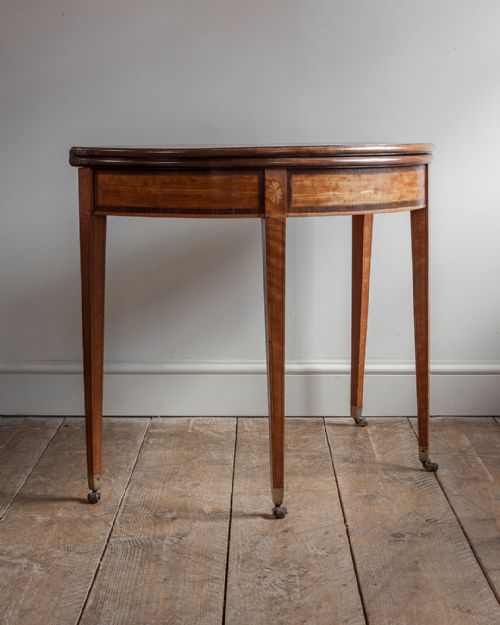
A georgian satinwood card table offers a folding or turn-over top designed for evening play, combining figured timber with refined proportions.
Georgian Satinwood Card Table
When you search for a georgian satinwood card table, you encounter pieces intended for domestic card games and social gatherings during the eighteenth and early nineteenth centuries. The pieces on this page span the georgian, regency, and later revival periods, encompassing demi-lune, D-shaped, and serpentine forms with hinged tops that fold over to create a playable surface.
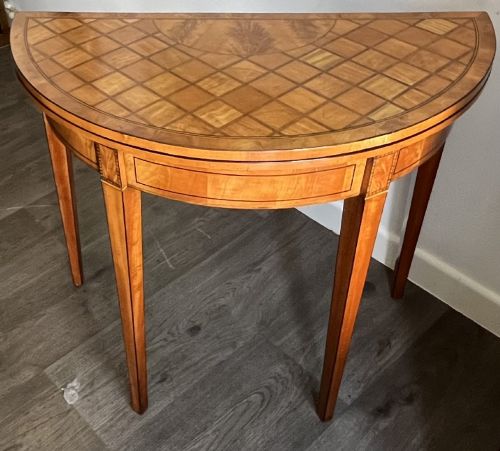
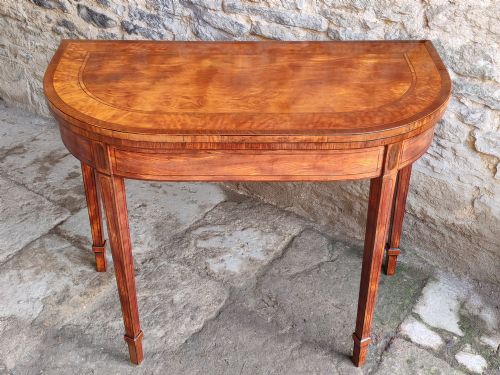
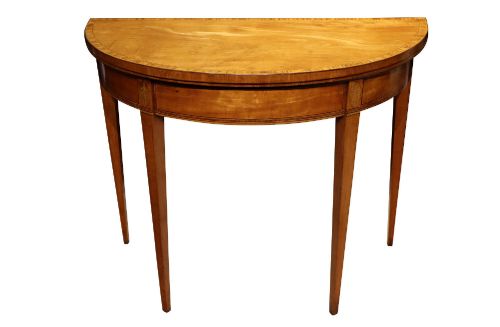
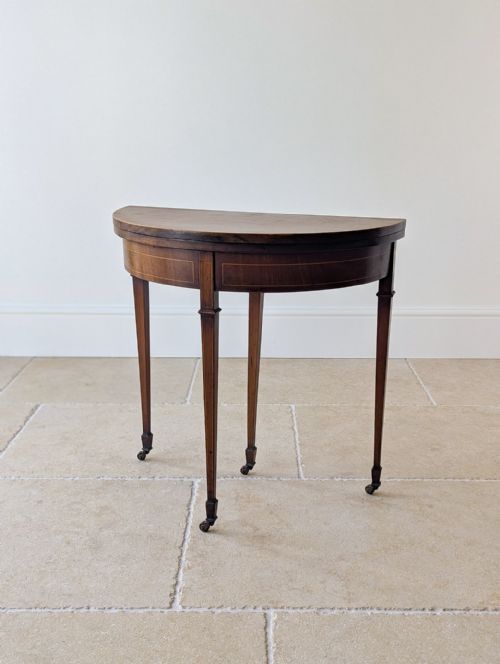
The version you are most likely to meet here dates from the georgian period or follows its neoclassical design principles, frequently utilising a demi-lune or semi-circular shape. These tables often incorporate contrasting crossbanding and delicate inlay, reflecting the prevailing taste of the eighteenth century and subsequent revival eras.
How They Were Made
Cabinet makers constructed these tables using a carcase of mahogany or oak as a stable foundation, applying satinwood as a face veneer for its luminous golden grain. They enhanced the surfaces with contrasting timbers such as rosewood, ebony, kingwood, and boxwood, creating geometric borders and panel details.
Craftsmen employed marquetry and parquetry techniques to set intricate floral or geometric patterns into the satinwood ground. Many examples also incorporate fine stringing lines of dark wood, hand-painted decoration, or brass inlay to accentuate the edges of the fold-over top and legs.
Listings feature georgian, regency, and Edwardian periods, utilising satinwood, mahogany, rosewood, and brass materials.
What Varies in Quality
The distinction between tiers of quality rests upon the crispness of the cabinet work, the selection of the timber figures, and the precision of the inlay. Superior pieces display book-matched satinwood veneers and complex multi-timber crossbanding that remains flush with the surrounding wood.
Another measure of distinction lies in the architectural harmony of the frame and the retention of original hinging mechanisms and brass fittings. Tables that exhibit hand-painted detailing or intricate marquetry executed with sharp definition stand apart from plainer variants.
The Georgian Satinwood Card Table Glossary
- Demi-lune
- Having a half-moon shape with a flat straight edge for placing against a wall when folded closed. This form is characteristic of late eighteenth-century card tables.
- Crossbanding
- A narrow strip of veneer applied around the border of a table top with the grain running perpendicular to the centre panel. It frames the primary satinwood surface.
- Marquetry
- The art of forming decorative patterns using thin pieces of wood veneer of different colours and grains. It frequently appears on the tops of higher-grade tables.
- Stringing
- Thin inlaid lines of contrasting light or dark timber used to outline panels and legs. This technique defines the edges of geometric shapes on the woodwork.
- Gateleg
- A table action where a hinged leg swings outward from the frame to support the opened leaf. This provides stability when the top is unfolded for games.
Georgian Satinwood Card Table: Frequently Asked Questions
How did people use a card table?
These tables stood against a drawing room wall when not in use, displaying ornaments or candles. When evening arrived, the hinged leaf unfolded to reveal a baize-lined surface for card games.
After play concluded, the top folded back down to save space. They served as versatile pieces of social furniture in domestic interiors.
What is satinwood?
Satinwood is a dense, lustrous tropical timber known for its golden-yellow colour and reflective grain. Cabinet makers prized it during the georgian period for decorative veneering.
Because the timber is difficult to work in solid form, it appears primarily as fine surface veneers. It contrasts effectively with darker woods like mahogany and ebony.
Where should I place a card table?
These tables suit hallways, landings, or living rooms where the closed top can sit flat against a wall. Their compact depth allows them to fit into narrow spaces without obstructing movement.
Keeping them away from direct sunlight and strong heat sources protects the delicate satinwood veneer from fading and splitting. Placing them on level flooring ensures the folding leaves align correctly.