


Georgian Rosewood Tea Chest
A georgian rosewood tea chest is a refined timber box made to secure precious tea leaves, bringing period elegance to any drawing room.
Georgian Rosewood Tea Chest
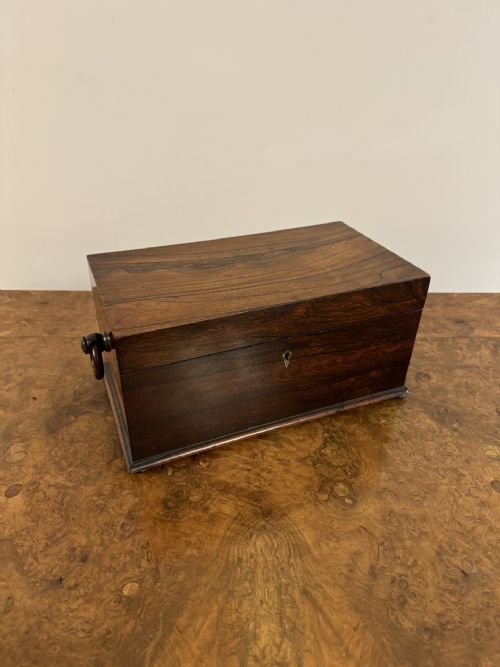
A georgian rosewood tea chest is an enclosed receptacle designed for the safe storage of dry tea leaves when tea was an expensive commodity. The examples seen here predominantly date from the Regency and Georgian eras, spanning the early nineteenth century alongside occasional Victorian interpretations.
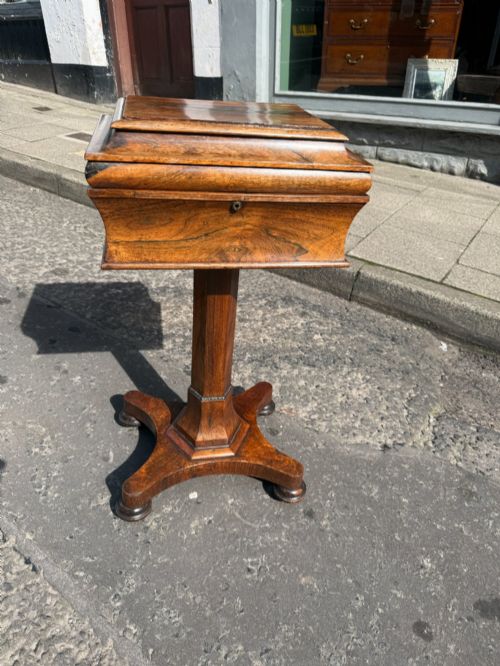
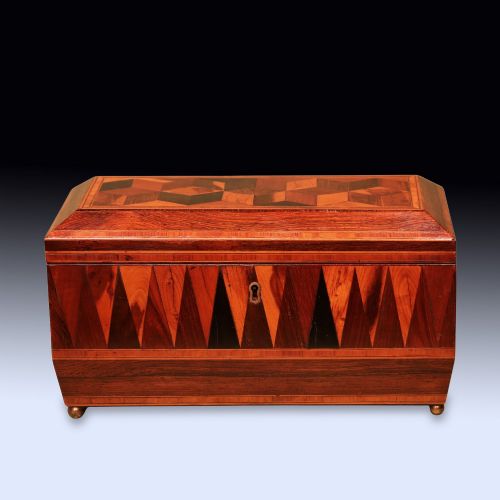
Buyers will encounter various forms, most commonly oblong, tapered, or architectural sarcophagus shapes resting on small feet. Some variants arrive mounted upon dedicated stands as teapoys, whilst others remain as tabletop boxes complete with internal lidded compartments.
How they were made
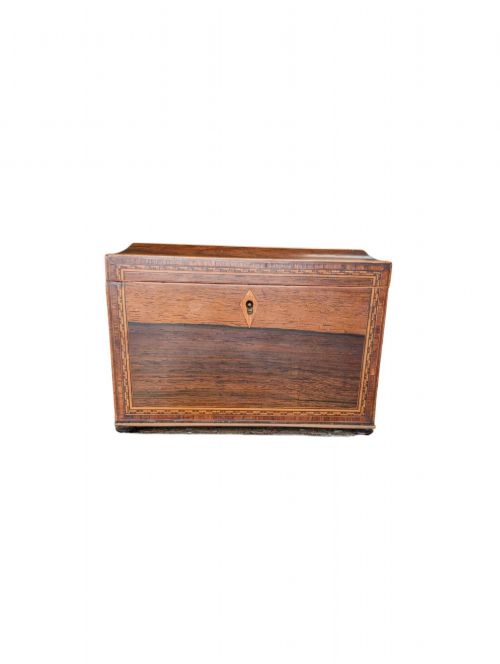
Cabinet makers utilised dense rosewood timber as the primary carcass, frequently embellishing the exterior surfaces with contrasting veneers and delicate stringing. Decoration relies upon precision inlays of brass, boxwood, satinwood, and mother of pearl, alongside detailed parquetry and Tunbridge Ware motifs.
Internal arrangements typically feature fitted wooden tea canisters with matching lids, sometimes accompanied by a central glass mixing bowl. Functional hardware such as brass lion mask handles and working locks with keys complete the construction.
Listings span the Regency, Georgian, and Victorian periods, utilising rosewood combined with brass, mother of pearl, and boxwood.
What varies in quality
The standard of a georgian rosewood tea chest depends heavily on the complexity of its exterior ornamentation and the precision of its brass or wood inlay. Pieces exhibiting intricate parquetry, pictorial mother of pearl work, or elaborate sarcophagus forms demonstrate superior craftsmanship.
Completeness dictates much of the desirability, particularly the retention of original internal lidded canisters and functional locking mechanisms. The grain quality of the rosewood timber and the crispness of decorative brass mounts further separate standard examples from finer works.
The Georgian Rosewood Tea Chest Glossary
- Sarcophagus form
- A box shape featuring a domed or stepped lid resembling a stone coffin, popular for larger tea caddies during the Regency period.
- Teapoy
- A freestanding piece of furniture comprising a tea chest mounted upon a central pillar and platform base.
- Tunbridge Ware
- A type of decorative woodwork characterised by tiny mosaic tiles formed from various coloured woods to create pictorial patterns.
- Parquetry
- Geometric patterns formed by the fitting together of small strips of veneer onto a wood surface.
- Stringing
- Thin lines of contrasting wood inlay used to outline panels and edges on furniture.
Georgian Rosewood Tea Chest: Frequently Asked Questions
What is a teapoy?
A teapoy is a tea chest elevated on a standalone pedestal base rather than designed purely for a tabletop.
These pieces often incorporate interior compartments for multiple varieties of loose leaf tea.
How do I date a tea caddy?
Dating relies upon stylistic markers such as brass inlay, sarcophagus proportions, and woods like rosewood and satinwood.
Most surviving examples originate from the Regency and Georgian periods of the early nineteenth century.
Were these boxes locked?
Tea was a highly valuable commodity in the Georgian era, requiring secure storage against theft by domestic staff.
Original working locks and matching keys are frequently found integrated into the front of the chest.
What was inside a tea chest?
The interior typically contained two or three fitted wooden caddies or canisters to separate different tea leaves.
Some layouts also included a circular glass bowl in the centre used for blending leaf varieties.