


Georgian Rosewood Card Table
A georgian rosewood card table provides a folding surface for parlour games, appearing primarily in Regency and George III designs.
Georgian Rosewood Card Table
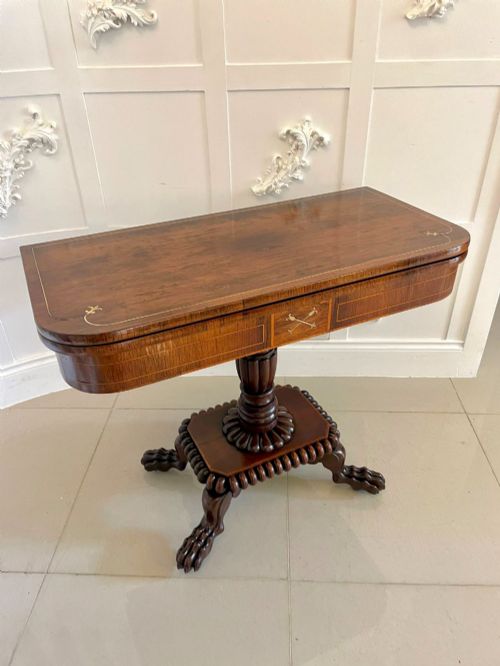
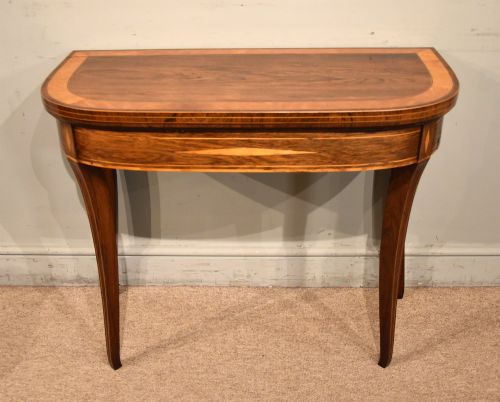
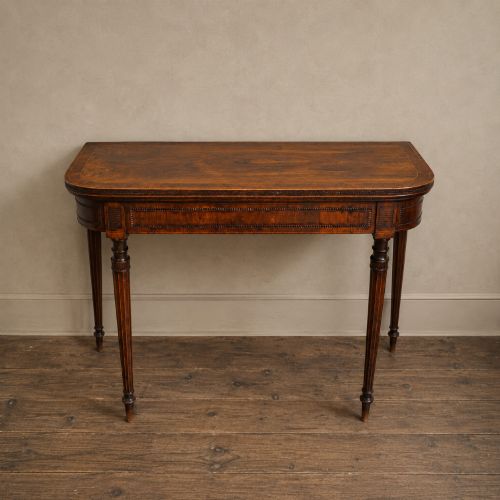
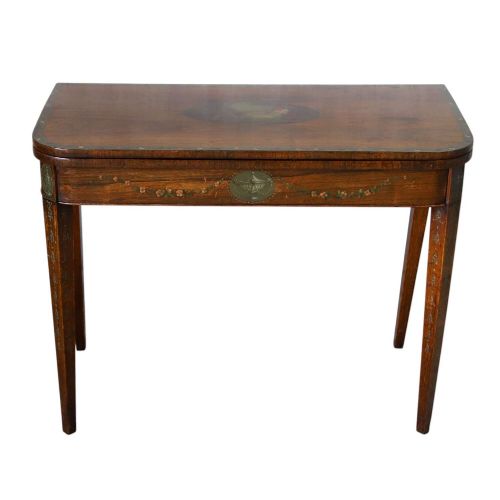
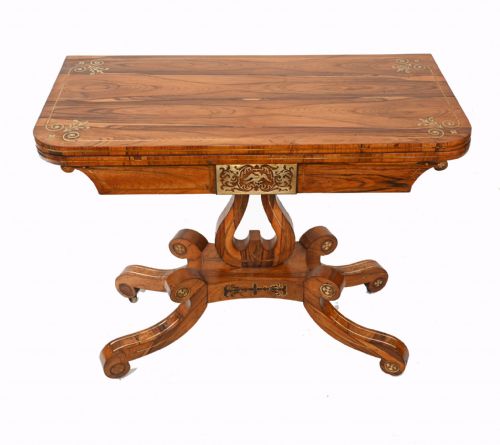
A georgian rosewood card table brings a folding top and a lined playing surface into domestic rooms. These pieces serve for evening pastimes, functioning closed as console or side tables against a wall. The examples on this page emerge predominantly from the Regency and George III periods, displaying rectangular or demilune forms.
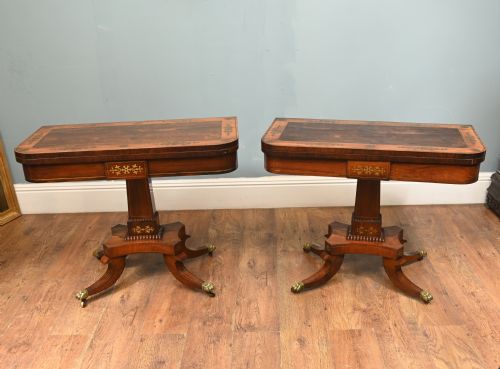
Buyers encounter fold-over leaves that swivel or hinge open to reveal baize surfaces for cards, chess, and backgammon. Many specimens incorporate crossbanding in satinwood, burr yew, or mahogany alongside timber structures. The range includes single tables and matched pairs raised upon pillar pedestals or sabre legs.
How they were made
Cabinet makers built these tables using dense rosewood timbers, frequently applying veneers over secondary woods and adding crossbanding in contrasting satinwood or burr yew. Decorative detailing relies upon brass inlay, brass mounting, and fine boxwood lines embedded directly into the surfaces. Some variants integrate painted decoration or gilding upon the timber frames.
The folding mechanisms depend on split swivelling tops or simple hinges that support the rotating leaf when open. Lower supports take the form of central pillars with platform bases or outward-curving sabre legs. Interior wells beneath the folding tops often store gaming pieces.
Card tables often conceal shallow timber wells beneath their folding tops, originally intended to harbour rogue dice and stray gaming counters.
What varies in quality
The distinction between tiers rests upon the precision of the brass inlay and the selection of figured veneers. Finer pieces display crisp boxwood and satinwood crossbanding that integrates cleanly with the surrounding rosewood grain, whereas simpler versions omit complex stringing.
Structural harmony also separates workshop outputs, visible in the stability of the swivelling top and the carving upon the pedestal supports. Tables featuring matched pairs or specialised inserts like chess and backgammon boards represent more ambitious commissions than standard fold-over examples.
Gillows
The Georgian Rosewood Card Table Glossary
- Crossbanding
- A narrow strip of veneer laid perpendicular to the surrounding grain along the edges of a table top. This technique frames the primary wood and provides a distinct visual border.
- Baize
- A coarse woollen fabric used to line the playing surface of games tables. It offers a soft texture designed to cushion cards during play.
- Demilune
- A half-moon shape used to describe tables with a curved front and a flat back edge. These pieces sit flush against a wall when closed.
- Sabre leg
- An outward-curving leg of uniform or tapering section that flares gracefully from the base of the table. This form appears frequently on Regency furniture.
- Satinwood
- A pale, lustrous timber imported from the tropics and utilised for contrasting inlay and banding. Cabinet makers paired it with dark rosewood to create striking visual borders.
Georgian Rosewood Card Table: Frequently Asked Questions
How do I use a card table today?
These tables function effectively as console or side furniture against a wall when the top remains folded shut. Opening the leaf reveals a surface suitable for lamps, drinks, or occasional board games.
Positioning the piece in a drawing room or hallway highlights the figured rosewood grain and inlay work. The folding mechanism allows the furniture to adapt quickly between display and utility.
What is inside a games table?
Lined baize surfaces occupy the interior of a georgian rosewood card table to provide friction for playing cards. Some variants include specialised inlaid wood boards for chess and backgammon.
Shallow timber compartments often sit beneath the folding leaves to store counters, dice, and cards. These concealed spaces kept gaming equipment close at hand during evening entertainment.
How do I tell Regency from George III?
George III pieces generally adhere to neoclassical proportions with straight lines and restrained brass or satinwood stringing. Regency examples introduce bolder pillar pedestals, platform bases, and more extensive brass inlay.
Cabinet makers during the Regency period also favoured sweeping sabre legs and contrasting crossbanding in burr yew. Overlapping stylistic traits mean transitional pieces often combine elements from both periods.
Are these tables sturdy enough for daily use?
The pivoting and hinged mechanisms require gentle handling when opening the heavy rosewood leaves. Supporting the rotating top properly prevents strain on the original pivot joints.
Routine domestic placement works well provided the environment avoids extreme humidity shifts that affect timber veneers. Normal care preserves the structural integrity of the pedestal and leg assemblies.