

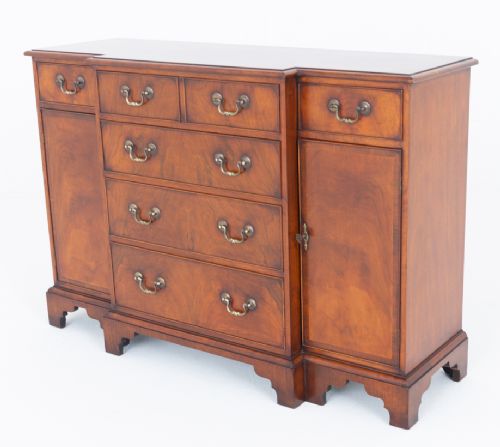


Georgian Revival Sideboard
These pieces unite Georgian form with later craftsmanship, offering a georgian revival sideboard to anchor a dining room with classical proportion and generous storage.
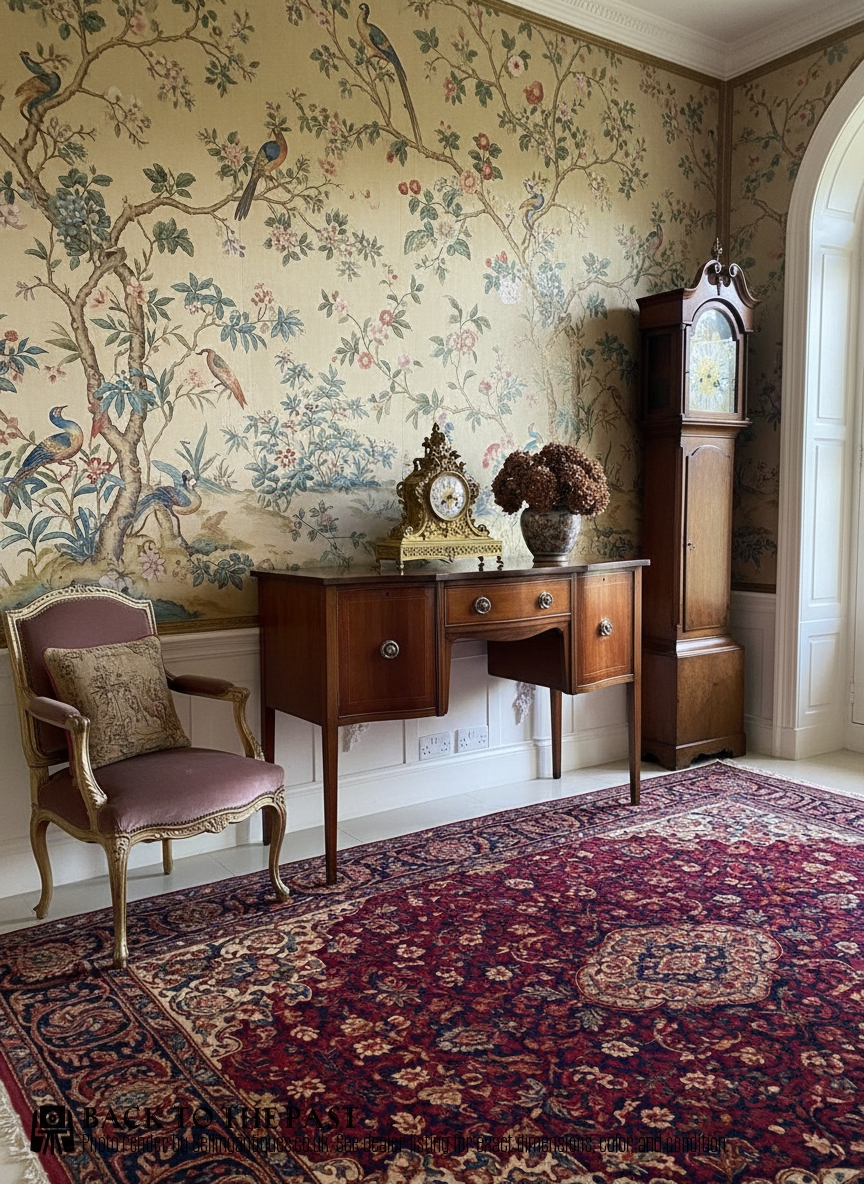
Georgian Revival Sideboard
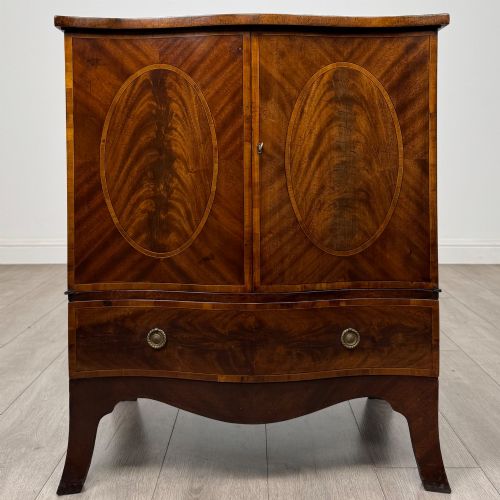
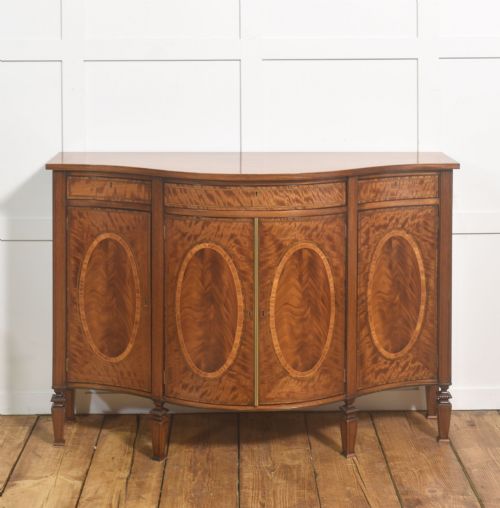
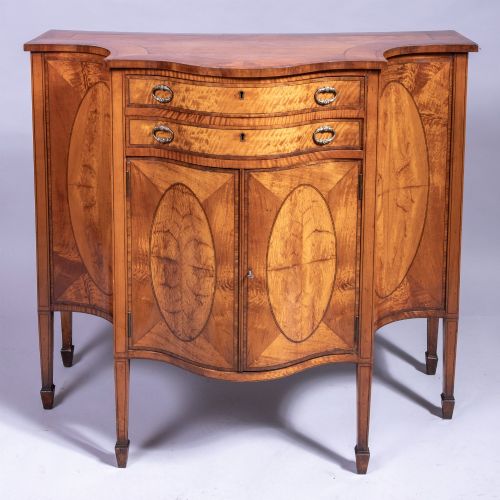
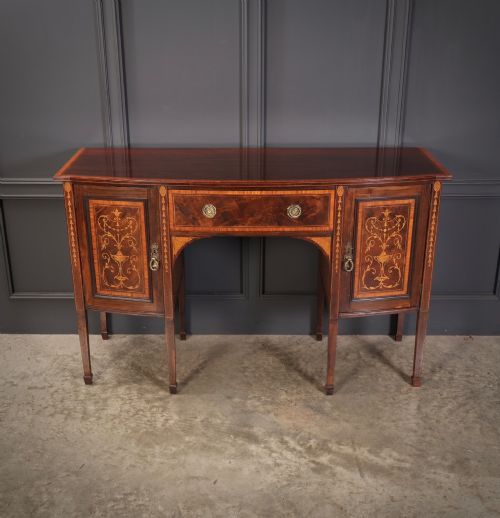
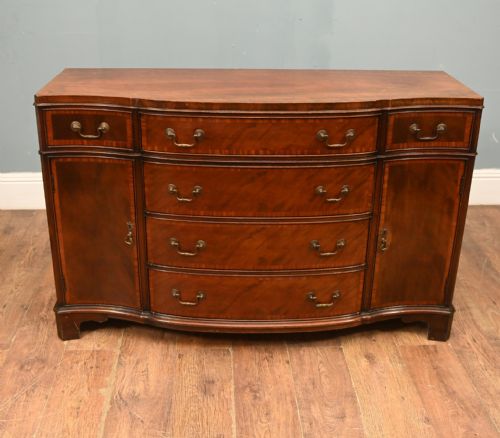
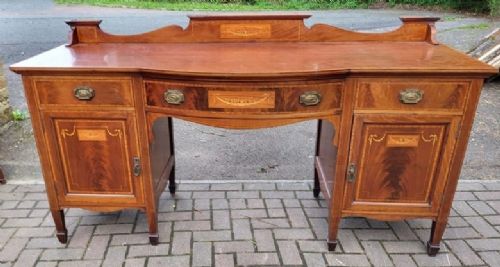
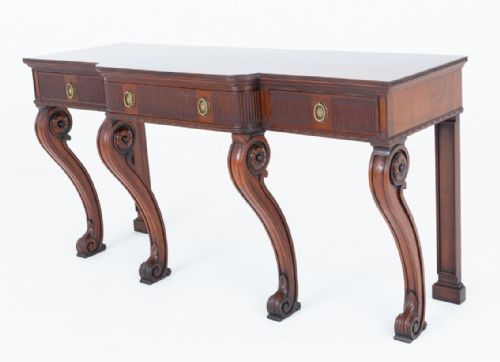
A georgian revival sideboard brings eighteenth-century elegance into late-nineteenth and early-twentieth-century interiors, drawing on the vocabulary of Sheraton, Adam and Chippendale designs. Buyers encounter breakfront forms, serpentine profiles and bow-front shapes that echo the proportions of earlier dining furniture.
Most examples date from the Edwardian era and the late nineteenth century, spanning periods from eighteen-eighty to nineteen-twenty. Makers of these decades combined substantial mahogany carcasses with lighter satinwood or boxwood inlay to suit contemporary tastes for refinement.
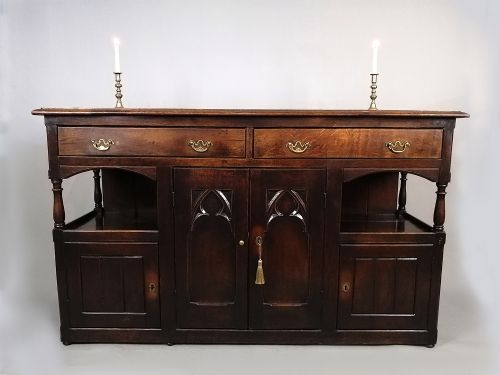
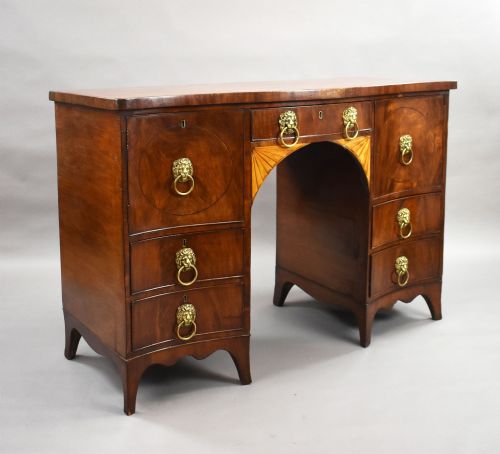
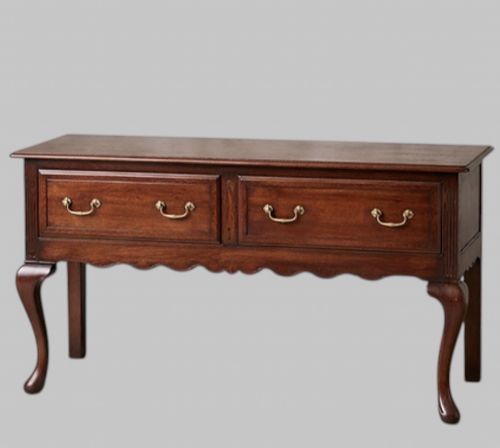
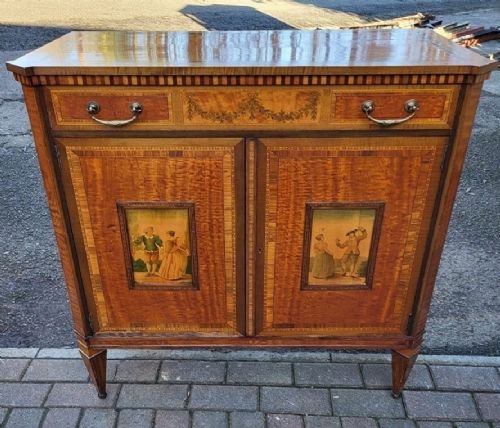
Beyond standard sideboards, the category includes side cabinets, serving tables and oak dresser bases built in the Georgian taste. These pieces served practical needs in period homes while satisfying a wider revival of classical design.
How they were made
Cabinetmakers constructed the primary carcase in solid mahogany or oak, often applying flame mahogany veneers to door panels and drawer fronts to create rich visual depth. Satinwood and boxwood cross-banding provided sharp linear contrast along edges and borders.
Inlay and marquetry demanded high skill, with floral motifs and classical urns assembled from tiny tinted veneers set flush into the timber. Brass hardware, including drop handles and backplates, completed the construction details.
Cabinets hide original key escutcheons designed to keep greedy household staff away from the silver tea service.
What varies in quality
Quality rests upon the selection of timber and the precision of the cabinetwork rather than sheer size. Finer pieces employ deeply figured flame mahogany and crisp, evenly spaced stringing that follows complex serpentine curves without lifting.
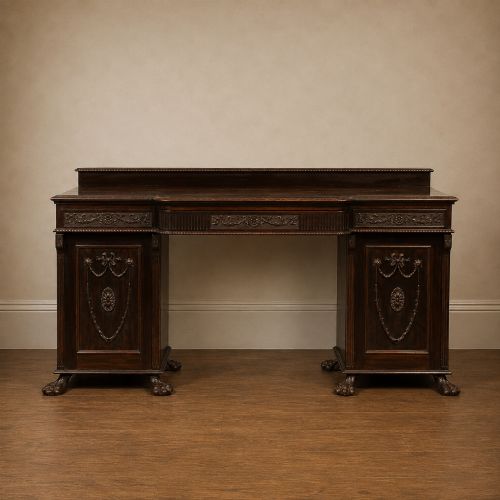
Carved details such as ball and claw feet or husks on the legs reveal the hand of a more accomplished artisan. Inferior examples rely on printed or painted decoration rather than genuine inlaid wood veneers.
Maple And Co.·Edwards And Roberts·Howard And Sons
The Georgian Revival Sideboard Glossary
- Serpentine
- A furniture front curving inward centrally and outward at the ends in a continuous wave. This shape requires advanced woodworking skill to match veneers smoothly across the bends.
- Bow-front
- A convex curved cabinet front projecting outward in an arc. It became popular in the late eighteenth century and was frequently revived during the Victorian and Edwardian eras.
- Breakfront
- A large piece of furniture whose central section projects forward from the flanking wings. This architectural arrangement creates depth and shadow in a dining room.
- Satinwood
- A pale, hard timber from tropical trees with a lustrous, reflective grain. It was widely utilised for inlay and decorative banding on darker mahogany furniture.
- Cross-banding
- A narrow strip of veneer laid across the grain of the primary surface to form a contrasting border. The technique frames drawer fronts and tabletops cleanly.
Georgian Revival Sideboard: Frequently Asked Questions
How do I date a revival sideboard?
Examine the secondary woods inside the drawers, such as oak or pine, alongside the construction methods and the style of the brass hardware. Revival pieces often display softer internal timber milling compared to eighteenth-century originals.
The presence of Edwardian or late-nineteenth-century secondary veneers and machine-sawn backing boards helps narrow the production window securely into the revival period.
How do I care for mahogany veneer?
Keep mahogany furniture away from direct sunlight and heat sources to prevent the timber from fading and the underlying veneers from lifting. Regular dusting with a soft, dry cloth preserves the finish.
Apply a microcrystalline wax occasionally to nourish the wood without building up a sticky residue that attracts dust.
What is the difference between Sheraton and Adam styles?
Sheraton designs lean towards rectilinear or curved forms with delicate satinwood inlay, tapered legs and classical urn motifs. Robert Adam introduced heavier neoclassical architectural elements inspired by Roman ruins.
Revival pieces often blended these influences, pairing Adam-style carved friezes with Sheraton-inspired bow-front proportions.