


Georgian Portable Writing Desk
A georgian portable writing desk is a compact timber chest built for travel, offering a fitted slope and compartments that let you write letters on the move.
Georgian Portable Writing Desk
A georgian portable writing desk brings officers and travellers a secure surface for paperwork while away from home. These pieces open to reveal a sloping writing bed lined with leather or baize, alongside inkwells and pen trays.
The selection here draws mainly on Georgian, George III, and Regency periods, alongside later Victorian and Edwardian examples. Forms range from brass-bound campaign boxes to tabletop bureaus and cheverets.
Mahogany and rosewood dominate the timbers, often reinforced with brass corners and strapwork to withstand rough travel. Elm, satinwood, and smaller stationary boxes also appear among the varied formats.
How they were made
Cabinetmakers constructed these boxes primarily in solid or veneered mahogany, rosewood, and elm, selecting dense timbers that resist warping. Brass edging, corner brackets, and flush carrying handles were integrated to protect the edges during military campaigns.
Interiors rely on precision joinery to house concealed drawers, inkwells, and folding writing flaps covered in leather or baize. Finer versions incorporate satinwood inlay and specialised compartments for stationery.
Listings feature periods spanning from the 18th century through the Georgian, Regency, Victorian, and Edwardian eras.
What varies in quality
The distinction between standard utility boxes and finer examples lies in the selection of figured mahogany or rosewood veneers and the crispness of the brass bound joinery. Superior pieces retain original leather writing surfaces, fitted silver-gilt inkwells, and working locks with functional keys.
Simpler elm table top bureaus and plain writing slopes show robust construction without the decorative brass inlay or intricate interior secret compartments found on officer-grade campaign desks.
The Georgian Portable Writing Desk Glossary
- Writing slope
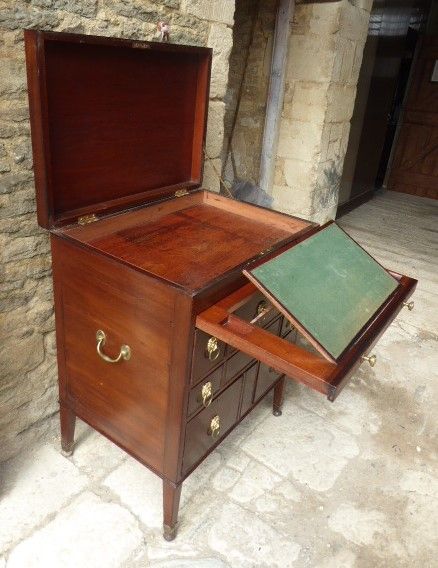
- A portable box with an angled lid designed to hold paper and provide an inclined writing surface. When opened, the hinged panels flatten out to reveal compartments for pens and ink.
- Campaign chest
- A modular set of drawers or a box built in sections with brass corners and inset handles for easy transport by military officers. These pieces separate into distinct segments for movement.
- Cheveret
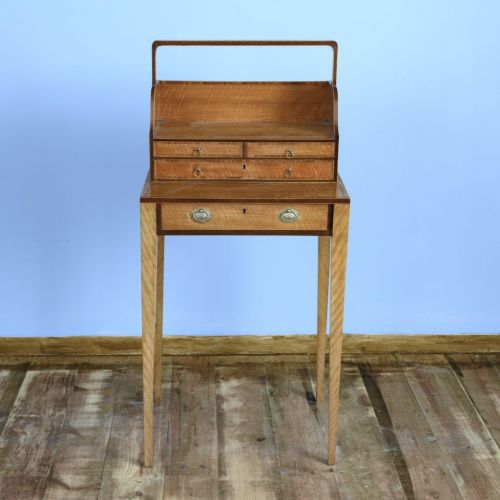
- A small freestanding table featuring a tiered superstructure with pigeonholes and small drawers above a writing surface. It often includes a pull-out slide for extra workspace.
- Baize
- A coarse woollen material resembling felt used to line writing surfaces inside boxes. It provides a soft, non-slip texture for writing.
- Stationary box
- A fitted wooden container designed to hold envelopes, paper, and writing accessories upright. These boxes often feature compartmentalised interiors.
Georgian Portable Writing Desk: Frequently Asked Questions
What is a portable writing desk?
A portable writing desk is a lidded wooden box that folds open to create an angled writing surface. It contains built-in compartments for inkwells, pens, and paper.
Officers, travellers, and writers used these desks to maintain correspondence while away from a stationary home bureau.
How were campaign desks used?
Campaign desks travelled with military officers and diplomats on active service, functioning as portable offices. Their robust timber frames and brass bindings protected the contents during transit.
Inside, secure drawers held confidential documents, wax seals, and currency alongside writing materials.
How do I identify a Georgian slope?
Georgian slopes typically feature solid mahogany or rosewood construction with hand-cut dovetail joints and brass corner brackets. The interior surfaces are usually lined with leather or baize.
Earlier examples from this era often display understated elegance and functional brass carrying handles rather than excessive ornamentation.
How do I care for a wood slope?
Keep wooden writing desks away from direct sunlight and radiators to prevent the timber from splitting and the veneer from lifting. Apply a quality wax polish occasionally to nourish the antique grain.
Ensure leather or baize linings remain dry and protect the brass hardware from moisture.