




Georgian Painted Bedroom Chairs
Georgian painted bedroom chairs bring lightness and colour to a room, offering elegance through delicate painted decoration and refined silhouettes.
Georgian Painted Bedroom Chairs
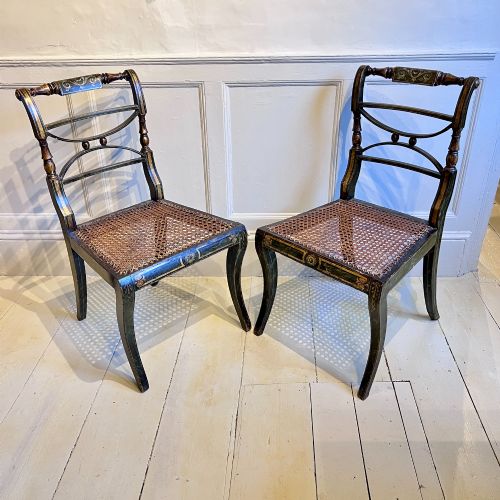
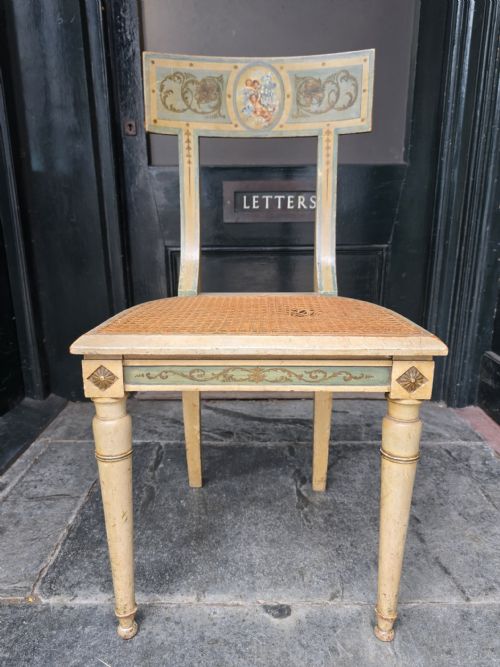
When you search for georgian painted bedroom chairs, you encounter seating fashioned primarily during the Regency and Georgian eras alongside later reinterpretations from the early twentieth century. These furnishings take the form of side chairs and armchairs designed for private chambers rather than grand public reception rooms. The selection includes matched pairs and individual pieces showing diverse decorative schemes.
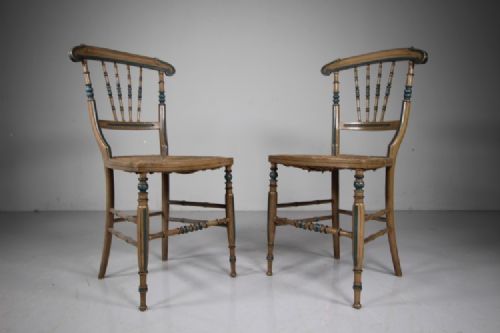
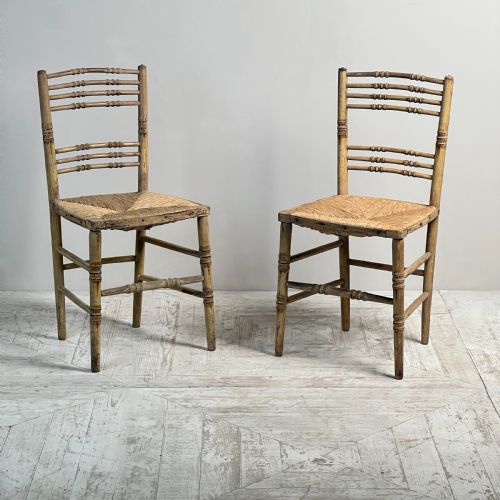
The prevalent examples span styles from classic Georgian Neoclassical and Sheraton designs to elaborate Chinoiserie and Grand Regency aesthetics. Many feature specific structural details like faux bamboo turnings, bergere panels, and open cane or rush seats. Their origins bridge the late eighteenth century up through 1930 revivals.
How they were made
Maker construction relies on timber frames shaped into side chairs and armchairs, frequently enhanced with applied paint and parcel gilt surfaces. Artisans incorporated organic seating elements such as cane and rush into the wooden frameworks to provide light, resilient bases.
Decorative treatments involve detailed painted ornamentation and specific motifs associated with Chinoiserie and satinwood finishes. Structural variety emerges through specialised framing like faux bamboo turnings and bergere configurations.
The inventory combines genuine Regency and Georgian items with twentieth-century interpretations spanning the 1920s and 1930s.
What varies in quality
Distinctions across the range rest on the sophistication of the original painted and decorated surfaces. Pieces retaining crisp, hand-painted detailing and coherent stylistic motifs demonstrate higher levels of period execution.
The integrity of integrated seating materials, from fine cane to woven rush and upholstered fabric, separates standard items from finer survivals. Overall proportion and the finesse of turned elements like faux bamboo further define the tier of each chair.
The Georgian Painted Bedroom Chairs Glossary
- Bergere
- A closed-arm armchair with an upholstered back and sides, often featuring exposed wooden frames. This French-inspired form appears in refined bedroom settings.
- Chinoiserie
- A European artistic style reflecting Chinese motifs and decorative techniques. It manifests on these chairs through painted scenic or floral patterns.
- Faux bamboo
- Turned wood carved and painted to imitate natural bamboo stalks. Makers utilised this technique during the Regency period to achieve an exotic, lightweight aesthetic.
- Parcel gilt
- A decorative method applying thin gold leaf to specific raised portions of a painted wooden surface. It highlights architectural details and turnings.
- Satinwood
- A durable hardwood with a lustrous yellowish grain used for fine furniture decoration. It forms the primary visual element in specific twentieth-century revival pieces.
Georgian Painted Bedroom Chairs: Frequently Asked Questions
What defines a georgian painted bedroom chair?
These seating pieces date from the Georgian and Regency periods, or later revivals, characterised by wooden frames adorned with paint, gilt, or specific decorative styles.
They function as decorative and functional bedroom furniture, frequently taking the form of light side chairs or armchairs with cane or rush seats.
How were these chairs used originally?
Bedchambers in large houses utilised these portable seats for dressing, resting, or furnishing private sitting rooms.
Their lighter construction compared to heavy dining chairs made them easy to move around private residential quarters.
How do I identify a faux bamboo chair?
Makers carved wooden frames with characteristic joint rings to replicate the segmented appearance of real bamboo canes.
Painters then finished these turned members with specific colours to complete the illusion.
Are all these chairs from the georgian era?
While many date to the Georgian and Regency periods, the selection also includes early twentieth-century pieces from the 1920s and 1930s.
These later examples replicate earlier styles like Chinoiserie and satinwood designs.