
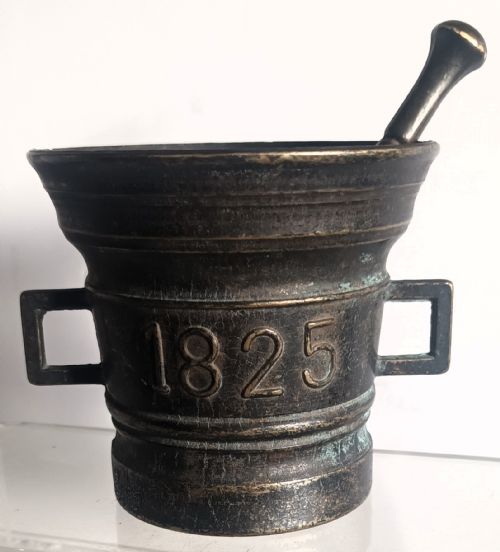
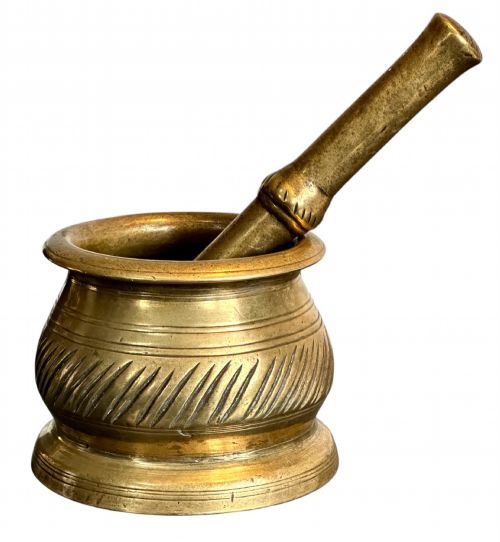
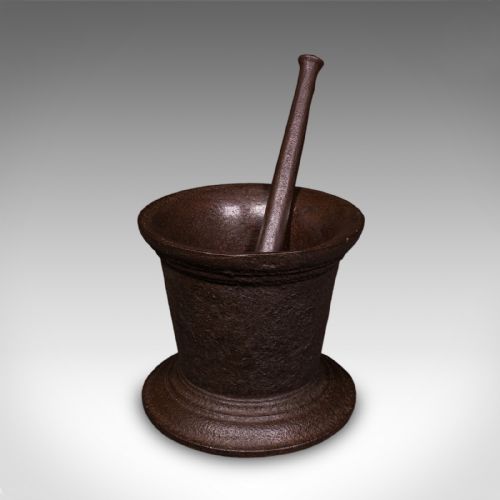


Georgian Metal Pestle
These georgian metal pestle sets are heavy utilitarian instruments of bronze, brass, and iron that bring centuries of industrial and domestic history to a modern tabletop.
Georgian Metal Pestle
A georgian metal pestle arrives paired with a matching mortar, forming a heavy grinding set designed for kitchen, apothecary, and workshop use. The forms span from modest domestic kitchen grinders to monumental dye maker vessels weighing over a hundred pounds.
The pieces appearing on this page belong predominantly to the Georgian era and the wider span of the eighteenth and nineteenth centuries, alongside earlier seventeenth-century survivals. Most examples are rendered in solid bronze, brass, or cast iron, reflecting the utilitarian demands of their original deployment.
Makers fashioned these implements for crushing, pounding, and mixing dry ingredients and chemical compounds. Surviving sets show clear signs of past labour in their patinated metal surfaces and worn grinding interiors.
How they were made
Foundries produced these objects primarily through sand casting or traditional bell-founding techniques, pouring molten bronze, bell metal, or brass into moulds to achieve thick, resilient walls. This heavy construction ensured the mortar could withstand the repeated impact of the pestle without cracking.
Iron and cast iron variants offered alternative durability for heavier industrial applications such as dye manufacturing. Workers finished the raw metal surfaces by hand, leaving tool marks and surface textures that survive on many Georgian and eighteenth-century examples.
Current listings feature materials spanning bronze, brass, cast iron, iron, and bell metal, originating across the Georgian, eighteenth, and nineteenth centuries.
What varies in quality
Quality in a georgian metal pestle set rests upon the integrity of the casting and the proportional balance between the mortar and its striking pestle. Heavier bronze and bell metal examples display crisp decorative moulding and a resonant tone when struck, marking them out from standard utility pieces.
The presence of an original matching pestle elevates the desirability of any set, as many surviving mortars were separated from their striking tools over centuries of use. Depth of wear and the preservation of an honest, untouched metal patina further separate ordinary kitchen survivals from exceptional apothecary and workshop instruments.
The Georgian Metal Pestle Glossary
- Mortar and pestle
- The dual instrument comprising a bowl-shaped vessel for holding substances and a heavy club used for pounding and grinding them. These tools date back antiquity and saw heavy service in kitchens and apothecary shops.
- Bell metal
- A hard alloy consisting of copper and tin utilised for casting bells and high-grade mortars. It produces a clear, ringing tone and resists the continuous friction of grinding.
- Apothecary
- A historical practitioner who prepared and sold medicines and drugs. Their shops relied heavily on bronze and brass mortars to pulverise roots, herbs, and minerals.
- Georgian
- The period spanning the reigns of the four British monarchs named George, covering most of the eighteenth century and the early decades of the nineteenth. Objects from this era display distinct neoclassical or vernacular proportions.
Georgian Metal Pestle: Frequently Asked Questions
What were metal mortars used for?
These vessels served to crush, grind, and blend dry goods, medicinal herbs, and chemical compounds before the advent of modern commercial powder production.
Households used them in kitchens for culinary spices, while apothecaries and dye makers employed heavier bronze and iron versions for industrial preparation.
How do I date an old metal pestle?
Dating relies on the alloy composition, the casting method, and the specific profile of the mortar rim and base. Earlier pieces often display rougher sand-casting textures and simpler flared rims compared to later Victorian iterations.
Consulting the metal type, such as bell metal versus cast iron, helps narrow the production era alongside any recorded history of the maker or workshop.
Are the pestles usually original to the mortars?
Many surviving sets keep their original matching pestle, though centuries of separate storage often led to pairings of convenience. A true matched set shares the same alloy composition, wear patterns, and surface patina.
Inspect the striking end of the pestle and the interior base of the mortar to see if the wear marks correspond naturally.
How do I clean a bronze mortar?
Maintenance requires nothing more than a dry cloth or a gentle wipe to preserve the historic dark patina accumulated over centuries of handling. Aggressive metal polishes strip away the aged surface character that collectors value.
Keeping the metal away from damp environments prevents active corrosion while maintaining the stable oxide layer.