




Georgian Mahogany Wall Instrument
A georgian mahogany wall instrument records the pressure of the air and the passage of time inside a timber case.
Georgian Mahogany Wall Instrument
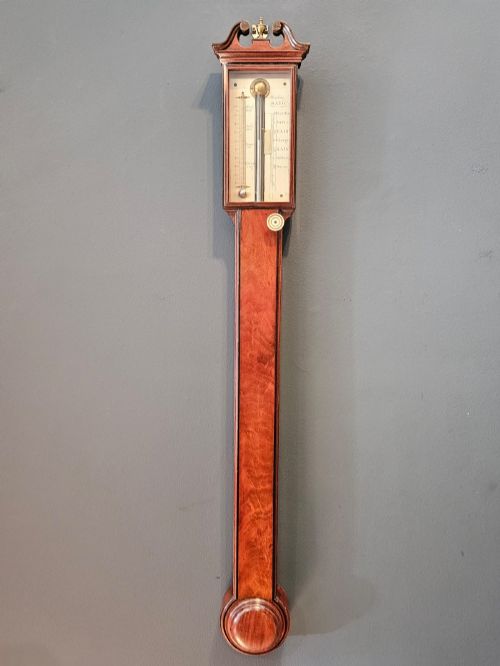
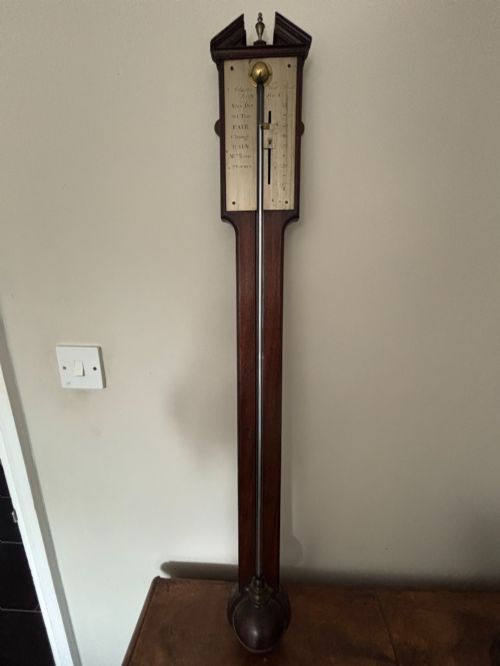
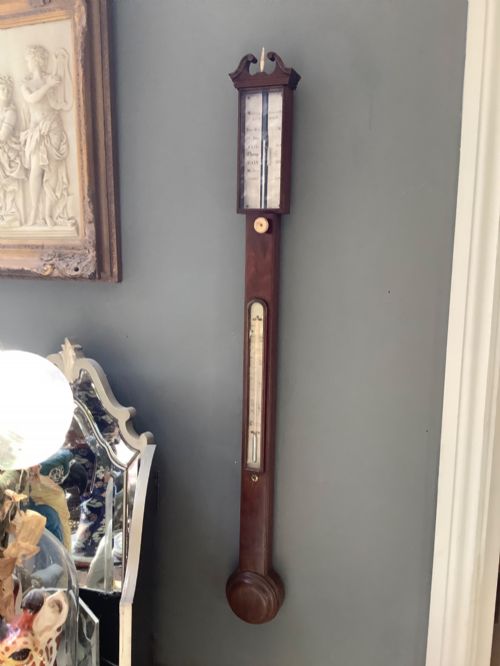
A georgian mahogany wall instrument takes the form of a stick barometer, a banjo barometer, or a wall thermometer designed to hang vertically.
Most examples appear from the Georgian, Regency, and nineteenth century periods, housed in dark timber cases.
Makers housed these precision movements in simple straight trunks or wider banjo shapes fitted with dials and silvered metal plates.
Materials and construction
Makers constructed the primary case from mahogany, often adding boxwood inlay, marquetry, or parquetry to the borders.
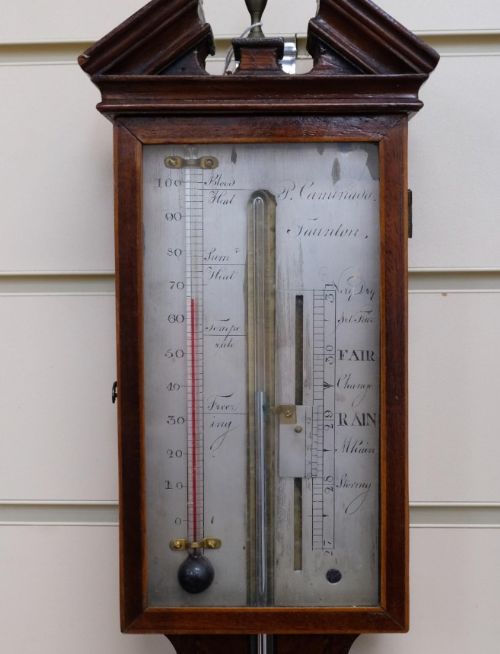
The working parts combine brass, glass, bone, and silvered brass or silvered metal for the register plates and thermometer scales.
Object types recorded across the inventory include stick barometers, wheel barometers, wall thermometers, and fusee wall clocks.
Distinctions in craftsmanship
Quality rests upon the crispness of the case woodwork and the precision of the engraved silvered metal dial plates.
Signed instruments by known makers carrying detailed brass scales and original glass tubes command greater interest than plain unsigned variants.
P Caminada·George Adams·Dollond·Ganthony·Prada·Molton·Luisetti·Bate·Cox·L Casatelli·Watkins·Roncoroni·H Marks·Sandrino·Vecchio and Co·Gilbert·Bianchi·James Gatty·Alexander Adie·J Groce·Bassi·Charles Aiano
The Georgian Mahogany Wall Instrument Glossary
- Stick barometer
- A tall, narrow instrument measuring atmospheric pressure through a vertical tube of mercury against a silvered brass scale. The mahogany trunk protects the column from damage.
- Banjo barometer
- A wheel barometer housed in a wider, curved mahogany case resembling the shape of a banjo. These variants often include a hygrometer, thermometer, or spirit level on the face.
- Fusee wall clock
- A spring-driven clock designed to hang on a wall, utilising a fusee cone to maintain even power as the mainspring unwinds.
- Silvered metal
- A brass or copper plate treated with a silver solution to create a bright, legible surface for engraved numbers and inscriptions.
Georgian Mahogany Wall Instrument: Frequently Asked Questions
What is a georgian mahogany wall instrument?
A georgian mahogany wall instrument is a barometer, thermometer, or clock built to hang on a wall during the eighteenth and nineteenth centuries.
These pieces combine functional science with cabinet timber work, serving both to measure the weather and to decorate a room.
How do stick and banjo barometers differ?
Stick barometers feature a long, straight mahogany trunk housing a vertical mercury tube and a narrow register plate.
Banjo barometers widen at the base into a circular dial that reads pressure through a mechanical wheel linkage.
Where should I hang a wall instrument?
Hang these pieces away from direct heat sources and strong sunlight to protect the mahogany timber and the fragile glass tubes.
Ensure the wall can support the weight of the timber case and internal mercury column securely.
How do I identify the period?
Inspect the style of the mahogany case, the framing of the dial, and any signature engraved upon the metal plate.
Neo-classical details, string inlay, and maker signatures help narrow the date of manufacture between the Georgian and Victorian eras.