
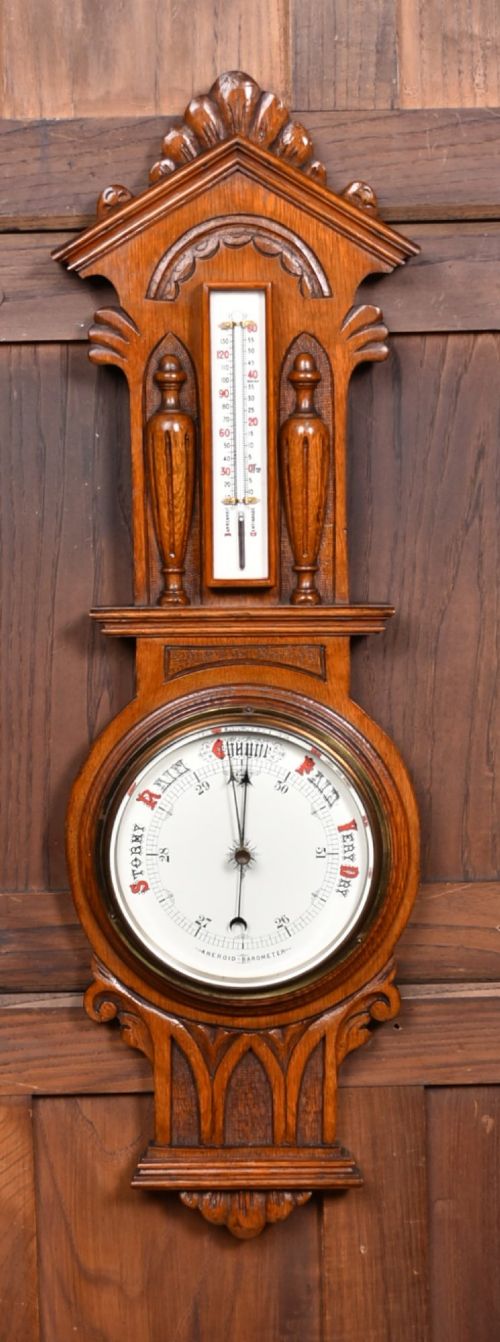


Antique Mercury Wall Gauge
These antique mercury wall gauge pieces, taking the form of barometers and thermometers, bring practical science into the home with traditional craftsmanship.
Antique Mercury Wall Gauge
When you search for an antique mercury wall gauge, you are looking at functional meteorological instruments designed to measure atmospheric pressure or temperature. The listings here predominantly feature wall-mounted barometers and thermometers spanning the Georgian and Victorian eras up to the Art Deco period.
You will most commonly encounter banjo barometers, wheel barometers, and stick barometers housed in timber cases. These instruments originated as scientific tools for domestic, maritime, or agricultural use, eventually becoming decorative fixtures in period interiors.
The selection on this page ranges from eighteenth-century mahogany cased wall thermometers to late nineteenth-century stick barometers and compact carved oak banjo barometers. Each piece reflects the evolving domestic interest in weather observation across the eighteenth, nineteenth, and early twentieth centuries.
How they were made
Instrument makers housed sensitive glass barometer tubes and mercury reservoirs within sturdy wooden chassis. Mahogany, oak, and rosewood are the predominant timbers used for the cases, often shaped into banjo profiles or rectangular wall plaques.
Dials and plates were typically fashioned from silvered metal, brass, or porcelain, with graduations and maker details engraved or enameled onto the surface. Finer examples incorporate boxwood inlay and detailed wood carving to enhance the decorative appeal of the case.
Farmers relied on rugged wall barometers to outsmart stubborn livestock and sudden showers.
What varies in quality
The distinction between standard domestic instruments and exceptional pieces lies in the precision of the case construction and the reputation of the maker. Master instrument makers produced signed dials and refined timber veneers that elevate simple utility items into notable works of applied art.
Materials and secondary ornamentation set the hierarchy among these wall instruments. Solid rosewood bodies, intricate boxwood stringing, and heavy cast brass bezels indicate a higher grade of production than plain pine or basic oak carcases.
George Adams of Fleet Street·Alexander Wright Westminster·Negretti and Zambra·Cox of Plymouth Dock·James H Kelly of Glasgow·Dollond London
The Antique Mercury Wall Gauge Glossary
- Barometer
- An instrument used to measure atmospheric pressure in order to forecast weather changes. Most period examples employ a column of mercury within a sealed glass tube.
- Thermometer
- A device for measuring temperature, utilising scaled glass tubes containing mercury. These appear as standalone wall plaques or paired alongside barometers.
- Banjo Barometer
- A domestic wall barometer shaped broadly like a banjo, featuring a circular dial at the base and a long trunk holding the thermometer or tube.
- Stick Barometer
- A tall, narrow wall instrument where the mercury tube and scale are exposed or protected by a glass panel down the vertical trunk.
- Silvered Metal
- A brass or copper dial plate treated to achieve a bright silver finish, typically engraved with weather descriptions and numerical scales.
Antique Mercury Wall Gauge: Frequently Asked Questions
How do mercury barometers work?
These instruments measure atmospheric pressure by balancing the weight of mercury in a glass tube against the pressure of the air. Changes in the surrounding weather cause the mercury level to rise or fall accordingly.
Historical models were calibrated to help households anticipate rain, wind, or fair conditions before heading outdoors.
Where should I hang a wall gauge?
Mount your barometer or thermometer securely on an interior wall away from direct sunlight and sudden drafts. Stable indoor temperatures ensure more accurate readings from the mercury column.
Traditional locations included hallways, libraries, and studies where residents could check conditions before daily travel.
How do I date a barometer?
Examine the timber species, case design, and the style of the engraved dial lettering. Georgian instruments often feature simpler architectural lines, while Victorian examples embrace richer woods and decorative carvings.
Signatures from known instrument makers provide a reliable anchor for determining the active working period of the workshop.
What is a stick barometer?
A stick barometer is a slender wall-mounted instrument where the main glass tube is housed in a long vertical wooden trunk. This form was favored for its scientific precision rather than decorative display.
Earlier maritime and domestic models often utilised this minimalist format to monitor rapid pressure drops.