

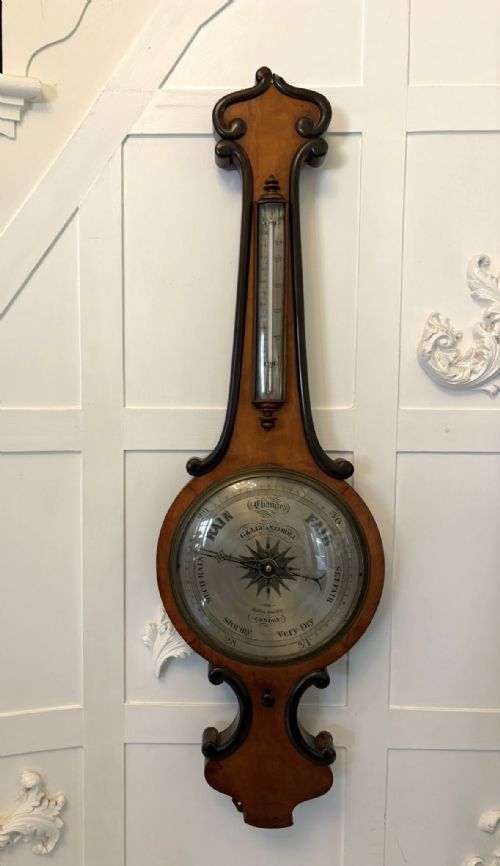


Georgian Mercury Thermometer
A georgian mercury thermometer is a sensitive instrument for measuring atmospheric temperature, prized for its classic cabinetry and the clear reading of liquid silver in glass.
Georgian Mercury Thermometer
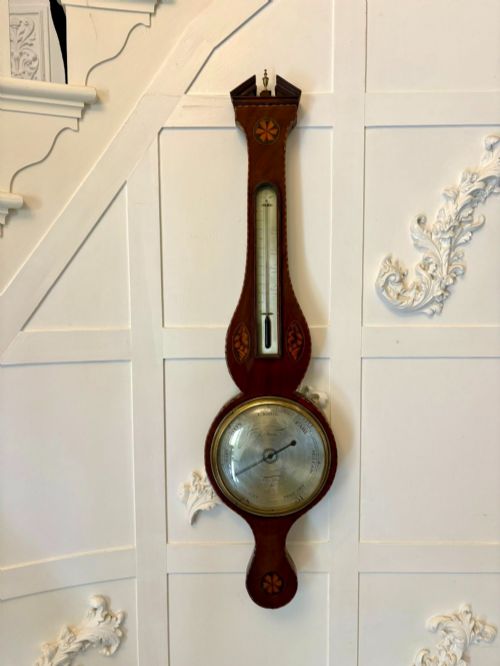
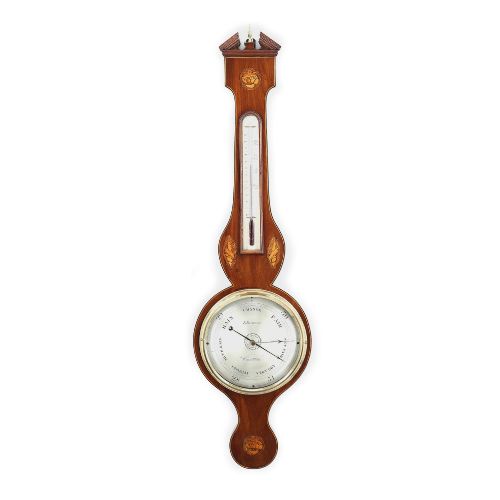
A georgian mercury thermometer combines scientific utility with cabinetmaking, appearing in simple wall-mounted cases and larger banjo or wheel barometers containing thermometer scales.
The pieces on this page span the eighteenth and nineteenth centuries, featuring Georgian, Regency, and Victorian examples alongside later Georgian Revival interpretations.
Makers housed these instruments in timber frames, most frequently mahogany, alongside rosewood, satinwood, and walnut, often ornamented with shell inlay.
How They Were Made
Craftsmen built the housings using solid and veneered timbers such as mahogany and rosewood, frequently incorporating brass fittings and silvered metal dials.
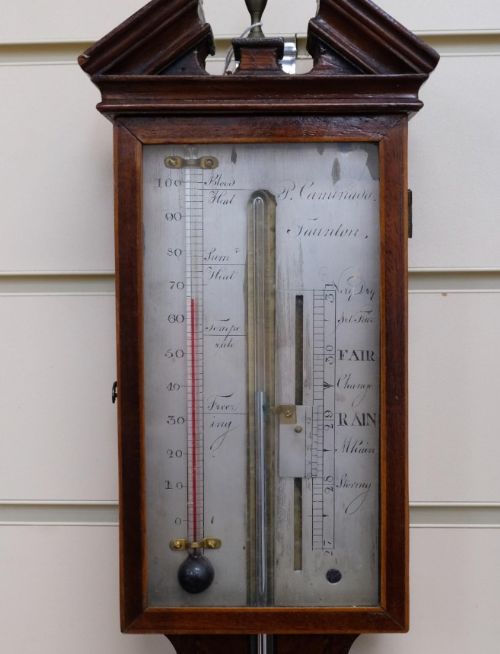
Glass tubes containing mercury were mounted alongside engraved scales on silvered brass or bone plates, protected behind glass bezels in the wheel and banjo variants.
Listings feature glass, brass, mahogany, bone, rosewood, silvered metal, satinwood, and silvered brass.
What Varies in Quality
Quality rests in the precision of the maker's engraving on the dial plates and the crispness of the timber cabinetry, particularly the execution of shell inlay and edge mouldings.
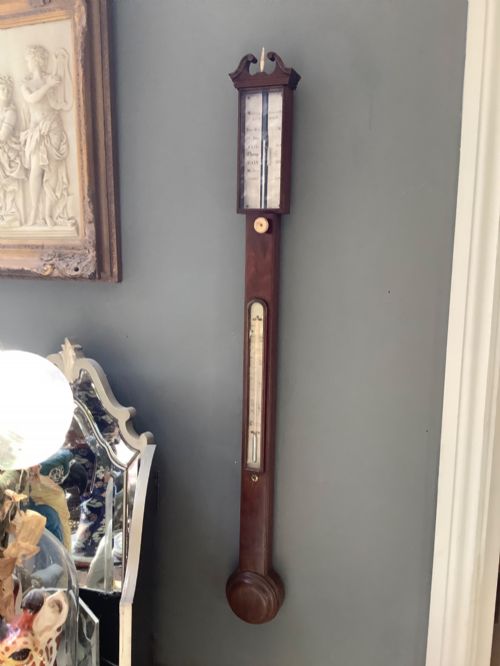
The distinction between standard domestic instruments and finer works lies in the signature of the maker and the complexity of the case design, whether a simple stick barometer or a full wheel barometer with a visible thermometer.
P. Caminada·B. Besozzi·George Adams·G & L Guanziroli·Molton of Norwich·Luisetti of London·Jenkins Of Old Swindon·Cox of Plymouth Dock·Vecchio & Co·J Groce·J C Moretti·Dominic Gatty·Corti of Exeter·George Dollond·Schiavi of Chesham
The Georgian Mercury Thermometer Glossary
- Banjo barometer
- A domestic weather glass housed in a case shaped like a banjo, typically combining a dial barometer with an attached thermometer. This form dominated the late eighteenth and nineteenth centuries.
- Stick barometer
- A tall, narrow instrument enclosing the mercury tube directly behind a long scale, valued for its straightforward presentation of atmospheric pressure.
- Silvered brass
- A metallic dial plate treated with a silver solution to provide a bright, readable surface for engraved numbers and maker signatures.
- Wheel barometer
- An instrument that uses a pulley system and a visible dial to indicate changes in pressure, frequently incorporating a subsidiary thermometer at the top of the case.
Georgian Mercury Thermometer: Frequently Asked Questions
How do I read a mercury thermometer?
Read the top of the silver column against the engraved scale on the metal plate.
Changes in temperature cause the mercury to expand or contract within the glass tube.
Where should I hang a wall barometer?
Mount the instrument on an interior wall away from direct sunlight and heating vents.
Stable ambient temperatures ensure the most accurate reading from the mercury.
How do I date a mahogany instrument?
Examine the construction of the timber case, the style of the dial engraving, and the signature of the maker.
Earlier Georgian pieces often display simpler lines, while nineteenth-century banjo formats introduce more elaborate scrollwork and inlay.
Can these instruments still be repaired?
Specialist conservators can restore the wooden cases, re-silver the metal dials, and replace damaged glass tubes.
Working with mercury requires specific expertise and adherence to safety regulations.