
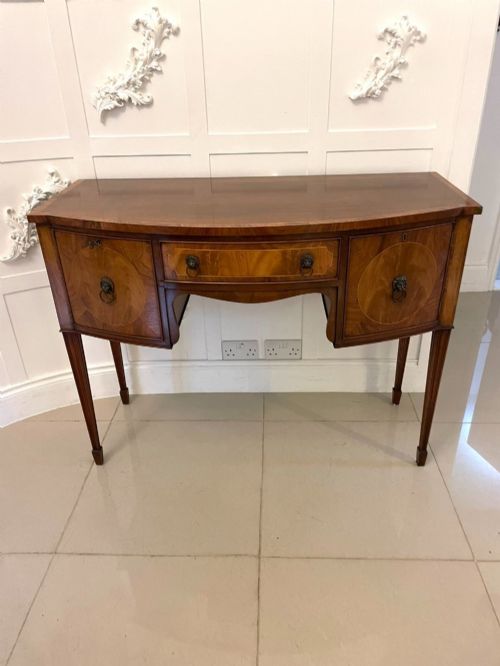
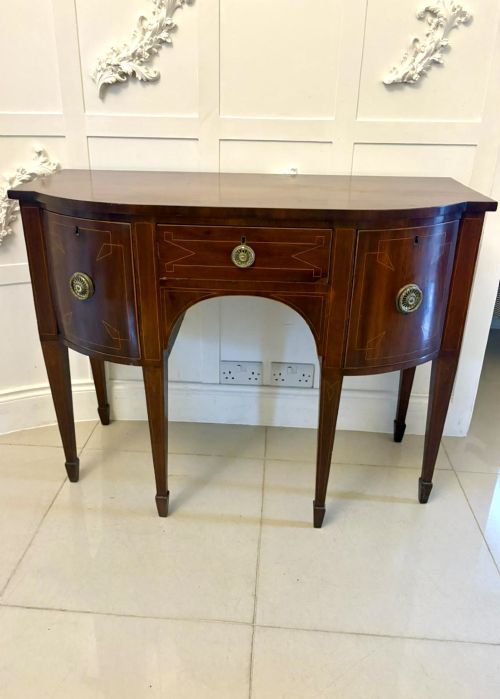
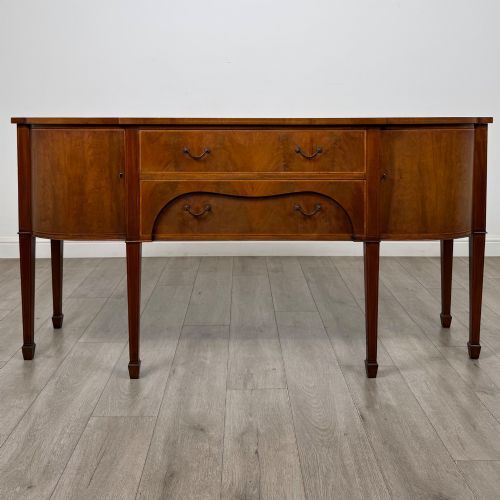
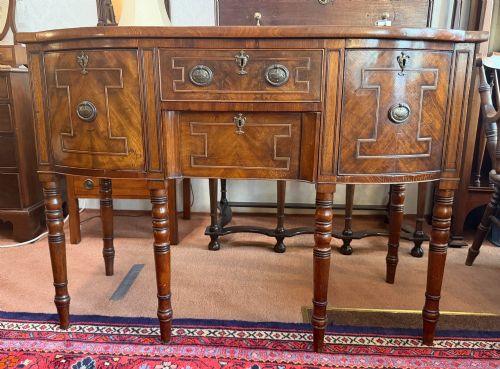
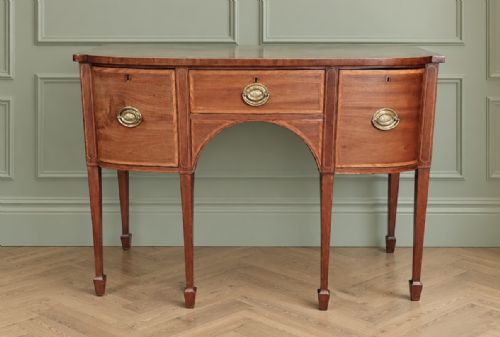
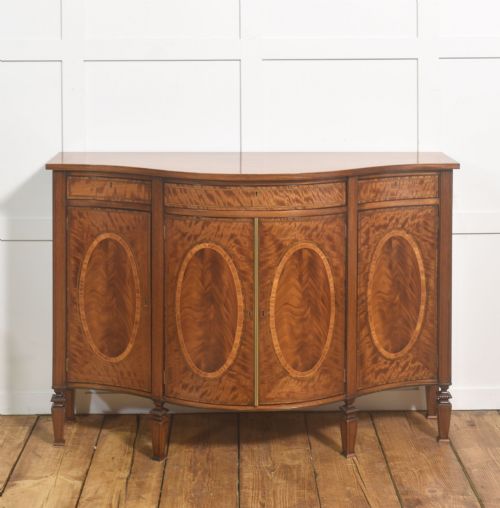
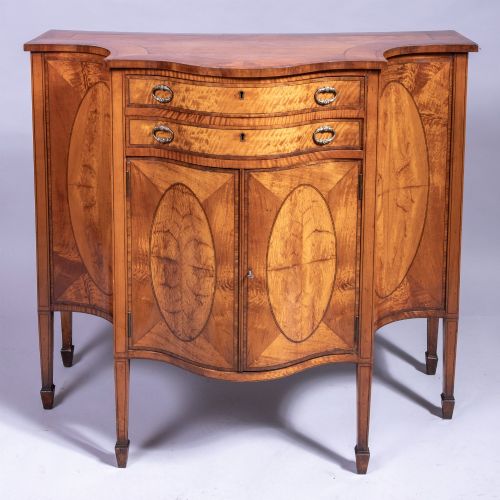
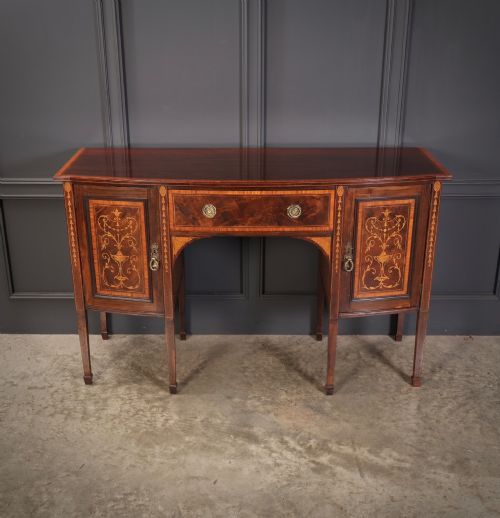
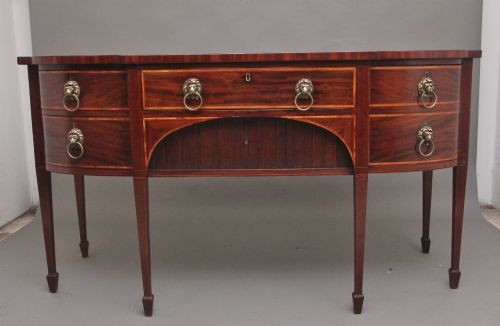
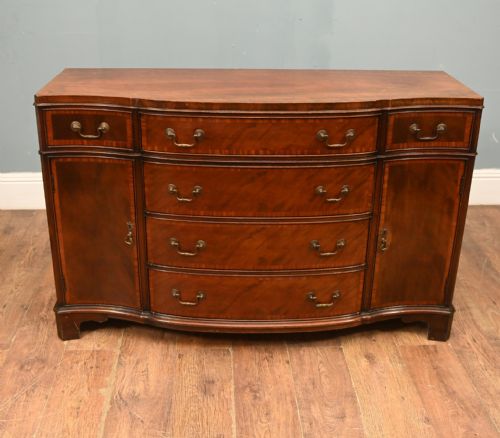


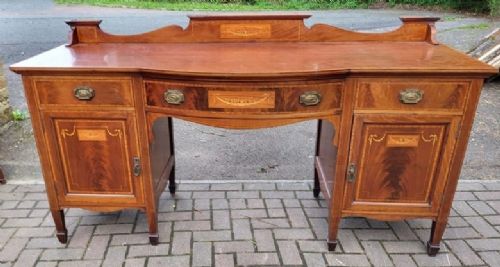


Georgian Inlaid Bowfront Sideboard
A georgian inlaid bowfront sideboard brings warmth and curved elegance to a dining room while offering deep storage.
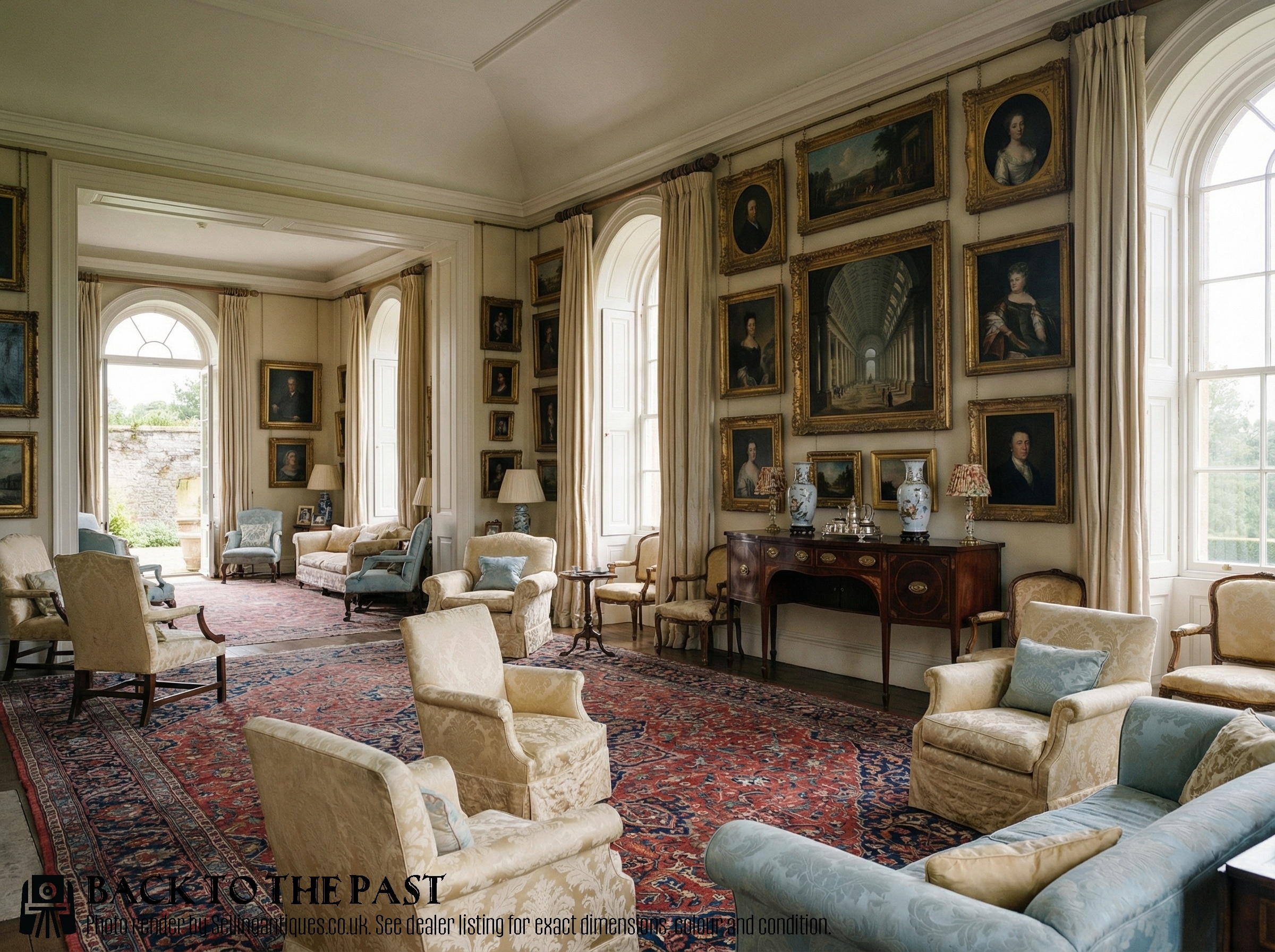
Georgian Inlaid Bowfront Sideboard
A georgian inlaid bowfront sideboard is a dining room serving piece featuring a rounded front and decorative woodwork. The pieces seen here span the Georgian and Regency periods alongside later Sheraton Revival and Edwardian interpretations.
Makers shaped these surfaces from mahogany, walnut, and satinwood, applying boxwood and ebony stringing to outline the curved drawers and top. Cabinets range from compact six-legged examples to larger breakfront forms designed for service.
Original 18th-century pieces sit alongside 19th-century interpretations and early 20th-century revivals. Buyers encounter traditional drawer configurations flanked by deep cupboards intended for bottles and linens.
Materials and construction
Cabinet makers built these carcasses primarily in figured mahogany, selecting timber with natural grain movement for the primary facade. They shaped the curved bow fronts from solid stock or layered veneers over secondary woods.
Workshops contrasted the dark mahogany bodies with pale inlay lines of boxwood and satinwood, creating geometric borders and fan motifs. Brass hardware, including ring pulls and backplates, completed the functional elements of the drawers and doors.
Structural support relied on straight or tapered legs, sometimes numbering six on larger proportions to carry the heavy top. Joinery utilised traditional frame and panel construction to accommodate seasonal wood movement.
Some larger Georgian sideboards were constructed with six legs to safely support heavy platters of meat during feasts.
Evaluating craftsmanship
Quality rests in the crispness of the inlay and the selection of the mahogany veneer. Finer examples display tightly figured flame patterns matched symmetrically across the curved drawer fronts.
The precision of the cabinet work dictates the value, visible in the tight mitres of the stringing and the smooth action of deep drawers. Secondary woods and internal drawer linings also reveal the original tier of production.
Revival pieces from the Edwardian and Sheraton Revival eras vary according to the depth of hand-carving and the richness of the marquetry work compared to their 18th-century predecessors.
The Georgian Inlaid Bowfront Sideboard Glossary
- Bowfront
- A convex curved cabinet front that projects outward in a smooth arc. This shape softens the profile of a room.
- Inlay
- Contrasting woods or materials set flush into the surface of a primary timber to create decorative patterns. Boxwood and ebony frequently form these lines.
- Stringing
- Thin, narrow strips of light or dark wood inlaid into grooves around drawer edges and borders. It frames the panels.
- Marquetry
- Elaborate pictorial or geometric veneer work assembled from various tinted woods. It often decorates the top surfaces.
- Breakfront
- A piece of furniture where the central section projects forward from the flanking cupboards. This creates architectural depth.
Georgian Inlaid Bowfront Sideboard: Frequently Asked Questions
How do I style a bowfront sideboard?
Place the sideboard against a principal dining room wall where the curved front can catch sidelight. Anchor the top surface with a low mirror or painting flanked by matching lamps or candlesticks.
Keep the central space clear for serving food during meals. Use the deep internal cupboards to store table linens, silver, and glassware close at hand.
What is the difference between Georgian and revival sideboards?
Original Georgian pieces date from the 18th and early 19th centuries, built with period construction methods and native timber patination. Sheraton Revival and Edwardian examples date from the late 19th to early 20th century.
Revival pieces often utilise lighter satinwood timbers and extensive marquetry. Both types function well in modern interiors, though they carry different historical periods.
Can I use a sideboard in a hallway?
Compact bowfront sideboards fit narrow spaces like hallways and landings due to their curved profiles. The shallow depth at the edges prevents obstruction while providing useful surface space.
The drawers hold everyday items like keys and post, while lower cupboards store shoes or household items out of sight.
How do I identify boxwood inlay?
Boxwood is a dense, pale yellow hardwood that cabinet makers used to create stark contrast against dark mahogany. It appears as narrow linear stringing or small geometric blocks.
Look closely at the borders of the drawer fronts to trace these crisp, light-coloured lines running through the darker wood.