
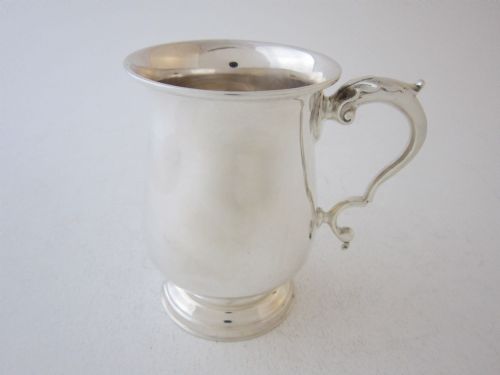
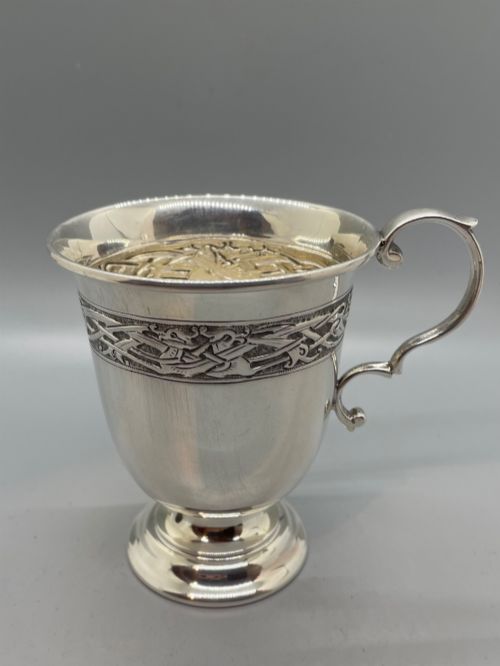


Georgian Hallmarked Silver Tankard
A georgian hallmarked silver tankard is a solid metal drinking vessel built for heavy use, offering the heft and bright polish of centuries past.
Georgian Hallmarked Silver Tankard
A georgian hallmarked silver tankard encompasses sturdy drinking vessels and christening mugs shaped across the eighteenth, nineteenth and early twentieth centuries. These objects range from compact christening cups bearing engraved decoration to substantial lidded tankards produced in London and Birmingham.
The selections on this page span several eras, moving from early pieces struck in the seventeen-hundreds through Regency and Victorian examples up to later twentieth-century iterations. Buyers encounter forms designed for daily service alongside commemorative presentation pieces intended to mark a birth or childhood.
Mugs and tankards appear in various capacities, some featuring fitted lids and spouts while others remain open-topped with simple handles. Each piece carries official marks that verify its metallic standard and place of origin.
How they were made
Silversmiths formed these vessels from sterling silver or higher-purity Britannia standard silver, hammering and soldering sheet metal into cylindrical bodies. Handles were cast separately and soldered securely to the main body alongside any spouts or hinged lids.
Craftsmen applied surface decoration through hand engraving, shaping floral motifs, initials or geometric borders directly into the metal walls. Stamping sets added the required hallmarks to authenticate the silver content, assay office and date of creation.
What varies in quality
The weight of the metal fundamentally dictates the quality of a vessel, with heavier gauge silver providing greater structural rigidity and a more substantial feel in the hand. Thicker walls prevent denting and preserve the crispness of any engraved details over generations of use.
The clarity and completeness of the hallmarks affect value and historical interest, as legible stamps confirm the maker and exact year of production. Furthermore, the precision of the handle attachment and the snugness of any lidded mechanism reflect the skill of the original silversmith.
William Bateman
The Georgian Hallmarked Silver Tankard Glossary
- Hallmark
- Official stamps pressed into metal to certify its purity, assay office and year of manufacture. These marks serve as the primary tool for dating British silver.
- Britannia Standard
- A higher purity of silver containing ninety-five point eight percent pure metal, introduced by law in England during the late seventeenth century.
- Sterling Silver
- An alloy consisting of ninety-two point five percent silver and seven point five percent other metals, chosen for durability in tableware.
- Assay Office
- The official body responsible for testing precious metals and applying hallmarks. London and Birmingham offices appear frequently on these pieces.
- Christening Mug
- A small presentation cup traditionally given to a child upon their baptism. Many examples feature engraved names or dates from the nineteenth and twentieth centuries.
Georgian Hallmarked Silver Tankard: Frequently Asked Questions
What is a georgian hallmarked silver tankard?
A georgian hallmarked silver tankard is a sturdy drinking vessel or mug produced during the eighteenth or early nineteenth century, bearing official assay stamps.
These pieces were constructed from solid silver to hold liquids and often doubled as presentation items for milestones such as christenings.
How do I clean an antique silver tankard?
Cleaning requires a soft cloth and a specialised silver polish formulated to remove tarnish without abrading the surface. Avoid harsh chemical dips that can strip away the natural patina accumulated over centuries.
Rinse the vessel thoroughly in warm water and dry it immediately with a lint-free cloth to maintain its bright polish.
Are these silver tankards safe for drinking?
Most of these vessels are safe for holding cold beverages, provided the interior is clean and free of old residue. Silver naturally possesses antimicrobial properties that made it popular for tableware.
Buyers should inspect the interior for any historical repairs or solder lines before using them for consumption.
How can I tell the age of a silver mug?
The age of a silver mug is determined by reading the hallmarks stamped into the metal, which include a date letter corresponding to a specific year and assay office. Stylistic clues such as the shape of the handle and the style of engraving also help indicate the period.
Why do some tankards have lids?
Lidded tankards originated in eras when covers served to keep debris out of drinks and to retain heat or carbonation. Hinged lids required precise metalwork by the silversmith to ensure a tight seal against the rim.