

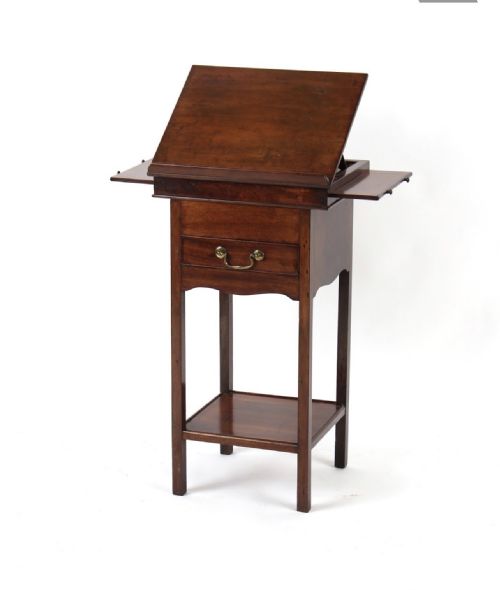


Georgian Drafting Desk
A georgian drafting desk offers an adjustable working surface designed for architects, cartographers and artists, combining fine mahogany with practical mechanical ingenuity.
Georgian Drafting Desk
A georgian drafting desk serves as a specialised workspace for drawing, planning and reading, built with adjustable tops and sliding components. These pieces date from the 18th century, the Regency era and the early 19th century.
Makers such as Gillows contributed to this form, producing architectural and library furniture designed to elevate practical utility into fine cabinet making.
What varies in quality
The sophistication of the mechanical adjustments separates standard writing tables from superior architectural pieces. Smoothly operating brass ratchets and well-integrated riser mechanisms indicate high workshop competency.
The choice of figured timber and the crispness of the boxwood details distinguish cabinet work of notable refinement. Structural integrity in the lifting frames and intact original leather or baize surfaces further define the better examples.
Georgian Drafting Desk Retail Price Guide 2026
Typical asking prices for georgian drafting desk among the pieces listed under this phrase on Sellingantiques today, from the lower quarter to the upper quarter. They describe what is for sale here now, not the wider market.
Listings feature mahogany as the primary material, alongside brass, boxwood, leather and baize across Georgian and Regency periods.
Gillows
The Georgian Drafting Desk Glossary
- Mahogany
- A durable tropical hardwood prized for its deep reddish-brown colour and stable grain. It forms the primary structural material for these desks.
- Regency
- An English design period spanning the early 19th century, known for incorporating classical motifs and refined mechanical furniture.
- Ratchet
- A notched metal mechanism used to support and adjust the angle of a rising desk top. It allows the user to lock the working surface at various inclinations.
- Baize
- A coarse woolen material resembling felt, frequently used to line writing surfaces and pull-out trays. It provides a soft, durable layer for drawing and writing.
- Folio table
- A large surface designed for storing and consulting oversized maps, prints and architectural plans. These often feature lift-over mechanisms or deep storage compartments.
Georgian Drafting Desk: Frequently Asked Questions
What is a georgian drafting desk used for?
These tables were built for architects, cartographers and artists who required an adjustable surface for drawing plans and reading large documents. The rising top allowed users to work while standing or sitting at a comfortable angle.
Today, they function effectively as specialised writing desks or display tables in a study or library. Their mechanical versatility makes them practical for modern creative work.
How do you adjust the top?
Adjustment is typically achieved through internal brass ratchets or folding struts that lift the wooden platform to the desired slant. Users simply raise the surface to engage the mechanism at the preferred notch.
Care should be taken when lowering the heavy mahogany platforms to ensure the brass supports disengage smoothly. Many examples also feature sliding ledges to keep papers from slipping off the angled surface.
What materials are used in these desks?
Mahogany is the predominant wood found in these pieces, frequently chosen for its strength and decorative grain patterns. Boxwood is often applied as a contrasting inlay for decorative edging.
Working surfaces commonly feature inset leather or baize to provide a tactile writing area. Brass fittings are standard for handles, hinges and the internal ratchets.
How do I date a drafting desk?
Dating relies on observing the stylistic characteristics of the 18th century, the Georgian period and the Regency era. Cabinet making techniques, such as the construction of the drawers and the shaping of the legs, provide key chronological clues.
The presence of specific hardware styles and secondary timbers also helps narrow down the decade of manufacture. Comparing the piece to documented examples by makers like Gillows offers further confirmation.