




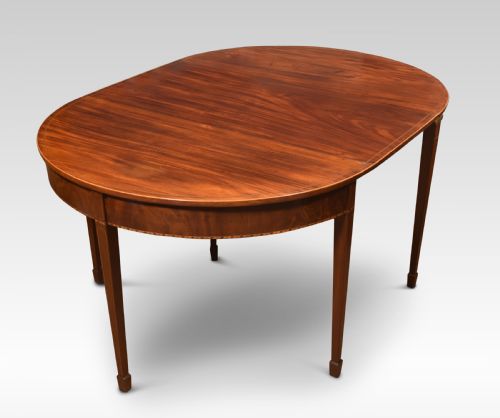


Georgian D End Table
A georgian d end table is a flexible modular dining piece that splits into console sections and grows with leaves.
What a Georgian D-End Table Is
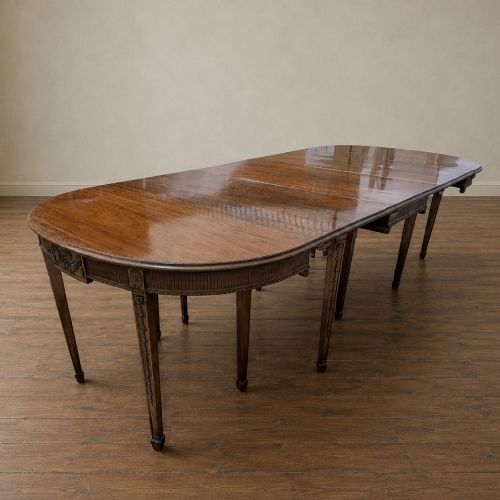
Makers of this period built these tables in sections so families could adapt their dining rooms for different occasions. Central drop-in leaves supported by pedestals or legs allowed the tables to expand, seating large numbers of guests when pushed together.
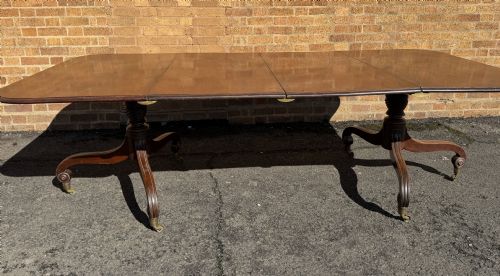
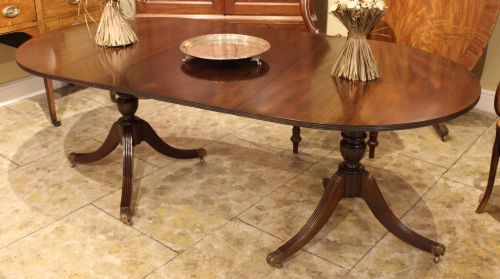
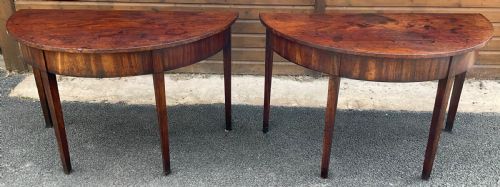
The archive shows these tables appearing both as matched pairs of console tables and as grander multi-pillar extending dining formats. Their modular nature means individual sections frequently survive independently as side or end tables.
Materials and Construction
Cabinet makers built these tables using solid timber frames overlaid with figured mahogany veneers. Selected pieces display decorative satinwood inlay along the edges and banding to contrast with the dark grain of the primary wood.
Joinery techniques relied on sturdy framing, stability brackets, and heavy timber pedestals designed to bear the weight of multiple removable leaves. The modular sections required precise alignment fittings underneath so the tops met flush when assembled.
Listings in this archive show mahogany as the predominant timber utilised, occasionally accented with satinwood inlay.
What Varies in Quality
Quality rests in the choice of timber and the crispness of the secondary veneers, where richly figured flame mahogany elevates a piece above plain stock. Finer examples exhibit subtle satinwood banding and careful attention to the grain alignment across the separate leaves.
The integrity of the structural mechanism also dictates worth, as tables with original brass clips, stable pedestals, and unwarped tops command greater appreciation. The balance between the console sections and the central leaves shows the precision of the original workshop.
The Georgian D End Table Glossary
- D-end
- A table end shaped in the semi-circular profile of the capital letter D. These sections served as console tables when separated from the main dining assembly.
- Console table
- A table designed to stand flat against a wall, frequently built in pairs with D-shaped tops during the period.
- Extending dining table
- A table equipped with removable leaves and internal supports to lengthen the surface area for guests.
- Satinwood banding
- A decorative narrow strip of contrasting light timber inlaid around the perimeter of a tabletop.
- Pedestal
- A central column support resting on splayed legs, often fitted with brass castors to ease movement.
Frequently Asked Questions
How do you separate a D-end table?
The tables separate by lifting the central leaves out from the middle and unlatching the brass alignment clips underneath.
Once the leaves are removed, the two semicircular ends can be pulled apart and pushed back against the dining room walls as console tables.
Were D-end tables always used for dining?
While primarily built for expandable dining rooms, their modular design meant they served multiple domestic functions.
When split into individual console sections, families utilised them as side tables or serving surfaces during quieter household hours.
How do you identify an 1800 table?
Identification relies on examining the timber construction methods, fixing types, and the depth of the mahogany grain.
Tables from around this period feature heavy solid timber underframes, hand-cut joints, and fine veneer selections without modern mechanical fasteners.
Can these tables fit modern homes?
Their modular construction makes them adaptable because the console sections take up very little floor space when separated.
When extra guests arrive, the leaves can be added back in to create a full dining surface.