
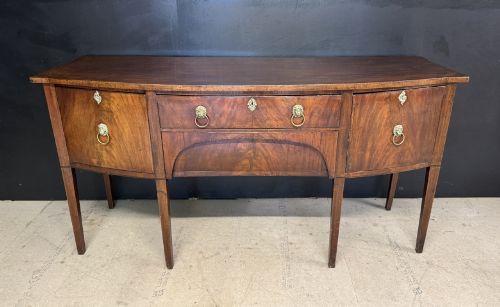
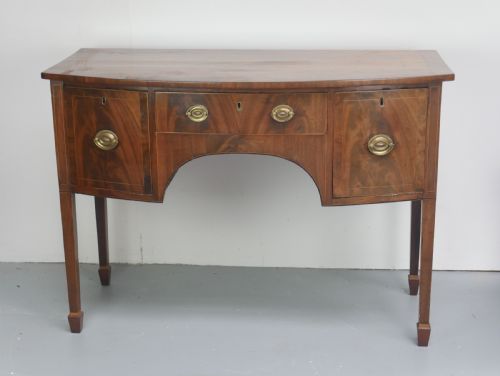
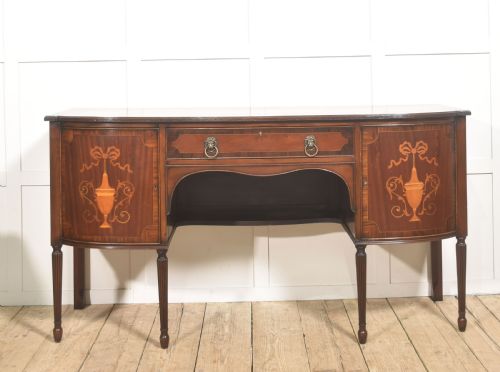


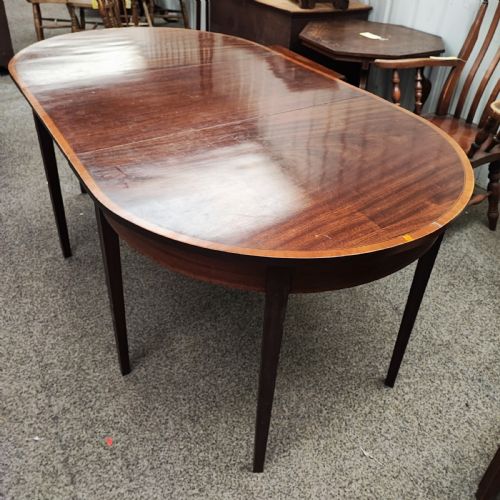


Hepplewhite Style Dining Table
A hepplewhite style dining table brings classic Georgian proportion into a room, offering refined woodwork and elegant mahogany grain.
Hepplewhite Style Dining Table
A hepplewhite style dining table draws upon 18th Century and George III design principles, often appearing in forms such as D-end tables alongside related dining chairs and sideboards. These pieces reflect the lighter, more graceful furniture proportions introduced during the Georgian period and revived in later decades.
The versions met on this page span several centuries, encompassing original Georgian pieces as well as later 19th Century and early 20th Century revivals. Mahogany serves as the principal wood across these examples, sometimes accompanied by detailed satinwood and boxwood inlay.
Materials and construction
Makers built these tables primarily using solid and veneered mahogany, a dense timber that accepted fine carving and sustained a polished finish. Cabinetmakers selected boards with rich grain patterns to form the tabletops and rails.
Detailing relied on precision woodwork techniques including satinwood and boxwood inlay, creating contrasting geometric or floral borders. Brass hardware and fittings appeared on associated pieces like serving tables and sideboards to complement the warm tones of the mahogany.
The furniture spans from 18th Century Georgian originals through 19th Century examples to 20th Century revival pieces.
Judging quality and craftsmanship
Quality rests in the crispness of the timber selection and the precision of the inlay work. Superior examples display carefully matched mahogany veneers and neatly integrated boxwood and satinwood details that remain flush with the surrounding surface.
The integrity of the structural frame dictates the longevity of the piece, particularly where D-end sections join to form an extended dining surface. Finer tables maintain balanced proportions and secure joints that support daily use without compromising the delicate silhouette.
Gillow
The Hepplewhite Style Dining Table Glossary
- D-end dining table
- A table featuring semi-circular ends that can stand alone as side tables or join together with a central leaf to form a longer surface. This configuration allowed dining rooms to adapt their layout for different occasions during the Georgian period.
- George III
- The period of British history spanning from 1760 to 1820, noted for refined cabinetmaking and classical restraint. Furniture from this era often exhibits tapered legs and balanced proportions.
- Inlay
- A decorative technique where contrasting woods such as satinwood or boxwood are inserted into recesses cut into the primary mahogany surface. This method creates flat ornamentation along table edges and drawer fronts.
- Serpentine
- A furniture front or edge shaped with a gentle convex curve flanked by two concave curves. This contour requires skilled carpentry to shape the solid mahogany accurately.
Hepplewhite Style Dining Table: Frequently Asked Questions
How do I care for a mahogany dining table?
Maintain the wood by dusting with a soft, dry cloth and avoiding placement near direct heat sources or strong sunlight. Periodic application of appropriate furniture wax helps protect the polished mahogany finish.
Lift the table rather than dragging it when rearranging a room to prevent stressing the joints and legs. Use protective mats for hot dishes to preserve the timber surface.
Are these tables suitable for everyday dining?
These tables provide sturdy surfaces designed for regular use, constructed from durable mahogany timber. Their solid framing supports daily meals while retaining their decorative character.
Use coasters and placemats to guard against moisture and scratches during daily use. Regular maintenance ensures the table remains both functional and visually appealing.
How can I tell an original Georgian table from a later revival?
Examine the construction methods, secondary woods used underneath, and the type of wear present on the timber. Original 18th Century pieces show hand-cut joinery and signs of age consistent with continuous use.
Revival pieces from the 19th or 20th centuries often utilise more uniform machine-sawn components and different internal timber species. Consulting the overall style indicators helps clarify the manufacturing era.
What chairs pair well with a Hepplewhite style table?
Chairs featuring shield-backs or straight tapered legs complement the proportions of these tables. Mahogany chairs matching the period or revival style create a cohesive dining room arrangement.
Armchairs, often referred to as carvers, frequently accompany side chairs around the perimeter of the table. Ensuring consistent wood tones and leg styles unifies the seating collection.