
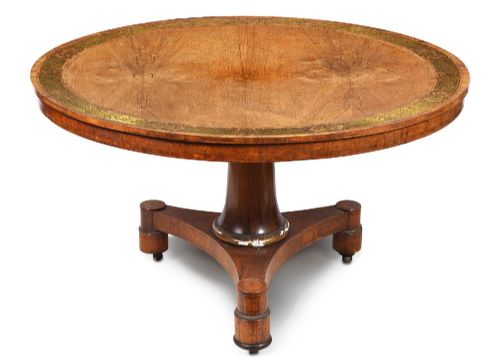
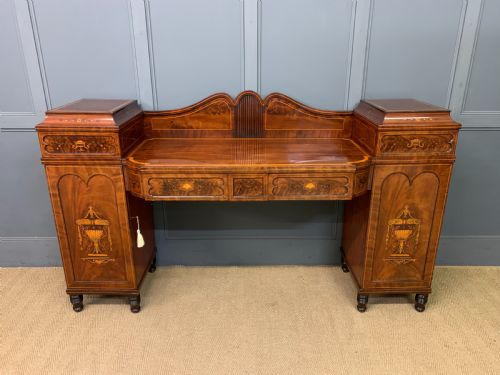


Georgian Marquetry Dining Table
A georgian marquetry dining table brings striking inlaid timber surfaces and classic proportions into a dining room.
Georgian Marquetry Dining Table
A search for a georgian marquetry dining table reveals dining furniture alongside related forms such as centre tables and sideboards from the eighteenth century onwards. The pieces listed span periods from George III and the Regency era through to later Victorian, Edwardian, and Sheraton Revival interpretations.
Buyers frequently encounter formal sideboards, pedestal sideboards, and centre tables rather than extensive extendable dining surfaces under this heading. These examples demonstrate the enduring popularity of classical forms combined with decorative woodwork across multiple centuries.
How they were made
Cabinet makers constructed these pieces primarily using solid mahogany and rosewood as a sturdy base for elaborate surface decoration. Artisans applied contrasting veneers of satinwood and boxwood to create intricate marquetry and linear inlay patterns.
Metals such as brass appeared as fine inlay work or structural mounts, particularly on Regency centre tables. Timber selection and precise veneer placement determined the visual depth of the finished surface.
Listings span George III, Regency, Victorian, and Edwardian periods, utilising mahogany, rosewood, satinwood, and boxwood.
What varies in quality
The sophistication of the timber work and the complexity of the inlaid designs dictate the standing of an individual piece. Finer examples display meticulous attention in the juxtaposition of satinwood and boxwood against rich mahogany or rosewood grounds.
The harmony between the structural form, such as a pedestal base or sideboard carcase, and the decorative vocabulary defines the overall success of the piece. Later revival periods interpret these traditional methods with varying degrees of decorative ambition.
Howard And Sons
The Georgian Marquetry Dining Table Glossary
- Marquetry
- Decorative veneer work arranged in pictorial or geometric patterns. Craftsmen cut thin pieces of various timbers to fit precisely together before applying them to the carcase.
- Satinwood
- A durable hardwood with a natural golden sheen and smooth grain. It provides a bright contrasting element in detailed inlay work.
- Boxwood
- A dense, pale wood frequently utilised for fine stringing and linear details. Its neutral tone sets off darker primary timbers.
- Pedestal
- A supportive architectural column or pillar beneath a table top or sideboard end. It often terminates in splayed legs with metal fittings.
Georgian Marquetry Dining Table: Frequently Asked Questions
How do I identify a Regency centre table?
Regency centre tables often incorporate rosewood and brass inlay, reflecting the classical tastes of the early nineteenth century. They typically stand on central pedestals or refined legs rather than traditional dining frames.
These versatile tables functioned as central display pieces in large rooms. Their distinct brass detailing sets them apart from earlier Georgian designs.
What materials are used in these tables?
Mahogany and rosewood serve as the primary structural and visual timbers across these pieces. Craftsmen used them to provide a dark, rich background for lighter details.
Satinwood and boxwood appear specifically for inlay and marquetry work, offering contrasting tones. Brass elements also feature as decorative inlay on select Regency items.
Are Sheraton Revival pieces genuine antique furniture?
Sheraton Revival furniture dates from later periods such as the late nineteenth and early Edwardian eras. These pieces consciously copied the lighter, refined styles of the eighteenth century.
Cabinet makers of the revival era used traditional techniques to recreate classic proportions. They offer an alternative period interpretation of georgian design themes.
How do I care for antique marquetry surfaces?
Antique marquetry surfaces require gentle cleaning with soft, dry cloths to protect the delicate veneer layers. Avoid harsh chemical polishes that can degrade historic finishes over time.
Keep wooden furniture away from direct heat sources and strong sunlight to prevent timber warping. Stable indoor humidity helps preserve both the base wood and the fine boxwood inlay.