



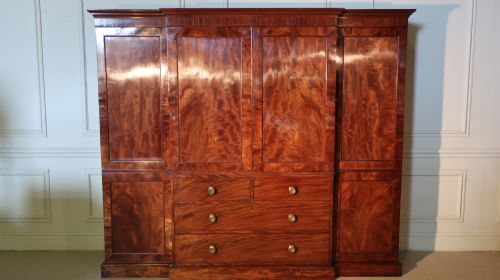
Georgian Breakfront Press
A georgian breakfront press is a commanding architectural storage piece for textiles or books, bringing stately proportion and timber depth to a room.
Georgian Breakfront Press
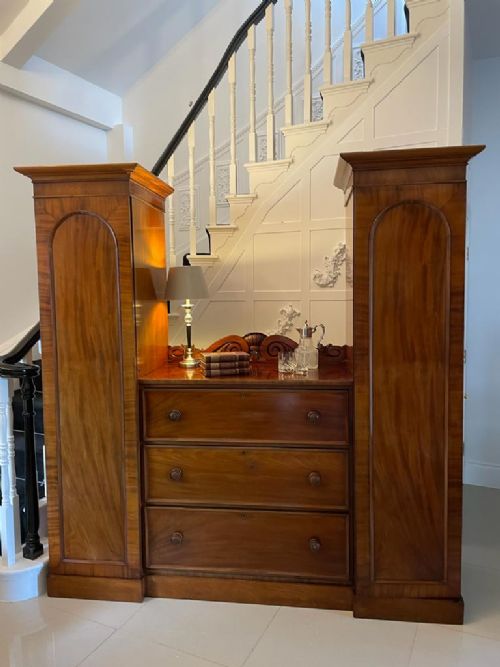
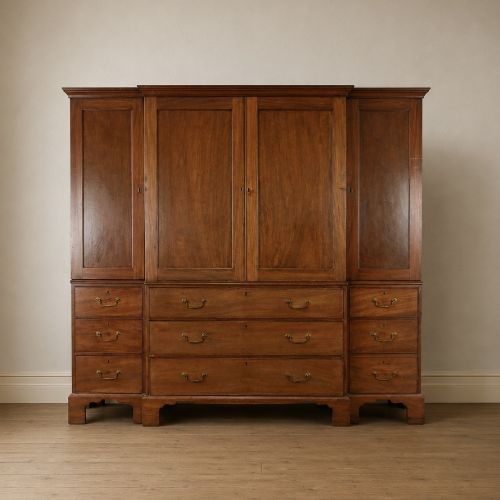
A georgian breakfront press stands as a substantial focal point in traditional interiors, offering grand scale and generous capacity. The defining architectural feature is the projecting central section flanked by slightly recessed wings.
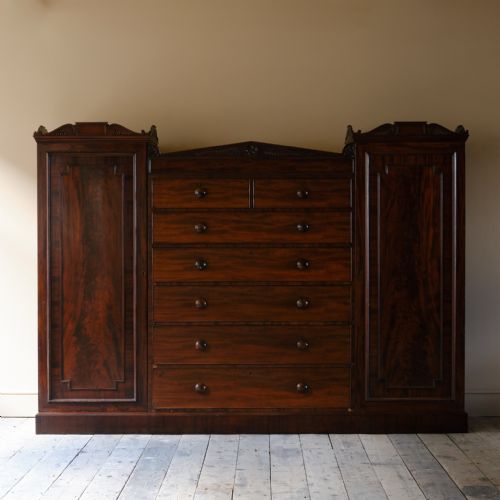
Most examples encountered here date from the eighteenth and nineteenth centuries, spanning the Georgian, Regency, and William IV periods. These monumental pieces frequently function as wardrobes, linen presses, or bookcase combinations.
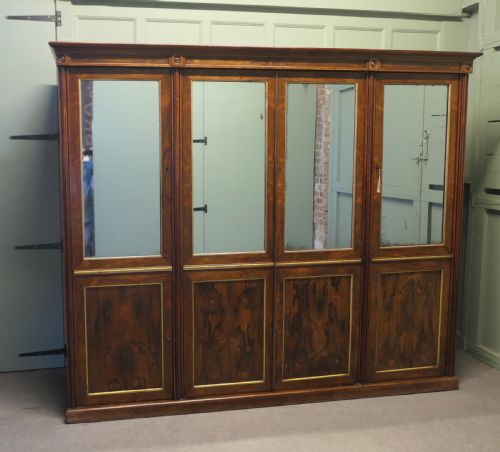
Timbers range from rich mahogany and flame mahogany veneer to sturdy oak and pine, sometimes featuring painted surfaces. Formats vary from stately four-door wardrobes to practical housekeepers cupboards.
Materials and Construction
Cabinetmakers utilised solid mahogany, oak, and pine for foundational carcases, applying figured veneers like flame mahogany to prominent door panels and drawer fronts. Secondary woods such as oak and pine provide structural stability inside the large enclosures.
Brass hardware, including escutcheons and hinges, complements the deep grain of the timber. Glass panelling appears on upper library bookcases, while painted finishes survive on select country house examples.
A scullery cupboard smells faintly of decades-old floor wax and dried herbs.
Judging Quality
The sophistication of the timber selection dictates visual success, with symmetrical flame mahogany veneers and dense grain separating the finest commissions from simpler utility cupboards. Crispness in architectural mouldings and the proportion of the central breakfront section reveal the cabinetmaker's skill.
Interior configuration also influences standing, as original linen slides, sliding trays, and fitted hanging spaces preserved behind substantial panelled doors demonstrate high-status domestic origin.
The Georgian Breakfront Press Glossary
- Breakfront
- An architectural facade where the central section projects forward from the flanking wings. This layout creates depth and shadow across the front elevation of large storage furniture.
- Linen Press
- A tall piece of furniture designed specifically for storing folded garments and household linens. Upper sections traditionally enclose sliding trays, while lower bases feature drawers.
- Compactum
- A comprehensive multi-compartment wardrobe combining hanging space, drawers, and shelving within a single unified structure. These multifunctional pieces maximise storage efficiency.
- Flame Mahogany
- A highly decorative veneer harvested from the fork of the mahogany tree where branches join the trunk. The resulting grain pattern displays a fiery, flickering motif.
- Housekeepers Cupboard
- A utilitarian storage cabinet used in large country houses for domestic provisions and household textiles. These pieces are typically constructed from robust oak or pine.
Georgian Breakfront Press: Frequently Asked Questions
What is a breakfront press?
A breakfront press is a large storage cabinet featuring a central section that projects forward from the two side sections. They were built to hold garments, books, or household linens.
These pieces combine architectural presence with functional capacity, making them prominent additions to large rooms. They date primarily from the eighteenth and nineteenth centuries.
How do I use one today?
These large cabinets serve effectively as master wardrobe storage, hallway linen organisation, or living room bookcases. Their generous internal capacity accommodates modern storage requirements.
Ensure adequate wall space and ceiling height before placement, as these monumental pieces demand substantial room to breathe. Freestanding design allows them to anchor a room without permanent installation.
How do I date a Georgian press?
Dating relies on architectural styling, timber choice, and construction methods. Georgian examples often showcase figured mahogany and classical mouldings, while Regency and William IV pieces incorporate bolder proportions and rosewood elements.
Internal carcase construction and drawer linings also provide chronological clues. Oak and pine secondary timbers shift in handling and tool marks across the decades.
What is the difference between a press and a wardrobe?
A traditional press contains sliding internal trays behind upper doors for folded linens, sitting above a chest base. A wardrobe focuses primarily on vertical hanging space for garments.
Many antique examples blur these distinctions or combine both functions within a single multi-door cabinet layout. The listings reflect this overlap through interchangeable terminology.