
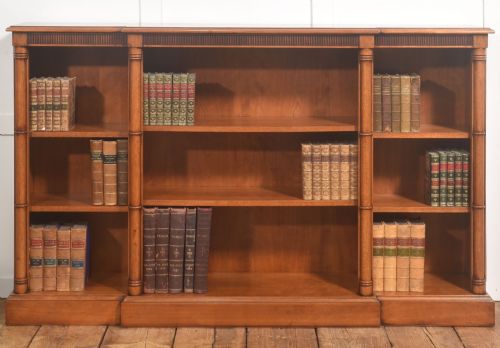
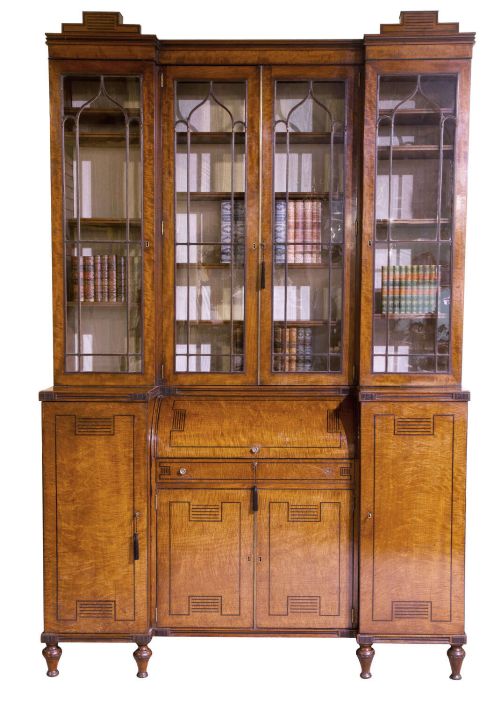
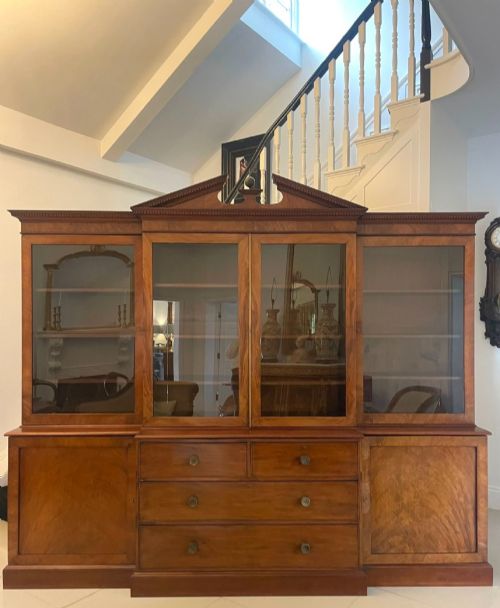
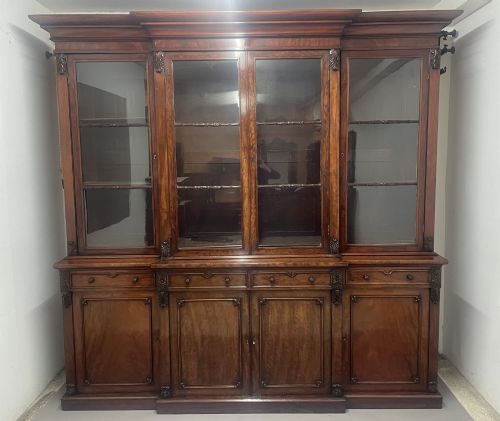



Georgian Breakfront Library Cabinet
A georgian breakfront library cabinet provides monumental proportions and refined storage for serious collections, offering architectural presence to a grand room.
Georgian Breakfront Library Cabinet
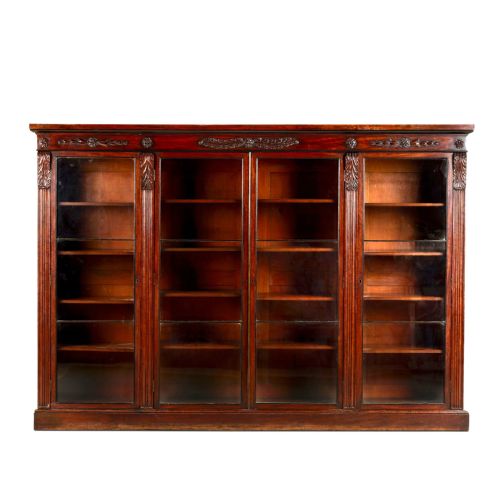
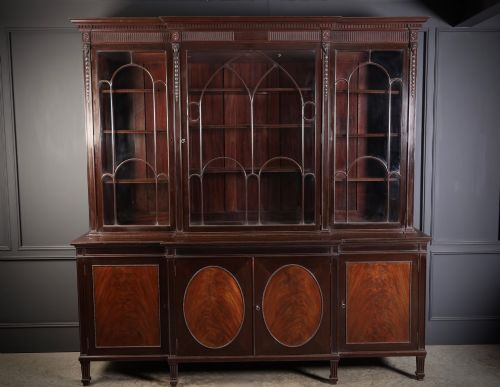
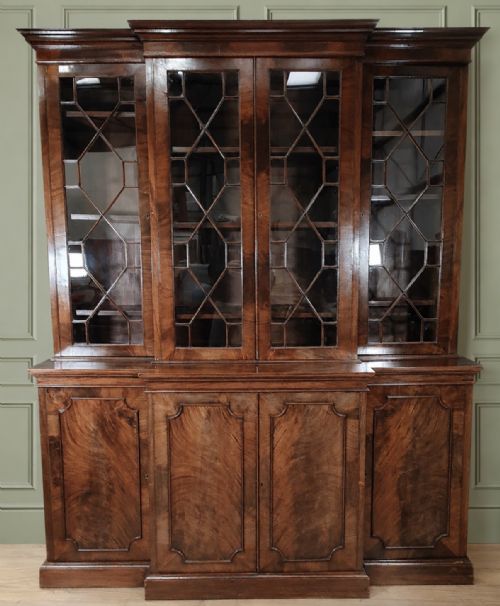
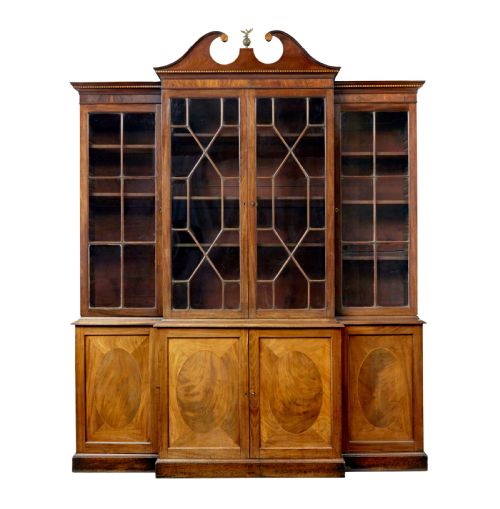
A georgian breakfront library cabinet is a substantial bookcase featuring a central section that projects forward from the flanking wings, creating a pronounced architectural silhouette. The examples found here span the eighteenth, nineteenth, and early twentieth centuries, encompassing genuine George III pieces alongside later Victorian, Edwardian, and revival interpretations.
Most pieces encountered on this page rely upon mahogany as the primary timber, often enhanced by flame mahogany veneer, satinwood, or contrasting stringing and inlays. Glazed upper doors with various pane arrangements dominate the form, protecting libraries while displaying finely bound volumes behind glass.
Makers and workshops of the period utilised modular carcass construction, allowing these large library pieces to be transported in sections before assembly in situ. The internal arrangements frequently combine adjustable shelving with secretaire drawers, fitted with drop-front writing surfaces and small compartments.
Materials and construction
Cabinet makers selected dense plantation timbers, predominantly solid mahogany and carefully chosen veneers, applying them over sturdy oak or pine carcases to prevent warping across wide expanses. Figured grains were matched symmetrically across the large door panels and drawer fronts to create decorative harmony.
Glass panels were secured within slender wooden glazing bars, which required skilled joinery to support large expanses without sacrificing structural integrity. Brass hardware, including locks, hinges, and escutcheons, was fitted flush to the timber surfaces to maintain clean lines.
Inlaid decoration utilised contrasting woods such as satinwood and ebony, cut into delicate lines and geometric motifs to accent the architectural cornices and plinth bases. Hand-applied polishes built up a deep lustre over the wood, highlighting the natural figure of the timber.
Current listings feature pieces spanning the eighteenth to the twentieth centuries, utilising mahogany, satinwood, and walnut across Georgian and Victorian styles.
Judging quality
The architectural ambition of the design dictates much of the distinction, separating standard utility pieces from those with refined dentil cornices, fluted pilasters, and finely carved pediments. Cabinet makers who invested time in timber selection achieved a cohesive grain pattern across the entire breakfront facade.
The handling of the glazing bars reveals the level of workshop competence, with narrower, crisper astragals indicating superior craftsmanship compared to heavier, utilitarian frames. Interior fittings, such as finely dovetailed secretaire drawers and original brass locks, distinguish bespoke commissions from more routine production.
Proportion and scale separate exceptional pieces from standard examples, particularly in how the projecting central section balances the side wings. Cabinets retaining their original glass, brasses, and surface patination hold greater integrity than those altered by later restorations.
Maple and Co
The Georgian Breakfront Library Cabinet Glossary
- Breakfront
- A cabinet design where the central section projects forward from the flanking end sections. This configuration breaks up the flat facade of large library furniture.
- Secretaire
- A desk disguised as a drawer, featuring a drop-front writing flap that conceals small pigeonholes and letter drawers. It combines workspace with standard bookcase storage.
- Astragal
- The narrow wooden moulding strips that divide panes of glass within a cabinet door. Fine astragals require precise joinery.
- Cornice
- The ornamental moulding running around the top edge of a cabinet piece. It crowns the architectural composition of the library case.
- Satinwood
- A pale, lustrous exotic timber used extensively for banding and inlay work. It contrasts strongly against dark mahogany grounds.
Georgian Breakfront Library Cabinet: Frequently Asked Questions
How do I fit a large cabinet?
Measure ceiling height and wall space carefully before acquisition, ensuring the room can accommodate both the physical footprint and the visual weight of a monumental bookcase.
Most large breakfront pieces dismantle into distinct modular sections, including a heavy base, upper shelving units, and a projecting cornice, facilitating transport into historic interiors.
Were these made for homes?
These grand cabinets originated in the libraries and country houses of the eighteenth and nineteenth centuries, designed to house extensive private book collections.
Wealthy patrons commissioned them to display learning and status, utilising the glazed upper sections for precious volumes and lower cupboards for folio storage.
How do I date a piece?
Examine the timber species, construction methods, and secondary woods such as oak or pine drawer linings to establish the period of manufacture.
Stylistic shifts from George III straight lines to Regency brass mounts and Victorian proportions provide reliable chronological markers when combined with hardware analysis.
How do I care for mahogany?
Maintain stable relative humidity and shield the timber from direct sunlight to prevent veneer lifting and timber shrinkage over time.
Apply traditional wax polishes sparingly and buff with a soft cloth to preserve the natural patination built up over centuries of use.