

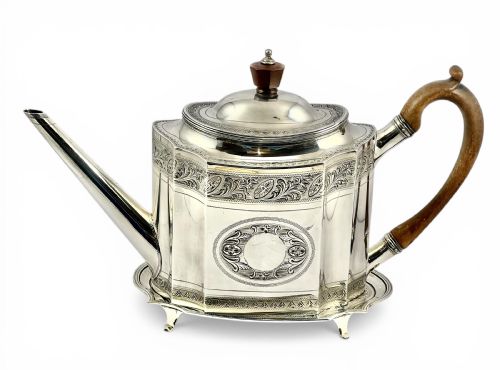


George III Silver Teapot
A george iii silver teapot brings Georgian elegance straight to the tea table, offering solid sterling construction and classic forms that collectors prize.
George iii silver teapot forms and origins
A george iii silver teapot represents Georgian silverwork at its finest, typically taking an oval form or standing upon a dedicated silver teapot stand. These pieces originate from the Georgian era, with specific dates stretching towards eighteen hundred and beyond.
The style spans Neoclassical and Georgian designs, reflecting the aesthetic preferences of the late eighteenth and early nineteenth centuries.
Materials and construction
Every george iii silver teapot is forged from sterling silver, bearing London hallmarks that verify its origin and metal purity. Handles on these solid silver pieces frequently utilise pear wood, providing a tactile contrast to the cold metal body.
Surface ornamentation often employs bright cut engraving, creating geometric or floral patterns that catch the light. Silversmiths shaped the silver into distinct oval forms before adding fitted lids and wooden insulators.
Judging quality and distinction
The distinction between a standard george iii silver teapot and an exceptional example rests on the crispness of the bright cut engraving and the integrity of the London hallmarks. Pieces retaining their matching silver teapot stand command greater interest from discerning buyers.
Makership elevates certain pieces, particularly those bearing the marks of renowned silversmiths like Hester Bateman or Robert Hennell I. The preservation of the original pear wood handle and the balance of the oval form also determine the overall desirability.
Robert Hennell I·Peter and Anne Bateman·James Mince·Benjamin Smith·Henry Chawner·William Burwash·Hester Bateman·Solomon Royes and John East Dix·Peter and William Bateman·John Emes
The George III Silver Teapot Glossary
- Hallmark
- Official marks stamped on precious metals to guarantee standard of purity. London hallmarks on these teapots typically include the lion passant and maker's mark.
- Bright cut
- A style of engraving using faceted cuts to produce a sparkling effect. This technique is frequently seen on Georgian silver teapots.
- Sterling silver
- An alloy of silver containing ninety-two point five percent silver and seven point five percent other metals. This is the standard material for these antiques.
- Teapot stand
- A small raised tray designed to hold a hot teapot and protect the table surface. Many George III examples survive alongside their teapots.
Frequently Asked Questions
What is a george iii silver teapot?
A george iii silver teapot is a sterling silver vessel for serving tea, produced during the reign of King George III. These pieces showcase Georgian craftsmanship, often featuring bright cut engraving and oval bodies.
Many examples include original pear wood handles and are accompanied by matching silver teapot stands bearing London hallmarks.
How do I identify a George III teapot?
Identification relies on examining the hallmarks stamped on the silver, which provide the assay office, date letter, and silversmith's mark. London hallmarks and specific maker marks help date the piece accurately.
Stylistic markers such as neoclassical bright cut decoration and oval forms also point directly to the Georgian period.
Were teapot stands always sold with them?
Teapot stands were often produced as companion pieces to protect wooden tables from heat, though they were sometimes made or sold separately. Surviving sets featuring both the teapot and its matching stand by the same maker are particularly sought after.
Standalone stands also appear frequently in the historical record, sharing the same bright cut engraving style.
How do I care for a silver teapot?
Caring for antique silver requires gentle cleaning with specialised silver polish to maintain the shine without wearing away the hallmarks or bright cut engraving. Avoiding harsh abras<bos>9s and storing the piece in a dry environment preserves the metal and the wooden handle.
Exhibiting the teapot on its matching stand keeps both elements together safely.