
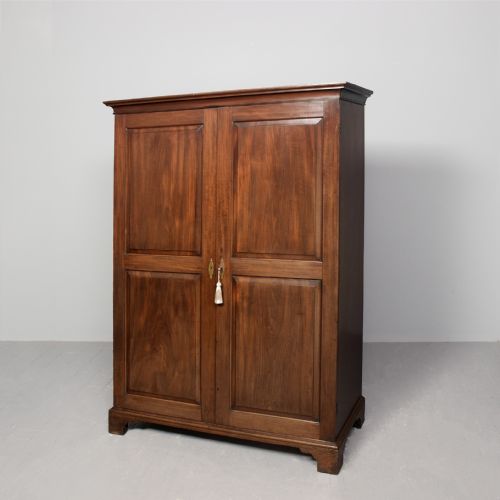
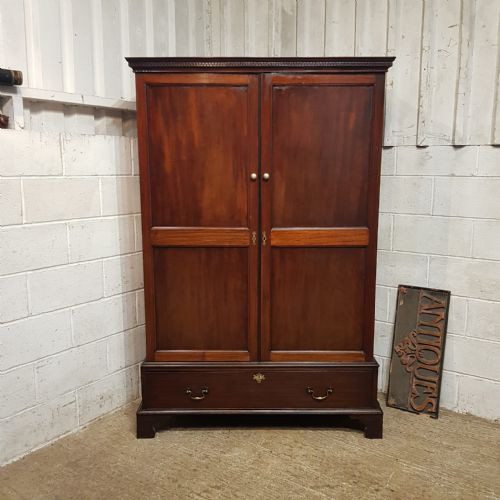
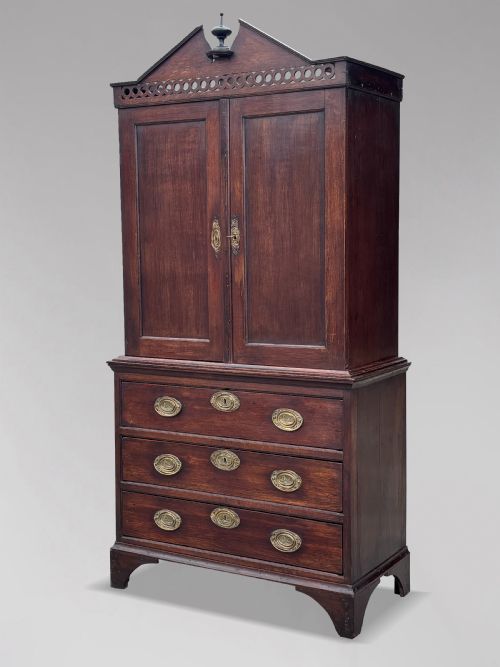


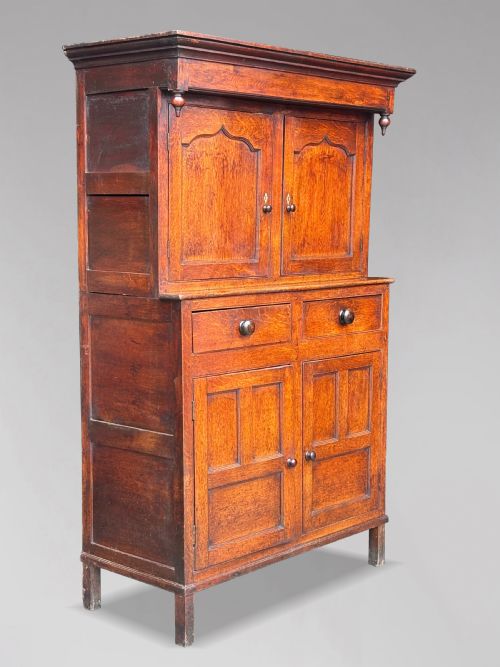
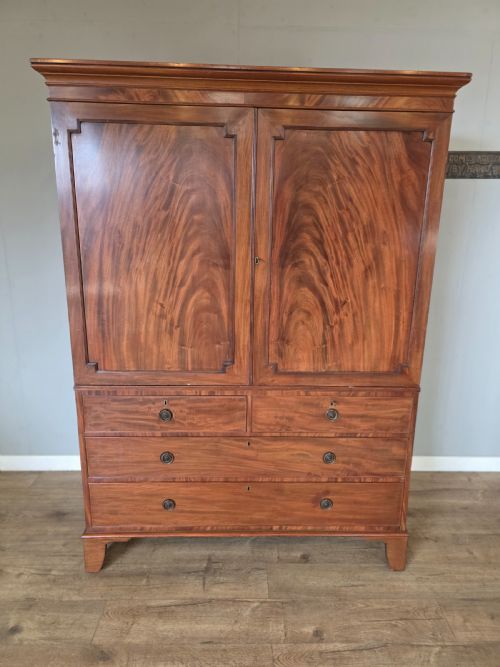


George III Press Cupboard
A george iii press cupboard brings architectural presence and deep utility into a room, combining hanging space with sliding tray storage behind panelled doors.

George III Press Cupboard
A george iii press cupboard is a substantial storage piece designed to hold household linens, garments, and papers, typically constructed in two main sections with upper doors concealing sliding trays or a wardrobe hanging space above a chest of drawers.
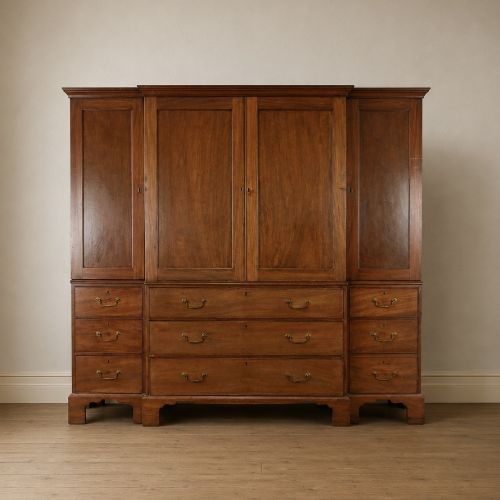
The versions most commonly met on this page span the mid to late eighteenth century and the opening decades of the nineteenth century, appearing in both tall breakfront formats and lower dwarf proportions.
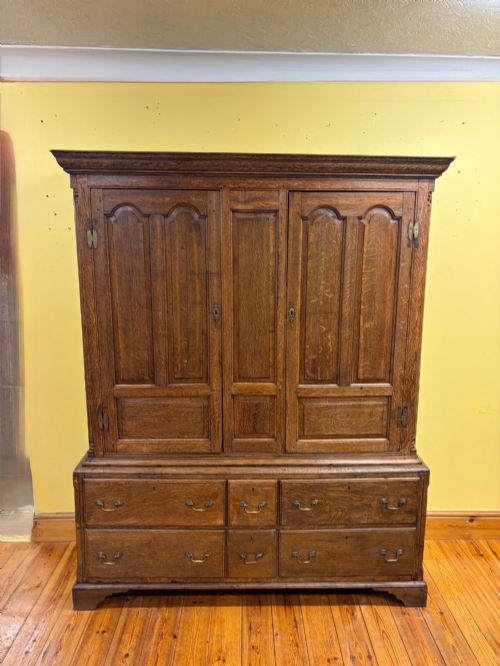
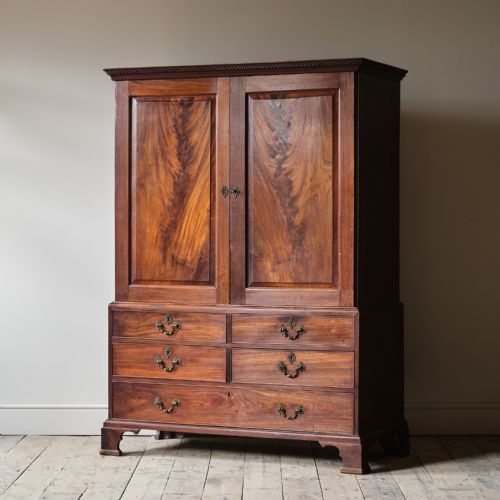
Makers produced these cabinets in regional oak as well as refined metropolitan mahogany, sometimes incorporating secretaire drawers, fitted estate compartments, or specialised shelving for household organisation.
Materials and Joinery
Cabinet makers selected dense mahogany, flame mahogany veneer, and sturdy regional oak as primary timbers, often pairing them with secondary woods like deal or pine for internal drawer linings and carcass backs.
Construction relied upon traditional hand-cut dovetailing for carcass frames and drawers, alongside pegged mortise and tenon joints designed to bear the heavy weight of stored household textiles.
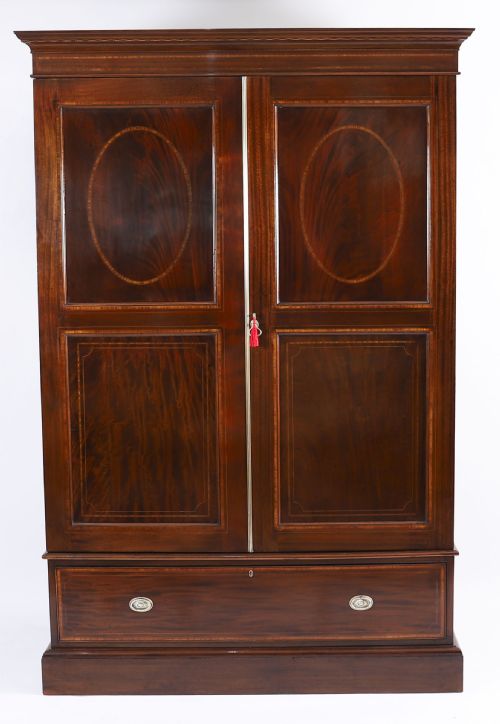
Surface enrichment frequently involved contrasting stringing, boxwood inlay, and satinwood banding, complemented by cast brass drop handles and escutcheons secured to the drawer fronts.
Listings feature both regional oak housekeeper's cupboards and metropolitan mahogany breakfront models dating from the eighteenth and nineteenth centuries.
Judging Quality and Proportion
Quality reveals itself in the careful selection of timber figure, such as well-matched flame mahogany veneers or finely grained quarter-sawn oak, which demonstrates the maker's eye for surface pattern.
Structural integrity and proportion separate superior examples, seen in crisp architectural cornices, tight joinery around the sliding trays, and drawers that retain their original brass hardware and smooth running action.
Gillows·Thomas Bradshaw
The George III Press Cupboard Glossary
- Linen Press
- A tall storage cabinet featuring upper doors that enclose pull-out wooden trays originally intended for flat linens. These trays allowed textiles to be stored without folding creases.
- Breakfront
- A cabinet design where the central section projects forward from the flanking outer wings. This configuration adds architectural depth and presence to large wardrobes.
- Secretaire
- A desk drawer fitted with a drop-front writing flap and small internal pigeonholes and drawers. It combines the utility of a writing cabinet with the storage of a chest.
- Swan-Neck Pediment
- An architectural roofline composed of two opposed ogee curves rising to a central terminal or plinth. It is frequently carved with floral or scroll details on formal pieces.
- Dwarf Press
- A reduced-height variation of the standard linen press cupboard. These lower versions were designed to fit beneath windows or within rooms with restricted ceiling clearance.
George III Press Cupboard: Frequently Asked Questions
What were linen presses used for?
These pieces were built to store household linens, sheets, and folded garments on internal sliding wooden trays before modern wardrobes with hanging rails became common.
Lower drawer sections provided additional space for heavier garments, making the entire cabinet a central storage hub for the domestic household.
How do I fit one in a modern bedroom?
Most pieces separate into two distinct sections, an upper cupboard and a lower chest base, which makes transport and room placement manageable.
Measure ceiling height and floor space carefully, ensuring adequate clearance for the large panel doors to swing fully open.
Are oak and mahogany versions from the same period?
Oak examples often reflect regional provincial workshops and earlier eighteenth-century traditions, while mahogany versions frequently indicate urban cabinet making and fashionable London tastes.
Both timbers ran concurrently through the Georgian era, depending on whether the piece was destined for a country house estate or a townhouse.
What is the difference between a press and a wardrobe?
A traditional press contains internal sliding trays behind its upper doors for flat storage, whereas a wardrobe utilises vertical hanging space for garments.
Many antique pieces have been converted over time from sliding trays to hanging rails to suit contemporary clothing needs.