



George III Music Rack
A george iii music rack brings genuine Georgian proportion to the room, offering a tidy place for sheets while keeping scores close at hand.
George III Music Rack
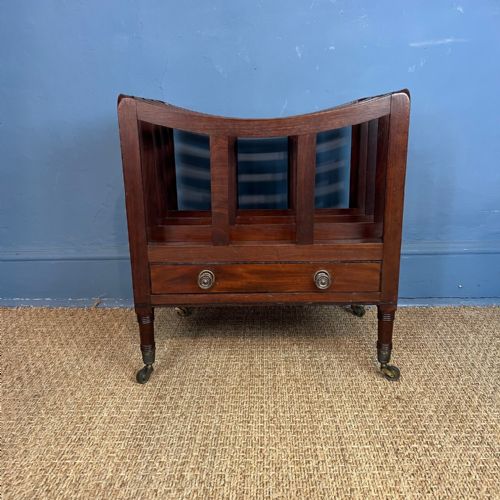
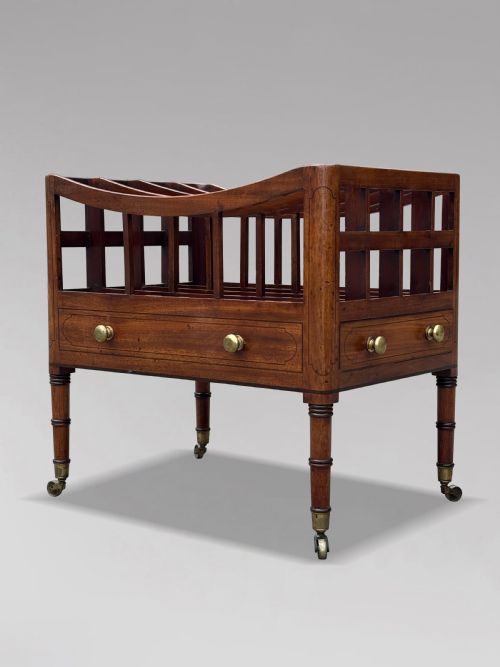
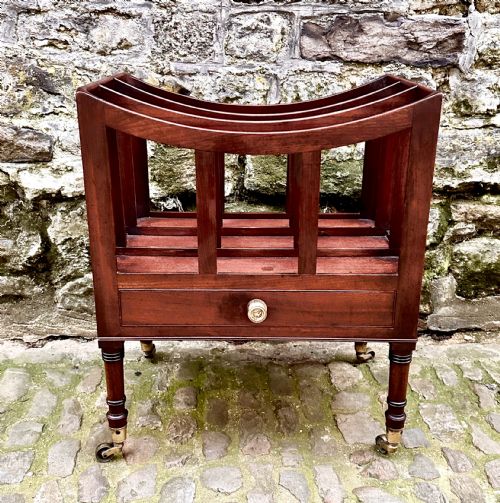
When you search for a george iii music rack, you are looking at canterburys and magazine racks originating from the Georgian period and the early nineteenth century. These pieces usually take the form of freestanding canterburys designed to hold folios and scores off the floor.
Makers of the period designed these stands with slatted dividers and frequently incorporated a low drawer beneath the partitions. They combine utility with refined timber work suitable for a parlour or music room.
How they were made
Cabinet makers relied principally upon mahogany and rosewood for these frames, often selecting dense grain for structural strength and turned supports. Brass fittings appear on castors and corner details, providing both mobility and accent.
Joinery techniques focused on sturdy partitions and dovetailed drawer construction to withstand the weight of heavy paper folios. Timber surfaces received careful polishing to bring out the natural figures of the wood without heavy staining.
George III Music Rack Retail Price Guide 2026
Typical asking prices for george iii music rack among the pieces listed under this phrase on Sellingantiques today, from the lower quarter to the upper quarter. They describe what is for sale here now, not the wider market.
Some nineteenth-century makers clearly understood that musicians accumulate clutter, adding secret little compartments alongside the standard sheet music slots.
What varies in quality
The distinction between standard pieces and the finest examples lies in the crispness of the turned legs, the selection of timber figures, and the inclusion of a functional drawer. Finer pieces demonstrate superior joinery in the slatted dividers and carry original brass castors.
Proportion and scale also separate the ordinary from the exceptional, with oversized or particularly harmonious dimensions commanding attention. The refinement of the moulding work and the integrity of the original timber patina dictate the standing of each piece.
The George III Music Rack Glossary
- Freestanding
- Designed to be viewed from all sides rather than placed flat against a wall. These pieces possess finished backs and upright supports suitable for placement in the middle of a room.
- Sheraton period
- A neoclassical style phase spanning the late eighteenth century, named after the designer Thomas Sheraton. It is characterised by straight tapered legs and delicate proportions.
- Mahogany
- A durable tropical hardwood imported for high-end cabinet making during the Georgian era. Its reddish-brown tone deepens gracefully with age and polishing.
George III Music Rack: Frequently Asked Questions
What is a george iii music rack used for?
These pieces were originally built to hold sheet music, scores, and folios near a piano or music stand. They kept scores organised and accessible in drawing rooms.
Today they serve a similar purpose for magazines and books, fitting neatly beside seating areas while displaying timber grain.
How do I date a george iii music rack?
Dating relies on timber choice, construction methods, and stylistic cues from the Georgian period. Pieces from this era generally employ solid mahogany or rosewood with hand-cut dovetails.
Turned legs, brass castors, and Sheraton period details help narrow the origin to the late eighteenth or early nineteenth century.
Are these racks sturdy enough for daily use?
Georgian canterburys were engineered to hold heavy stacks of paper without buckling. The vertical slats and framed bases provide solid structural integrity.
Careful handling of the original timber and joints ensures they remain practical for holding contemporary reading materials.
Did these pieces always include a drawer?
Not all examples feature a lower drawer, though many traditional canterburys incorporate one beneath the partitions for smaller accessories. Pieces with drawers offer extra storage for manuscript papers or small items.
Both open-base racks and drawer models were produced during the late eighteenth and early nineteenth centuries.