
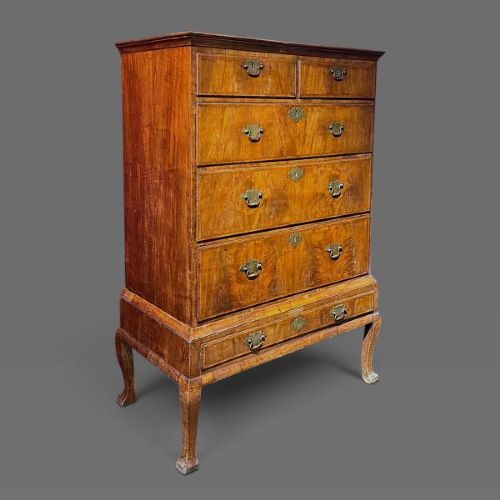
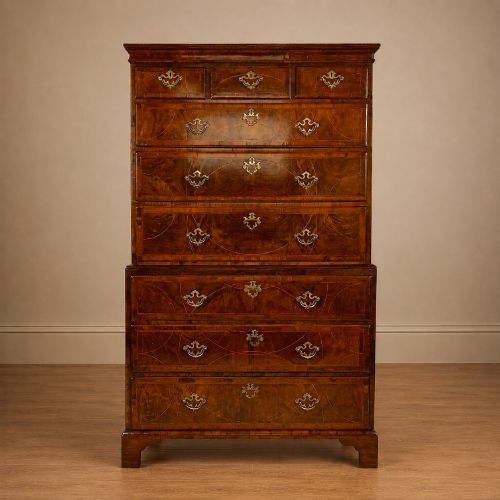
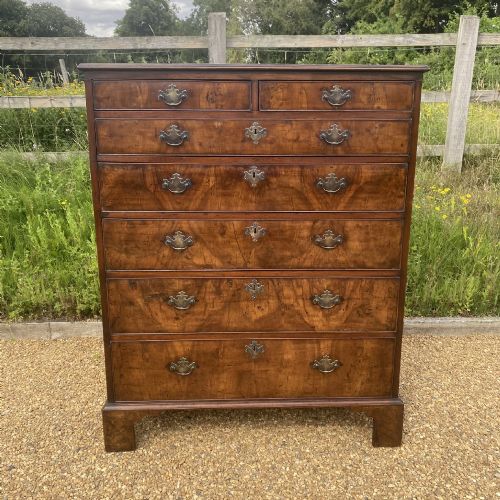
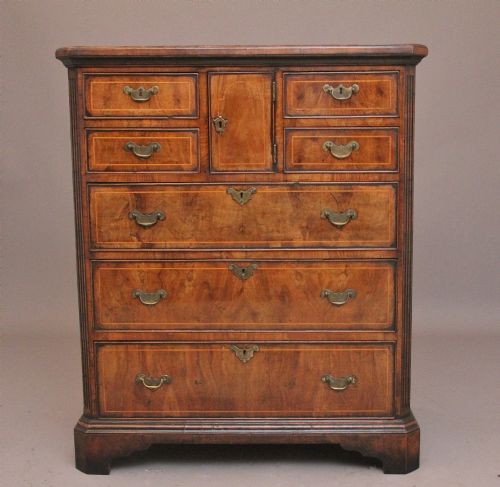
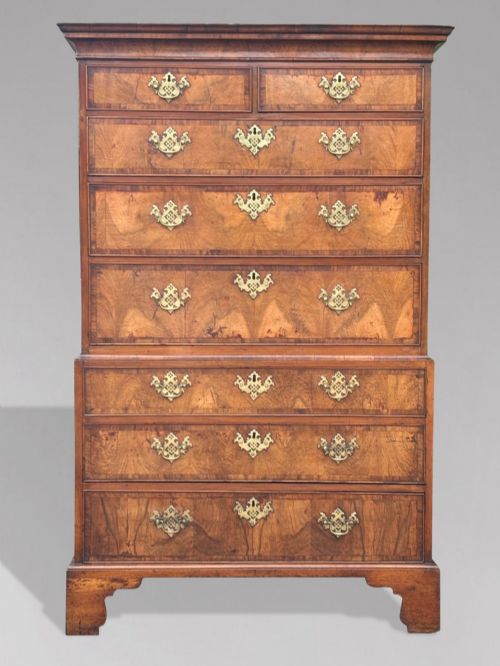
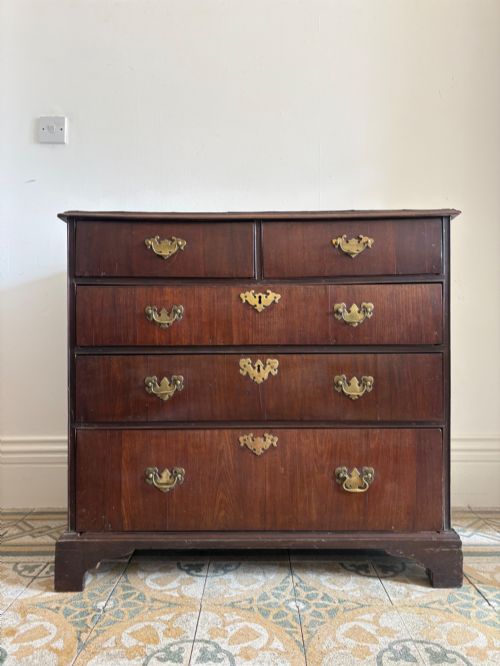


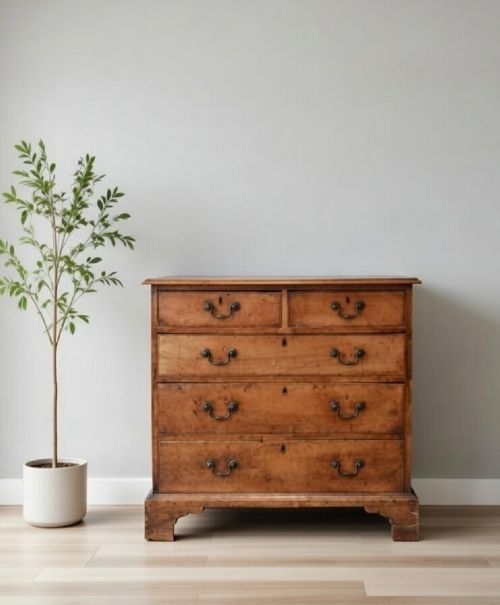

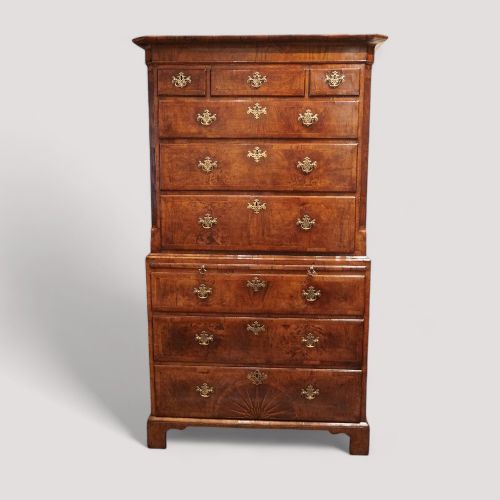

George II Walnut Tallboy
A george ii walnut tallboy offers serious storage and deep timber figure, bringing a commanding presence to a bedroom.
George II Walnut Tallboy
A george ii walnut tallboy is a stacked storage form, typically combining a lower chest of drawers with an upper section to create a tall chest on chest or chest on stand.
The pieces appearing on this page span the Georgian and Victorian periods, with many bearing the specific George II style alongside later Victorian interpretations.
Forms alternate between traditional chest on chest tallboys and more compact chests on stands, often using secondary woods like oak, pine, and fruitwood behind the primary walnut facade.
How they were made
Cabinet makers built these pieces using solid walnut, burr walnut, red walnut, and walnut veneer applied over construction timbers such as oak and pine.
Surface decoration frequently relied on line inlay, feather banding, and distinctive sunburst marquetry motifs set into the drawer fronts or cornices.
Original brass handles and mountings completed the construction, functioning as both structural pulls and decorative hardware.
Listings feature pieces spanning the Georgian and Victorian eras, incorporating brass, oak, pine, fruitwood, and multiple varieties of walnut.
What varies in quality
The visual hierarchy of a george ii walnut tallboy rests on the choice of timber, with highly figured burr walnut and red walnut commanding greater visual depth than plain veneers.
Proportion dictates refinement, separating standard bedroom furniture from smaller, finely scaled examples built for polite rooms.
The crispness of inlay work, the integrity of feather banding, and the retention of original brass hardware elevate individual pieces above standard production.
The George II Walnut Tallboy Glossary
- Tallboy
- A tall chest of drawers made in two sections, usually a chest on chest, providing substantial vertical storage. This form dominates the available selection.
- Burr walnut
- A highly prized wood grain showing intricate swirling patterns caused by growth knots in the walnut tree. It appears on finer drawer fronts and top panels.
- Feather banding
- A decorative border made from veneers cut diagonally and laid in a herringbone pattern around drawer edges. It frames the primary wood panels.
- Chest on stand
- A cabinet form where a set of drawers sits upon a raised frame with legs rather than directly on the floor. These often have shaped aprons.
- Red walnut
- An American or European walnut variety displaying a distinct reddish hue. It is frequently cited in mid eighteenth century cabinet making.
George II Walnut Tallboy: Frequently Asked Questions
What is a tallboy?
A tallboy is a tall chest of drawers built in two stacked sections, designed to maximise vertical storage space without taking up excessive floor area in a room.
Most examples split into an upper and lower carcase, allowing easier transport of heavy timber furniture up staircases during historic house moves.
How do I use a tallboy?
These pieces function as primary bedroom storage for folded clothing and linens, utilising the upper and lower drawers to organise different items.
The height places the top drawers at a convenient level while offering deep capacity near the floor.
How do I tell periods apart?
Distinguishing periods relies on examining construction methods, timber choice, and secondary woods like oak or pine used inside the carcase.
Earlier pieces show specific George II proportion and joinery details, whereas Victorian interpretations built in the George II style often display different secondary timbers and modern finishing techniques.
What is burr walnut?
Burr walnut is a decorative wood veneer harvested from growth deformations on walnut trees, creating swirling patterns of knots.
Cabinet makers used these striking veneers on principal display surfaces to catch the light and demonstrate the skill of the workshop.