
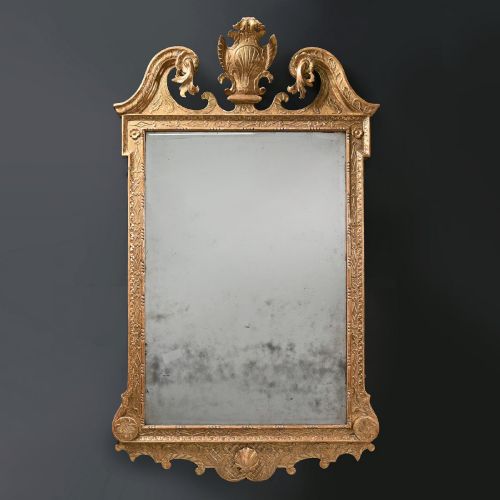


George II Pier Glass
These george ii pier glass examples bring height and architectural presence to a room, designed to hang between windows.
George II Pier Glass
A george ii pier glass sits within a tradition of tall wall mirrors built to reflect light between windows, often taking the form of a pier mirror or wall mirror. The examples found here span the original eighteenth-century period and later nineteenth-century revivals.
Original pieces date back to the mid-eighteenth century, whilst revival versions arrive from the Victorian era and around nineteen hundred. They appear in walnut, burr walnut, mahogany, and giltwood frames.
The dominant aesthetic draws on Palladian principles and architectural symmetry. Buyers encounter both compact domestic formats and larger scaled statement pieces.
Materials and construction methods
The construction relies on timber framing using walnut, burr walnut, and mahogany, frequently enhanced with gesso and giltwood finish. Carved gesso provides the raised ornamental detail on gilt frames.
Parcel-gilt highlights add contrast to dark wood grains like walnut and mahogany. Original glass plates appear alongside later replacements, showing the traditional bevels and silvering methods of the period.
Some mirrors carry the quiet ghost of long-gone drawing rooms, still holding onto centuries of reflected candlelight in their foxed glass.
Distinctions in craftsmanship and materials
Quality rests in the crispness of the carved gesso and the depth of the giltwood or timber finishing. Finer examples display meticulous proportion and balanced architectural detailing rather than heavy or indistinct mouldings.
The presence of original mirror glass plates elevates a piece, showing age and distortion characteristic of early manufacturing. Secondary woods and the integrity of the original framing construction further define the tier of the piece.
William Kent
The George II Pier Glass Glossary
- Pier glass
- A tall mirror designed specifically to hang on the narrow wall space between two windows. It frequently matches the proportions of a console table placed beneath it.
- Giltwood
- Timber, traditionally softwood or lime, coated with gesso and gold leaf. This technique creates a brilliant reflective surface popular in formal eighteenth-century interiors.
- Gesso
- A plaster-like mixture applied to wood frames to provide a smooth base for gilding or deep relief carving. It allows intricate moulded ornaments to be applied directly to the structure.
- Parcel-gilt
- A decorative treatment where parts of a wooden or painted surface are highlighted with gold leaf while other areas show the natural wood grain. Walnut and mahogany frames often utilise this method.
- Palladian
- An architectural style influencing furniture design through strict symmetry, classical proportions, and motifs derived from Andrea Palladio. Mirrors in this vein often feature broken pediments and architectural cornices.
George II Pier Glass: Frequently Asked Questions
Where should I hang a pier glass?
These mirrors were originally designed for the narrow wall space between two windows, where they bounced natural light back into the room.
Today, they work well in hallways, above mantelpieces, or on any substantial wall that benefits from vertical emphasis and architectural weight.
How do I spot a later revival piece?
Revival pieces from the nineteenth century often show differences in timber preparation, secondary woods, and the chemical composition of the mirror plate backing.
Examining the construction joints and the wear on the giltwood or gesso helps differentiate eighteenth-century originals from later copies.
Are original mirror plates common?
Some surviving examples retain their original glass plates, which typically exhibit light oxidisation, speckling, and gentle distortion.
Many pieces received replacement glass over the centuries to maintain a clearer reflection, which is a normal part of their preservation history.
What is parcel-gilt finish?
Parcel-gilt involves applying gold leaf selectively to specific carved details while leaving the surrounding walnut or mahogany exposed.
This technique highlights architectural elements like mouldings and foliage without overwhelming the natural grain of the timber.