
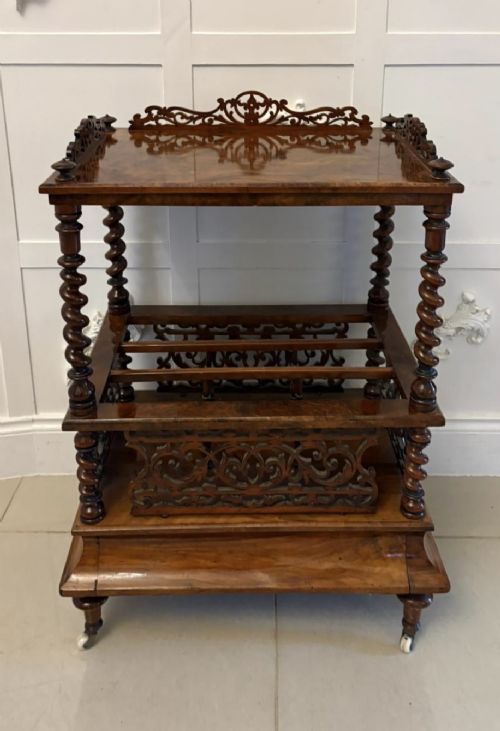
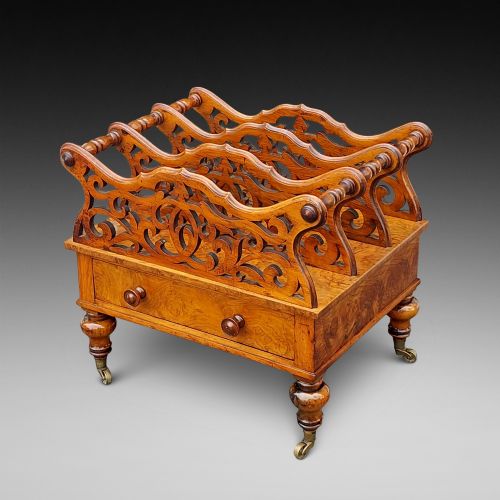
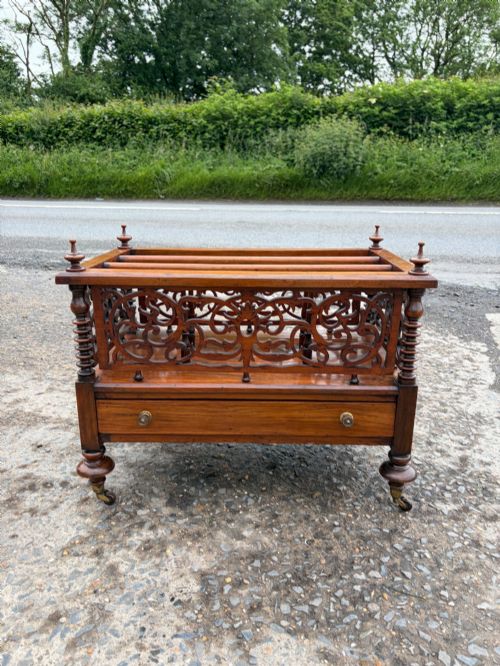


Fretwork Magazine Holder
These fretwork magazine holder pieces are nineteenth century canterburys and racks crafted for orderly rooms.
Fretwork Magazine Holder
When buyers search for a fretwork magazine holder, they are looking at nineteenth century canterburys, occasional tables, and music racks designed to store periodicals and folios. The pieces on this page originate from the Victorian period, spanning the decades around eighteen sixty and eighteen seventy.
The form most frequently met is the walnut or burr walnut canterbury, often featuring pierced scroll divisions, inlaid fretwork, or an oval top with three sections. Alongside these stand rosewood and mahogany examples, occasionally combining the function of a magazine rack with a small drawer or a music stand.
How they were made
Cabinet makers utilised rich timbers including walnut, burr walnut, rosewood, mahogany, and satinwood to construct these pieces. The distinctive pierced fretwork and scroll divisions were shaped by hand to create lightweight yet sturdy partitions for paper and folios.
Metal elements such as brass appear alongside ceramic and porcelain details on select items, while inlaid work adds surface pattern to the timber bodies.
Victorian readers clearly accumulated enough heavy folios to justify furniture specifically engineered to keep their reading matter from sliding onto the carpet.
What varies in quality
The distinction between ordinary and superior examples lies in the selection of timber veneers and the crispness of the pierced fretwork. Burr walnut and figured rosewood show greater visual depth than plain mahogany, while finely carved or pierced scroll divisions demand higher skill than simple turned bars.
The Fretwork Magazine Holder Glossary
- Canterbury
- A low stand with divisions, originally designed for sheet music and later utilised for magazines and newspapers. It often incorporates a small drawer at the base.
- Fretwork
- Openwork ornamentation carved or pierced through thin timber to form decorative patterns. It provides both structural division and visual lightness.
- Burr Walnut
- Timber taken from a walnut tree growth, prized for its swirling, highly figured grain patterns. It forms a decorative veneer on cabinet furniture.
- Whatnot
- A piece of open shelving with multiple tiers used for displaying objects or holding books. Some variants incorporate canterbury sections.
Fretwork Magazine Holder: Frequently Asked Questions
What is a canterbury?
A canterbury is a low compartmentalised stand designed to hold sheet music, periodicals, or books. Nineteenth century makers produced them in various timber types with partitioned sections.
They frequently double as occasional tables or small storage units suitable for placing beside seating in a parlour or sitting room.
How do I date these pieces?
Dating relies on timber choices, stylistic markers, and construction methods typical of the Victorian period. Pieces from this era often employ walnut, burr walnut, or rosewood.
Specific design traits such as pierced fretwork divisions and turned supports point towards the middle and later decades of the nineteenth century.
Were these used for music?
Many early variants served primarily to hold music scores and folios near pianos or music stands. As domestic habits shifted, the compartments accommodated magazines and newspapers.
Listings often describe them interchangeably as music racks, magazine stands, or canterburys due to this dual utility.
Where should I place one?
These pieces suit living spaces and studies where periodicals or books require accessible storage near seating. Their compact footprints allow placement beside armchairs or against panelled walls.
Care should be taken to keep polished timber away from direct heat sources and strong sunlight to protect the veneer.