


French Urn Clock Set
A french urn clock set brings together a striking mantel timepiece and matching garniture urns, creating a balanced and imposing decorative centrepiece.
French Urn Clock Set
A french urn clock set comprises a central mantel timepiece accompanied by two matching side garnitures, typically taking the form of decorative urns, vases or figures. These multi-piece decorative ensembles originate primarily from the nineteenth century, spanning periods from the 1850s through to 1930.
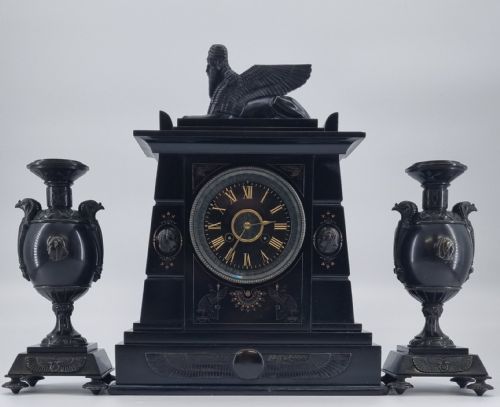
The aesthetic vocabulary draws heavily on historic design movements, with Louis XVI revival, French Rococo, Neo-Classical, and Egyptian Revival styles appearing frequently. Pieces often arrive complete with their original glass domes or matching bases, preserving the integrity of the ensemble.
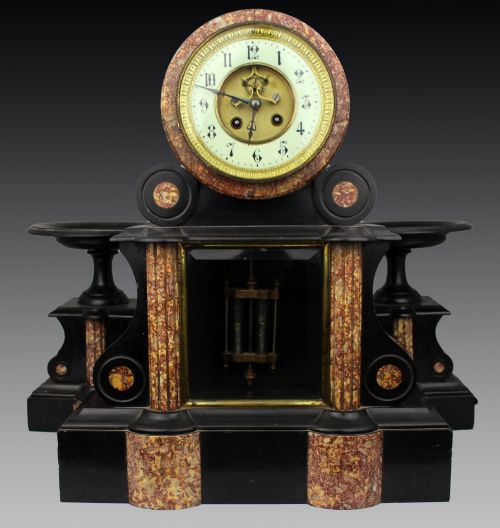
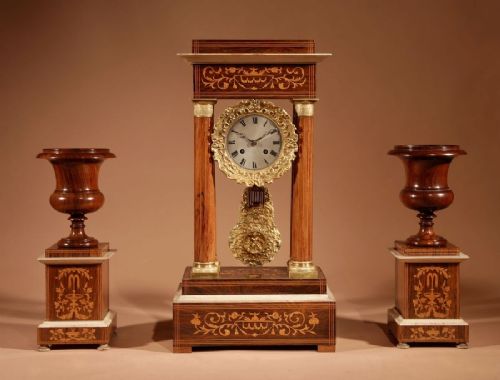
Forms vary from imposing architectural marble structures and portico clocks to delicate porcelain and ormolu mounts. The matching garniture pieces echo the materials and decorative motifs of the central clock, creating a cohesive visual statement designed for prominent display on a mantelpiece or console.
Materials and Craftsmanship
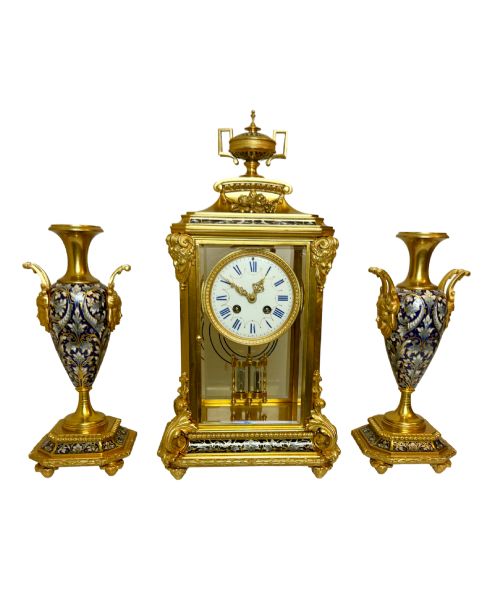
Makers utilised a diverse palette of hardstones and metals, combining black slate, white marble, sienna marble, alabaster, and onyx with cast brass, gilt bronze, and ormolu. Structural elements are often paired with decorative surface treatments such as champleve enamel, hand-painted porcelain panels, and toleware.
Clock movements were mechanical, driven by brass gear trains designed to run for eight days, frequently paired with white enamel dials that sometimes featured specialised complications like penny moon phases. Metal components were cast, chased, and gilded, while ceramic elements drew on porcelain manufactories including Sevres, Paris, and KPM Berlin.
Materials represented across the listings include black slate, white marble, sienna marble, alabaster, onyx, brass, gilt bronze, ormolu, glass, enamel, porcelain, and toleware.
Distinctions in Quality
The hierarchy of quality rests on the precision of the cast metalwork, the depth of the gilding, and the artistic merit of the painted porcelain or ceramic panels. Finer examples feature crisp, hand-chased ormolu mounts and heavy, substantial marble or slate bodies rather than lighter substitute materials.
The incorporation of named movement makers, specialised dial work, and complete matching garnitures under period glass domes elevates the status of an ensemble. Superior sets maintain absolute fidelity between the clock case and its flanking urns in both material quality and decorative detail.
Japy Freres·A.D Mougin·Vincenti of Paris·KPM Berlin·Sevres
The French Urn Clock Set Glossary
- Garniture
- A set of matching decorative objects, typically a clock flanked by two matching urns or vases designed to be displayed together on a mantelpiece.
- Ormolu
- Gilded bronze, produced by applying a mixture of gold and mercury to a bronze base and heating it to drive off the mercury.
- Champleve
- An enamelling technique where troughs or cells are hollowed out of a metal surface and filled with vitreous enamel before firing.
- Portico clock
- A mantel clock featuring an architectural case supported by four or more columns, resembling a classical temple facade.
- Toleware
- Painted or enamelled sheet metalware, often decorated with floral or scenic motifs in imitation of Asian lacquerwork.
French Urn Clock Set: Frequently Asked Questions
How do I display a clock set?
These three-piece ensembles look best centred on a mantelpiece, sideboard, or large console table. Place the main clock in the centre with the matching urns positioned symmetrically on either side.
Ensure the surface is level and sturdy enough to support the heavy marble, slate, or bronze weights of the set. If the pieces include delicate glass domes, keep them away from high-traffic areas to prevent accidental knocks.
What periods do these clock sets span?
The available pieces originate primarily from the nineteenth century, with specific examples dated from the 1850s, 1860s, 1870s, 1880s, 1890s, and into the early twentieth century around 1930. Victorian and late nineteenth-century productions are particularly common.
Stylistic influences range from earlier French Rococo and Louis Philippe designs to later Louis XVI revival, Neo-Classical, and Art Deco movements.
How do I identify different styles?
Stylistic periods are identified by their distinct decorative motifs and architectural lines. Louis XVI revival and Neo-Classical sets feature symmetrical urns, classical columns, and restrained gilt mounts.
Conversely, Rococo revival pieces display asymmetrical scrolling foliage and organic curves, while Egyptian Revival sets incorporate specific pharaonic symbols and motifs popular in the mid-nineteenth century.